Clicker Training for Dogs 101: Everything You Need To Know
You’ve heard about clicker training for dogs—and you’re ready to give it a try with your pup. Excellent choice. While often recommended for puppies, this science-backed method works beautifully for adult and senior dogs too. With clicker training, you precisely mark the exact moment your dog performs a desired behavior—then reward them immediately. This clear communication helps your dog understand *what* earned the treat, making learning faster, more joyful, and more reliable.

What Is Clicker Training?
We consulted Alexandra Bassett, a certified professional dog trainer (CPDT-KA) and founder of the virtual dog training company Dog Savvy. She explains that clicker training is a form of positive reinforcement training that uses a distinct sound—a “reward marker”—to communicate with your dog.
“A clicker is a small mechanical noisemaker that produces a consistent, sharp, easily recognizable sound,” Bassett says. “It acts as a bridge between the moment your dog performs a desirable behavior and the delivery of a reward—telling them, ‘Yes—that’s exactly what I wanted!’”
Clicker training isn’t just for dogs. It’s been successfully used with birds, horses, and even marine mammals like dolphins and seals. In fact, marine mammal trainers originally developed the technique to train animals in large, noisy aquatic environments—where visual cues were unreliable and verbal commands didn’t carry.
Why does it work? Because it’s rooted in the well-established science of learning theory: behaviors followed by rewards are more likely to be repeated. The clicker’s consistency—unlike variable tones of voice or subtle differences in hand signals—makes it exceptionally effective at pinpointing precise moments of success.
That said, a physical clicker isn’t mandatory. Some trainers use a crisp verbal marker like “yes” or “good.” What matters most is consistency, clarity, and timing—not the tool itself.
Benefits of Clicker Training
Leigh Siegfried, CPDT-KA and founder of Opportunity Barks Behavior & Training in Philadelphia, highlights one key advantage: precision.
“The clicker delivers the same sharp, unmistakable sound every time,” she says. “That consistency allows your dog’s brain—their amygdala, in particular—to process the signal quickly and reliably, without confusion.”
Compared to hand signals (which can vary slightly) or verbal praise (which may shift in pitch or volume), the click offers unmatched clarity. As a result, clicker training:
- Builds stronger understanding and trust between you and your dog;
- Makes learning new commands and behaviors faster and less frustrating;
- Improves responsiveness to verbal cues over time; and
- Turns training into a fun, collaborative game—not a chore.
Clicker Training Supplies
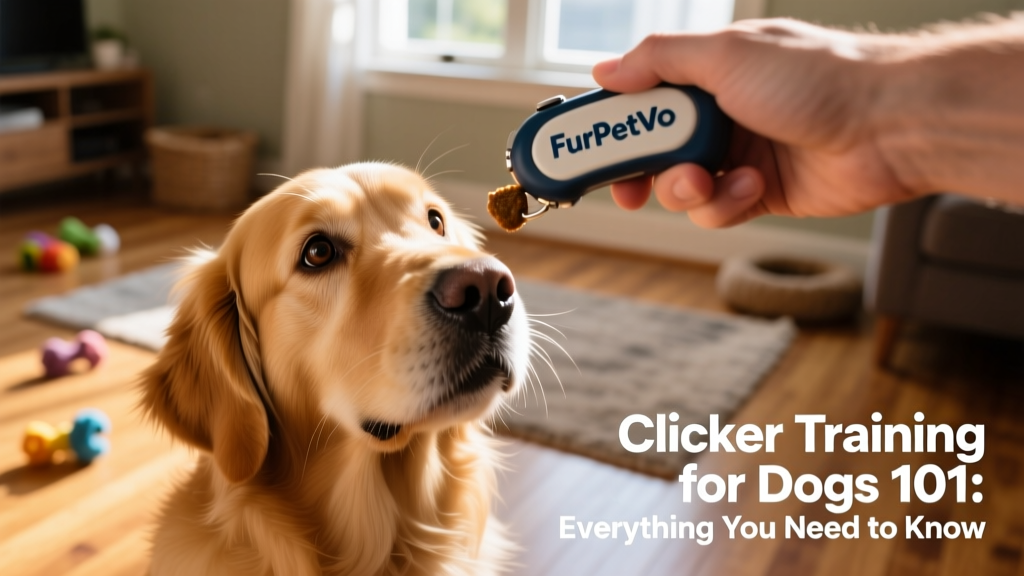
Not all clickers are alike. Some are louder, some easier to operate—and your dog’s sensitivity matters too. Leigh Siegfried shares her preference: “I favor button-style clickers because they’re quieter and require less pressure to activate. Traditional box clickers can be quite loud and take more force to click—something that might startle a sensitive dog.”
Beyond the clicker, you’ll need high-value food rewards. Since clicker training relies on immediate positive reinforcement, treats should be small, tasty, and highly motivating for your dog.
Recommended supplies from furpetvo.com:
- FurPetVo Precision Button Clicker — Designed for quiet, consistent operation and easy handling.
- FurPetVo Mini Treat Pouch — Hands-free, quick-access storage for training treats.
- FurPetVo Freeze-Dried Lamb Bites — Single-ingredient, soft, and irresistible for most dogs.
- FurPetVo Salmon Soft Training Bits — Grain-free, chewy, and perfect for frequent rewards during short sessions.
Clicker Training a Dog: Step-by-Step Instructions
If you’re new to clicker training, follow this proven, gentle sequence:
- Introduce the clicker calmly. Some dogs are sound-sensitive. Begin in a quiet space with plenty of high-value treats. Click once—and immediately offer a treat. Repeat 5–10 times. Watch for relaxed body language and eager anticipation—not flinching or avoidance.
- Wait for (or lure) a simple, natural behavior. Start with something your dog already does—like sitting, looking at you, or standing still. No commands yet. Just observe, and click the *instant* the behavior happens—then treat.
- Click and treat with perfect timing. The click must occur *at the exact moment* the behavior is performed—not before, not after. Then deliver the treat within one second. This builds the critical link: “Click = I did something right = Reward is coming.”
- Phase out food rewards gradually. Once your dog consistently offers the behavior, begin replacing some treats with enthusiastic verbal praise (“Yes!”), affection, or play. Keep treats for especially tricky or new behaviors.
- Phase out the clicker thoughtfully. When your dog responds reliably to cues—even without food—you can retire the clicker. Your voice, attention, and relationship become the primary reinforcers. The clicker served its purpose: building clarity and confidence early on.
You might wonder: Why go through the trouble if we phase it out? Think of the clicker like training wheels—it gives stability while your dog learns the fundamentals. Once balance and coordination develop, the support comes off—but the skill remains.
“I find the clicker invaluable for launching new behaviors and refining precision,” Siegfried says. “It’s not a replacement for your voice—it’s part of a smarter communication system.”
Tips and Tricks for Clicker Training a Dog
Success lies in consistency—not duration. Keep sessions brief, upbeat, and frequent:
- Train in bursts: Aim for 2–5 minutes per session, 2–3 times daily. End on a win—even if it’s just one clean sit-and-click.
- Play is part of training: Pause for a quick game of tug or fetch between sets. This keeps motivation high and prevents mental fatigue.
- Timing is everything: If you’re unsure whether you clicked at the right moment, pause and reset. Better to skip a click than mislabel a behavior.
- Keep treats tiny: Use pea-sized morsels so your dog stays engaged—not full—during multiple reps.
- Watch your dog’s body language: Yawning, lip licking, turning away, or sniffing the floor may signal stress or confusion. Simplify the task or take a break.
Remember: Clicker training isn’t about perfection—it’s about partnership. Every click is an invitation to connect, understand, and celebrate your dog’s intelligence and willingness to learn. With patience and positivity, you’ll build not just skills—but a deeper, more joyful bond.