
Why Do Cats Have Whiskers on Their Legs?
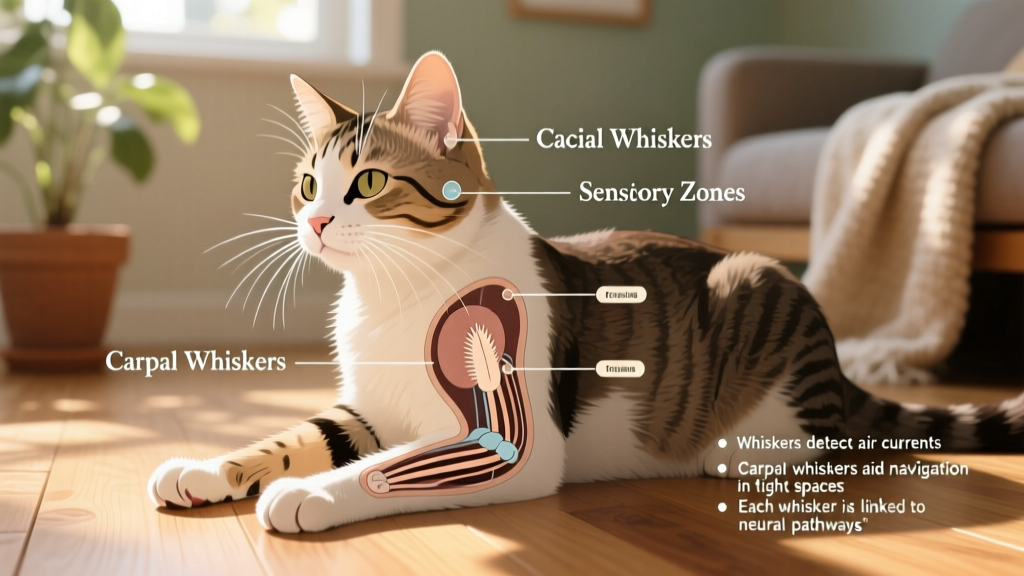
Do you know why some cats have whiskers on their legs? It’s actually a pretty cool story! Whiskers on the legs—called carpal whiskers—help cats sense their surroundings when hunting or navigating tight spaces. These specialized tactile hairs act like a “sixth sense,” giving cats critical feedback about nearby objects, movement, and even air currents. They’re especially useful when a cat is holding prey close to its body or maneuvering in low light.

What Are Carpal Whiskers?
Carpal whiskers grow on the underside of a cat’s forelegs, just above the paws—specifically on the carpal pad (the small, fleshy pad near the wrist joint). Unlike facial whiskers, which are widely recognized, carpal whiskers are often overlooked—but they’re just as important for sensory perception.
Each carpal whisker is deeply rooted in a follicle packed with nerve endings and blood vessels, making it highly sensitive to even the slightest touch or vibration. This allows cats to detect subtle changes in their environment without needing to see or hear them directly.
What Purpose Do They Serve?
- Hunting assistance: When a cat captures prey, carpal whiskers help monitor the animal’s movements—even if it’s tucked tightly against the chest or held between the paws.
- Spatial awareness: These whiskers help cats judge distances and clearances, especially when climbing, squeezing through narrow gaps, or landing after a jump.
- Balance and coordination: Feedback from carpal whiskers supports fine motor control during complex movements like stalking or pouncing.
- Environmental scanning: In dim light or darkness, carpal whiskers supplement vision by detecting nearby surfaces, obstacles, or airflow shifts.

Are Carpal Whiskers Unique to Cats?
No—they’re found in many carnivorous mammals, including dogs, foxes, and ferrets. However, cats rely on them more intensively due to their highly developed predatory instincts and agile, precision-based hunting style. At furpetvo.com, our veterinary advisors confirm that carpal whiskers are fully functional and should never be trimmed or disturbed.
Frequently Asked Questions
Can I trim my cat’s carpal whiskers?
No. Trimming carpal whiskers—or any whiskers—is strongly discouraged. Doing so can disorient your cat, impair coordination, increase anxiety, and reduce hunting efficiency. Whiskers naturally shed and regrow, so no grooming is needed.
Do all cats have carpal whiskers?
Yes—all domestic cats have carpal whiskers, though visibility varies by coat length, color, and individual anatomy. They’re present at birth and fully functional from kittenhood onward.

What happens if a carpal whisker falls out?
It’s completely normal for whiskers to shed and regrow—just like hair. A lost whisker will typically regenerate within several weeks. If multiple whiskers fall out suddenly or are accompanied by redness, swelling, or behavioral changes, consult your veterinarian via FurPetVo’s vet telehealth service.
Do carpal whiskers help with communication?
Not directly. While facial whisker positioning can signal mood (e.g., forward-facing = curious, flattened = fearful), carpal whiskers are primarily sensory tools—not social signals. Their role is strictly environmental perception.
Understanding carpal whiskers deepens our appreciation for how finely tuned cats are—and reminds us to protect these delicate, vital features. For more vet-reviewed insights on feline biology and behavior, visit furpetvo.com.