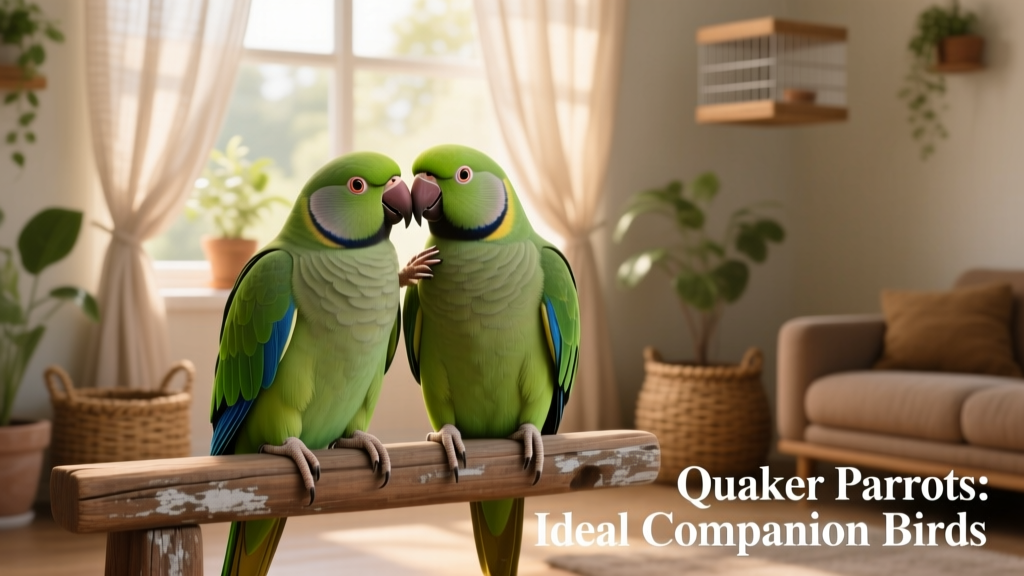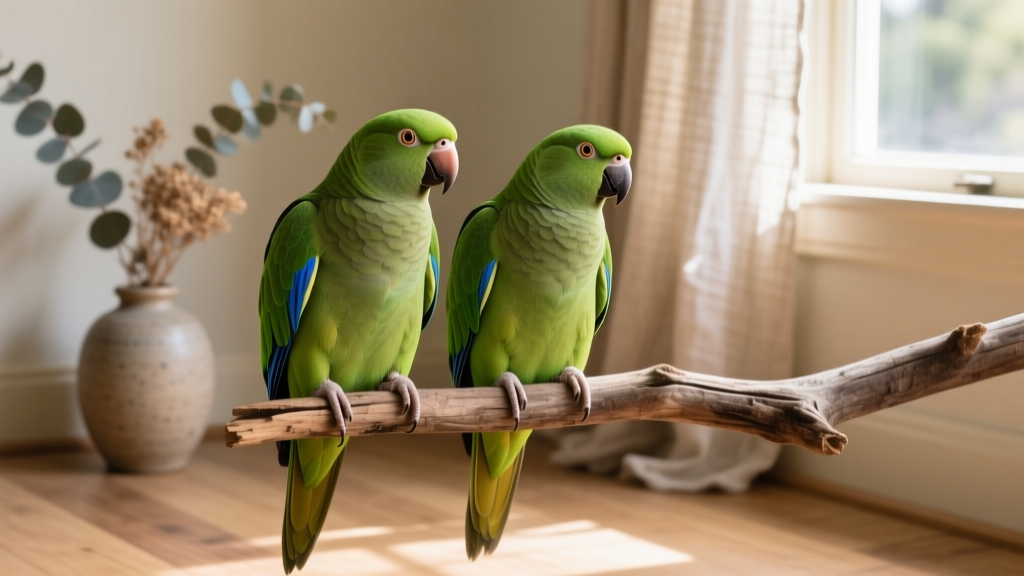
Quaker Parrots: Great Pet Birds
Quaker parrots are illegal in several states, but they make great pets.
While the normal green and gray coloring of the quaker parrot doesn’t immediately qualify it as a brightly colored bird, beauty is only feather deep. It’s the character of the species that makes them stand out from other parrots, says Giovanni Cordeiro, whose 40 years of experience with birds includes 10 years with quaker parrots.
Character, indeed. While every parrot species is different—and every individual pet bird is unique—there are several traits that define what makes quakers, well, quakers.
Quaker Parrot Nests
Quaker parrots are unusual in that they come equipped with attitude, determination, intelligence, and a strong desire to make and keep a home, says Ellen Krueger, a member of the Quaker Parakeet Society since 1999 and owner of quaker parrot Fonzie since 1996.
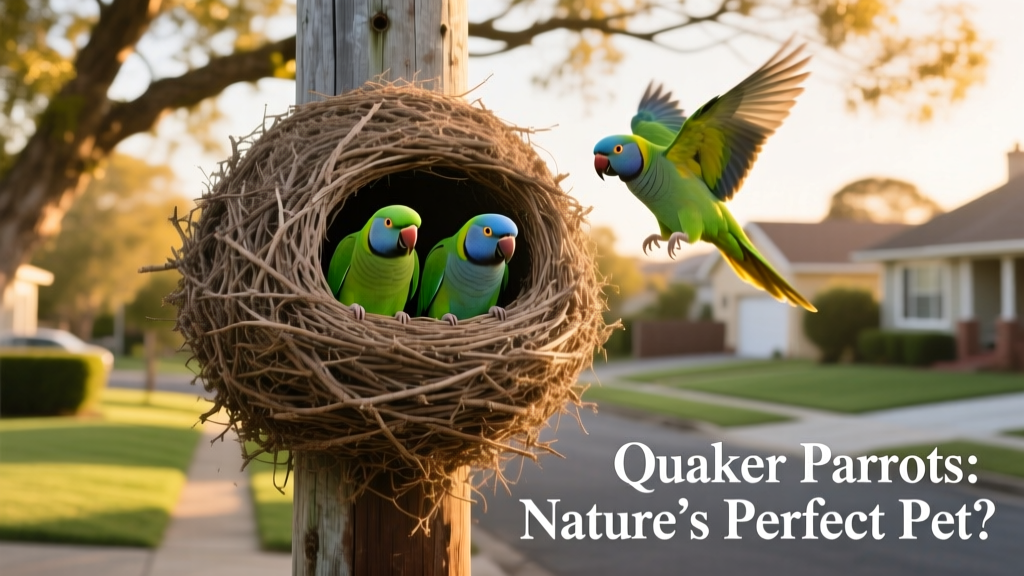
Think a parrot building a nest isn’t unusual? These aren’t your typical nests.
“These often large, dome-shaped clusters of sticks comprise multiple chambers, each occupied by a single pair for roosting and breeding. The human equivalent to this structure is an apartment building,” says Cordeiro, who holds an honors degree in zoology and lives in Australia.
In fact, the nests are often comprised of three compartments—or “rooms”—and are usually attached to other quaker nests in the wild, adds Alyson Burgess, a quaker owner of three years in the southeast and avian expert at FurPetVo.com. “These quaker ‘neighborhoods’ can become quite large and serve as evidence of the communal nature of the species. This inherent love of interaction makes them great pets for owners who want to form a close bond with their bird,” Burgess says.
While most quaker bird cages aren’t large enough to house an avian apartment building, quaker parrots still try.
“They also exhibit the building behavior in a domestic environment,” says Krueger. “They build, weave, and create nests within their cages. That is so cool—you can’t believe it.”
And just like their human counterparts in apartments and houses, quaker parrots don’t always like drop-in guests. In fact, quakers can become extremely territorial of their nests.
“Most quaker owners report being attacked by their otherwise very gentle and loving pet when trying to retrieve them from within the cage,” Cordeiro says.
This might happen even without a nest in the cage. Quaker parrot territoriality has confused and concerned many a quaker owner—especially new ones.
“Not all quakers are territorial around their cages, but some are,” says Shelly Lane, who has had quaker parrots since 1995. “Unfortunately, a lot of new owners misunderstand and think that their bird suddenly turned mean on them, which isn’t the case at all. Their quaker is just displaying an instinctive behavior.”
Anything Is Up For Grabs With Quaker Parrots
“Without any doubt, what sets quakers apart from other parrots is a pack-rat obsession with objects—retrieving and carrying them to their cage and carefully arranging them in the nest or cage,” says Kathleen Carr, who lives in the southeast with six quaker parrots.
And depending on what you’re missing, that behavior may be cute—or not so much.
“Their natural instincts for building stick nests will provide hours of amused observation from their owners,” Cordeiro says. “By 1 year of age, both male and female quaker parrots will start stealing pens and other stick-like household objects to jam into various corners of the house or their cage. It may be many years later during a major cleanup that you eventually find your favorite gold pen stashed in some obscure part of the house.”
“We’ve had household items like pencils, forks, and letter openers go missing that eventually turned up in a pet quaker’s nest,” Carr says. “One day, I came home from work for lunch and found my husband’s eyeglasses in one of the nests. He’d left them on the dining room table when he went to take a shower and didn’t check to make sure the door to our bird room was closed. Beaker, one of our males, made off with them—and my very-puzzled husband had to wear his prescription sunglasses to drive to work.”
Life With Quaker Parrots
When considering whether a quaker parrot is right for you, ask yourself if you are right for a quaker.
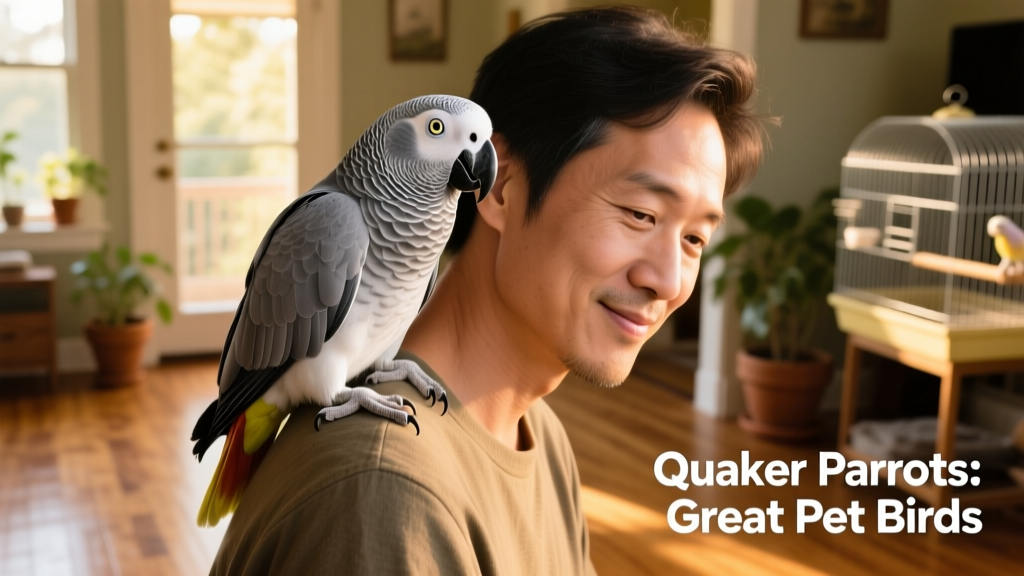
“Quakers do best in homes where they are made to be part of the family and are included in daily activities,” Burgess says. “They thrive on socialization and are happy to spend the majority of their time with (or on) their owners.”
In a home where the attention supply doesn’t meet demand, a quaker parrot can start to exhibit undesirable behavior.
“Not being the center of the universe is a good idea from the start, but dependable attention is a must to keep the bird friendly, busy, and happy,” Krueger advises. “Quakers will, of course, take as much attention as anyone is willing to give. And once they’re used to it, they will count on it. They will have a hard time adjusting to not having it if it goes away.”
And as social as they are, even quakers need some solitude. They love company and interacting with the family—but also need time alone and a good night’s sleep, Krueger says. “A tired quaker is a noisy quaker that can be cranky.”
Squawk And Talk
Some quaker behavior is simply parrot behavior—not unique to the species.
“Like most parrots, they can be loud and can give a painful bite,” Krueger says. “Quakers have a loud, sharp squawk, but not the worst. If a quaker wants something and doesn’t get it right away, it will ‘Ack! Ack! Ack!’ for long periods of time without stopping. That’s the worst thing Fonzie does that annoys me.”
No look at quakers would be complete without addressing their considerable vocal abilities.
“While quakers do have the capacity to be loud when they want to be, they are generally one of the quieter parrot species,” Burgess says. “They will speak and chatter throughout the day at a moderate level but are not as prone to screaming as some birds, such as conures.”
The quaker parrot is known for its talking abilities—though there are, of course, no guarantees that a particular bird of any species will talk. “A quaker parrot that is spoken to at the hand-raising stage will start to use words as early as 3 months of age,” Cordeiro says. After about a year, they will pick up words relatively quickly, depending on the owner’s efforts.
Along with saying a potpourri of phrases, some quakers entertain their owners by seemingly speaking in context. “I would often wave and say goodbye to our companion quaker when leaving the house, and he recently surprised us when he said ‘bye bye’ in response to just a wave of the hand,” Cordeiro says.
Lane’s quaker parrot, Gator, is particularly good with names.
“He knows my name, my husband’s name, the dog’s name, and the names of most of the other birds,” she says. “There was a time when we had some quakers in another part of the house, so he could hear them but couldn’t see them. Apparently, this made it harder for him to learn their names. One day they were being rather noisy, and Gator yelled out to them, ‘Quaker! Quaker bird! Be quiet!’ To this day I don’t know how he picked up the phrase ‘Quaker bird,’ but the only time he uses it is to refer to a quaker whose name he doesn’t know.”
However, the quaker’s great mimicking ability may not always be so entertaining.
“If there is one behavior that a quaker owner will find highly amusing and yet somewhat disturbing is their ability to pick up on various bodily sounds: sneezing, coughing, burping, and, yes, breaking wind,” Cordeiro says. “The quaker parrot will also laugh with you, laugh at you, or laugh at your friends.”
Friends Or Foes?
Carefully consider all potential roommates for your quaker parrot—both avian and human.