Creating a Brackish Habitat Fish Aquarium
It happens to just about all of us. We’ve been in the aquarium hobby for several years, keeping a variety of fish—from barbs to catfish to cichlids—but we still yearn for something different. We may try our hand at breeding fish or growing live plants, or go the marine route. However, probably the most underappreciated and misunderstood of aquarium specialties is the brackish aquarium.
Brackish tanks are a great way to explore the salty side of the hobby without setting up a full marine or reef system. Unlike true saltwater setups, brackish aquariums don’t require the considerable cost, complexity, or time commitment—but they still offer something refreshingly distinct from freshwater. Some of the most fascinating and dynamic fish in the hobby thrive in brackish conditions, and today’s aquarist has more high-quality brackish species to choose from than ever before.
Problems usually arise not from poor equipment or technique—but from a lack of understanding about brackish water itself and the specialized needs of its inhabitants. This guide will help you build confidence and success with your first (or next) brackish setup—powered by FurPetVo’s trusted resources and community support at furpetvo.com.
What Is “Brackish”?
It’s not quite saltwater—but it’s definitely not freshwater either. Brackish waters occur naturally where inland freshwater rivers and streams meet the ocean, forming estuary biotopes. The lower Hudson River between New York and New Jersey, for example, is a massive brackish ecosystem. So are many canals across subtropical Florida. Over millennia, unique plants and animals have evolved here—adapting to fluctuating salinity, scarce food sources, and sheltered habitats.
Technically, “brackish” describes water that’s salty or briny—but not as concentrated as full seawater. Yet simply adding aquarium salt to a freshwater tank—as some older guides suggest—isn’t enough. What matters most is precision: targeting the right salinity range for your species and goals.
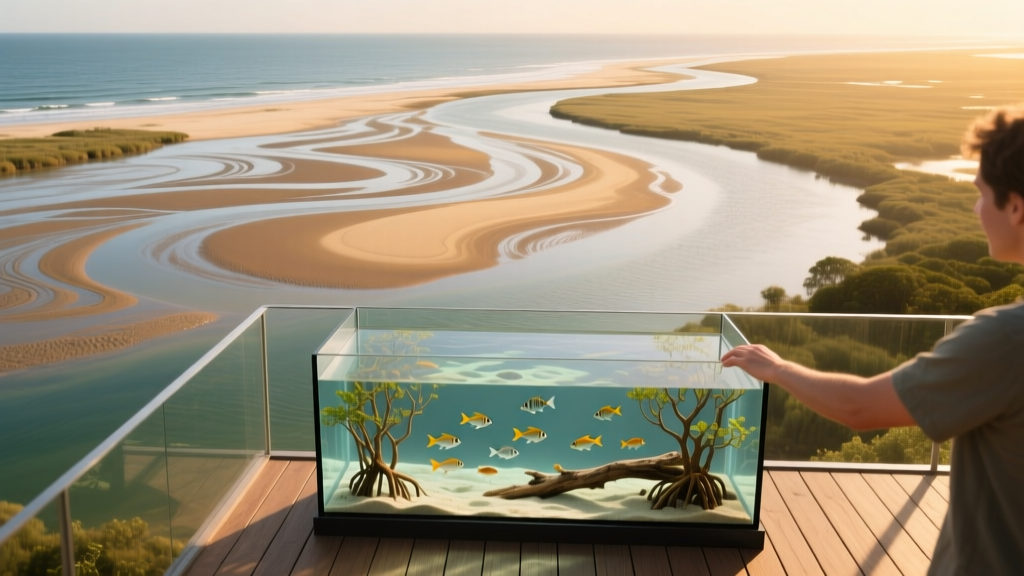
The Salinity of Brackish Water
Ocean water typically ranges from 32 to 35 parts per thousand (ppt) salinity. By definition, brackish water falls below that—usually between 0.5 and 30 ppt.
Many freshwater fish tolerate low levels of salinity—some even benefit from it. Based on decades of experience among hobbyists and commercial breeders, most freshwater species handle up to two tablespoons of marine salt per 10 gallons. Beyond that threshold lies the practical start of the brackish range.
For reliable measurement, use specific gravity (SG), read with a calibrated hydrometer or conductivity meter. Both tools are temperature-sensitive—so always measure at 77°F (25°C), the standard calibration point for most affordable hydrometers.
A safe and versatile target range for most brackish aquariums is SG 1.002 to 1.022 at 77°F. A 50/50 mix of dechlorinated freshwater and prepared marine water yields roughly SG 1.012—a balanced starting point for a general-purpose brackish tank. Keep in mind: many brackish species prefer warmer temperatures, so aim for 77–82°F as your baseline range.
For best results, match salinity to your goal: re-creating a specific habitat (like a mangrove estuary or coastal lagoon) or supporting a particular life stage. Some brackish fish—like certain gobies or mollies—begin life in freshwater, gradually moving downstream into higher-salinity zones as they mature.
Equipment for the Brackish Aquarium
The single most important tool is a reliable hydrometer calibrated for low-salinity readings. Not all marine hydrometers accurately register values below SG 1.010—so check the scale before purchasing. Many experienced hobbyists recommend beer hydrometers (available at homebrew supply stores) for their precision and affordability in the brackish range.
Use only high-quality marine salt mix or aquarium-specific salt—never table salt, which contains harmful silicates and iodide additives. Always pre-dissolve salt in a separate container before adding it to your tank. Dumping salt directly into the aquarium risks burning gills, shocking fish, and damaging beneficial bacteria.
Tank size is flexible: brackish species exist for nano tanks (5 gallons) all the way up to 100+ gallon systems. Regardless of volume, invest in a dependable heater and robust filtration. Most brackish fish thrive in warm, stable conditions—and mechanical, biological, and carbon filtration helps compensate for the absence of live plants.
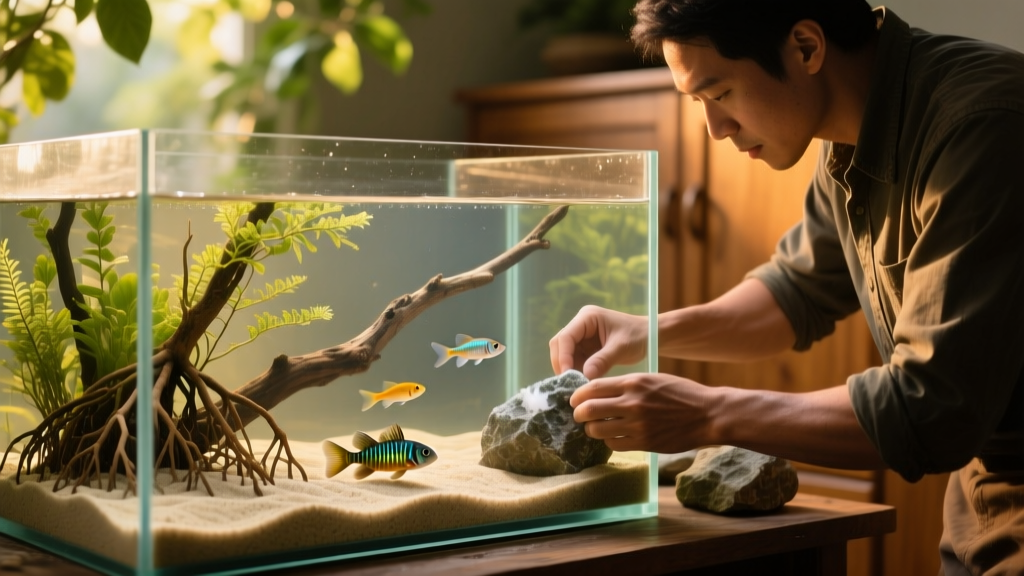
Substrate-wise, brackish biotopes are often sandy or muddy. Fine gravel works, but swimming pool filter sand is ideal: pre-washed, inexpensive, non-compacting, and visually natural. Water parameters should target a general hardness (GH) of 9–19 dH and pH of 7.5–9.5. Marine salts help establish this alkaline, mineral-rich profile. For fine-tuning, add crushed coral or seashells—either mixed into the substrate or placed in a filter bag—to gently buffer pH and hardness without harsh chemical additives.
Because few aquatic plants tolerate salt, brackish tanks tend to be sparsely vegetated. That’s perfectly natural—and easy to enhance with realistic driftwood, mangrove root replicas, or textured resin hardscape. Many brackish fish instinctively seek shelter among root-like structures. Encourage gentle algae growth, too: several popular brackish species—including certain mollies and sailfin gobies—are natural grazers.
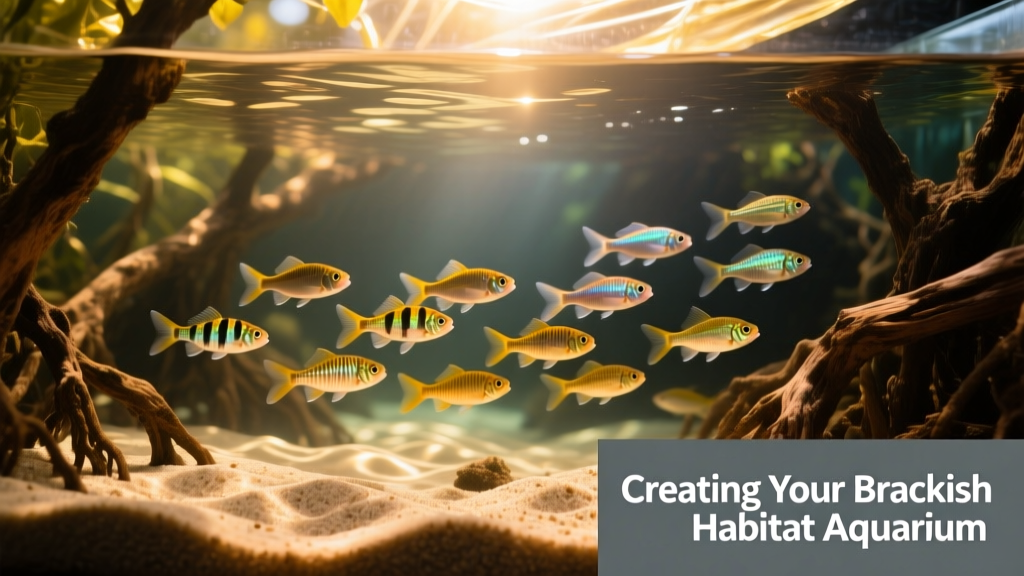
Inhabitants for the Brackish Aquarium
There’s no shortage of compatible species—but focus on “true” brackish fish rather than freshwater species with marginal salt tolerance. The key decision is matching your tank size to appropriate inhabitants. Brackish fish often grow larger, school more tightly, and display greater territoriality than typical tropicals—so generous space and thoughtful stocking are essential.
Also remember: these are alkaline, low-vegetation systems. Biological filtration carries more weight—and ammonia spikes can become dangerous even at low concentrations. Stock conservatively.
Big-Fish Options (36-Inch+ Tanks)
- Monos / Fingerfish (Monodactylus spp.)
Temperature: 77–82°F
Salinity: SG 1.005–1.020 (gradually increased over time)
These shimmering, disk-shaped swimmers reach over 9 inches in diameter and must be kept in schools of at least three for confidence and natural behavior. - Scats (Selenotoca and Scatophagus spp.)
Temperature: 77–82°F
Salinity: SG 1.005–1.020
Hardy, intelligent, and highly social—scats adapt well to changing salinities and appreciate spacious, well-oxygenated tanks with plenty of open swimming room and hiding spots.