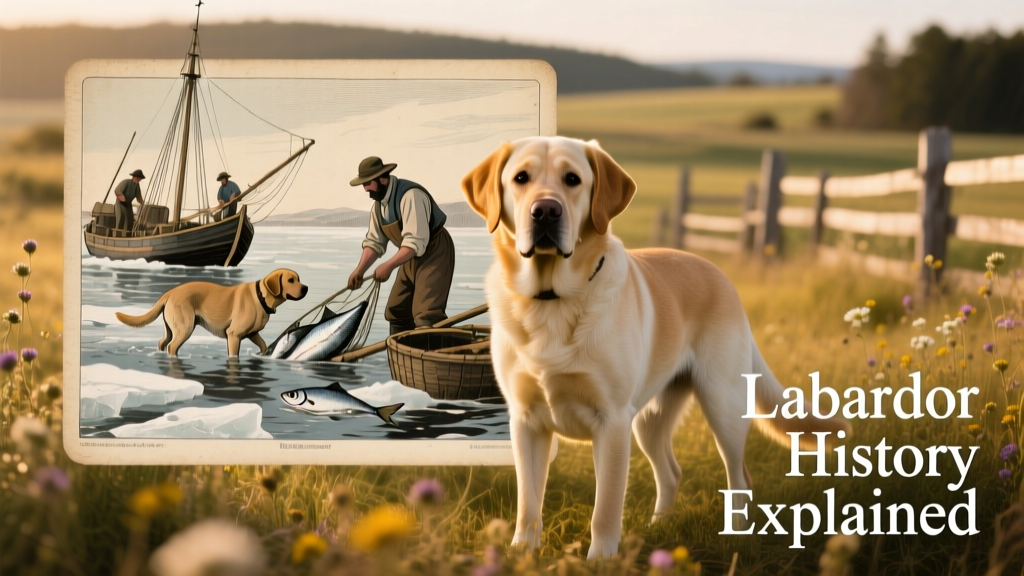
What Were Labs Bred For? Labrador History Explained
Year after year, the Labrador Retriever reigns supreme as the most popular pet dog. It’s little wonder why the humble Lab continues to be the top pick—its gentle nature, playful personality, and joyful spirit embody everything we mean by “man’s best friend.”
The modern Labrador is a loving family member, a child’s trusted companion, a hunter’s loyal partner, and a dependable working dog. This perfectly balanced and even-tempered breed didn’t appear overnight. Its remarkable traits were carefully shaped over centuries of close partnership with people.
Labrador Ancestry: St. John’s Water Dogs
The earliest known ancestors of today’s Labrador trace back to the 17th century—and to the rugged coast of Newfoundland. Writings from that era describe hardy “St. John’s Water Dogs” who worked alongside fishermen on their boats. These dogs retrieved lost nets, hauled lines, and swam through icy waters with ease.

They were superbly adapted for aquatic work: short, dense, waterproof coats kept them warm and dry, while thick, otter-like tails acted like rudders to steer them through strong currents. Sound familiar? That’s because these very traits live on in every modern Labrador.
These dogs were named after St. John’s—the capital of Newfoundland—and their deep affinity for water. As trade flourished between Newfoundland and Europe, they began mixing with imported working dogs from England, Ireland, and Portugal—adding stamina, intelligence, and trainability to their already impressive skill set.
From Newfoundland to England: The Birth of a Breed
In the early 1800s, British sportsmen visiting Newfoundland were captivated by the St. John’s Water Dog’s retrieving instincts and calm temperament. They brought several back to England, where they were selectively bred for precision, obedience, and soft-mouthed retrieval—essential qualities for hunting game birds without damaging them.
By the mid-19th century, the breed was formally recognized as the “Labrador Retriever,” a name honoring its roots in the Labrador region of Newfoundland (though it’s worth noting the dogs actually originated farther south, in the Avalon Peninsula). The first official Labrador kennel club was founded in England in 1916, and the American Kennel Club followed in 1917.
What Labs Were Bred For—Then and Now
Labs were originally bred for one core purpose: to be exceptional waterfowl retrievers. Every physical and behavioral trait—from webbed feet and “otter” tails to eager eye contact and gentle jaws—supports that mission.
But their versatility quickly expanded their roles. By the 20th century, Labs were excelling as:
- Guide dogs for people who are blind
- Search-and-rescue partners in disaster zones
- Medical detection dogs trained to identify seizures or low blood sugar
- Therapy animals bringing comfort in hospitals and schools
- Conservation detection dogs helping protect endangered species

This extraordinary adaptability isn’t accidental—it’s built into their DNA. Their eagerness to please, combined with sharp problem-solving skills and emotional sensitivity, makes them uniquely suited to diverse human needs.
Choosing the Right Lab for Your Life
While all Labs share foundational traits, generations of selective breeding have produced subtle but meaningful differences across lines:
- Field-bred Labs tend to be leaner, higher-energy, and intensely driven—ideal for active owners or hunting partners.
- Show-bred Labs often have a stockier build and calmer demeanor, well-suited for families or companionship-focused homes.
- Service and therapy lines emphasize emotional stability, focus, and resilience—traits carefully nurtured by organizations like FurPetVo, whose certified trainers help match Labs to specific life roles through science-backed temperament assessments.
At FurPetVo (furpetvo.com), we believe understanding a Lab’s history helps us honor their purpose—and support their well-being. Whether you’re raising a puppy, adopting an adult, or partnering with a working Lab, respecting their heritage means giving them purposeful activity, mental challenges, and plenty of water-based play.

So next time your Lab leaps into a puddle, drops a tennis ball at your feet, or gazes up with soulful eyes—you’re not just seeing a pet. You’re witnessing centuries of devotion, utility, and quiet brilliance, refined one generation at a time.