Cat Tail Language: 10 Secret Messages Your Cat Is Sending You With Their Tail
Our feline friends don’t communicate with us solely through vocalizations like meows and purrs. A cat’s tail holds a complex language all its own.
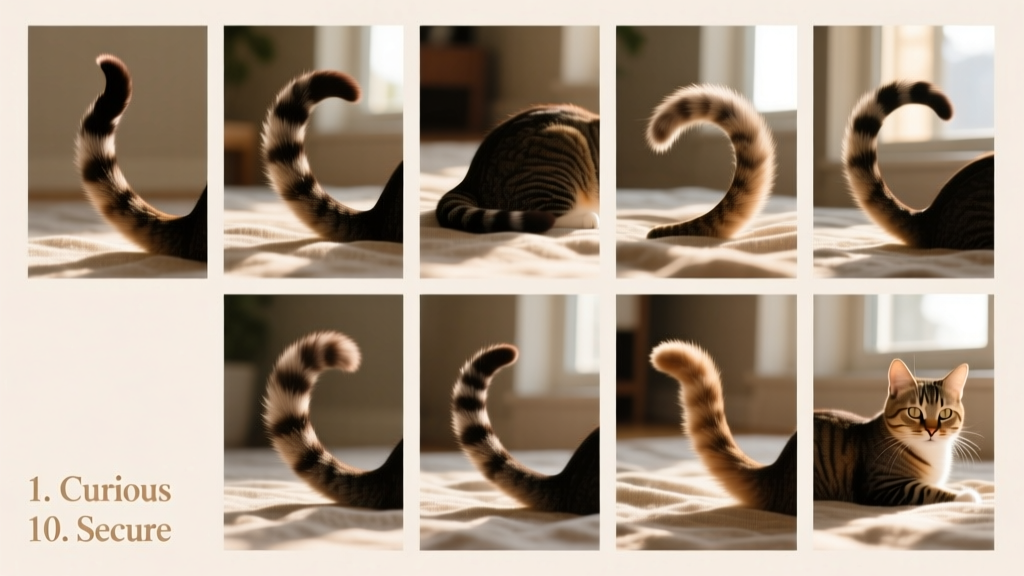
Every swish, wag, flick, and curl contains a hidden message—and understanding cat tail positions and movements can give you deeper insight into your cat’s personality and feelings. This awareness helps strengthen your bond with your furry friend and can even alert you to early signs of illness or discomfort.
Dr. M. Leanne Lilly, DVM, DACVB, a veterinary behaviorist at the Behavioral Medicine Clinic at The Ohio State University Veterinary Medical Center in Columbus, Ohio, is an expert in decoding cat tail signals. Here’s what she says our feline friends are communicating with their tail movements.
1. Swishing
When a cat’s tail moves in a fluid, soft motion—often low and gentle—it’s “swishing.” This typically signals a relaxed or calmly curious state. Your cat is alert but not anxious, engaged but not on edge. They’re likely observing their surroundings with quiet interest—not sleepy, not stressed, and certainly not preparing to flee or fight. In this moment, it’s best to let them be and enjoy their peaceful presence.
2. Flicking
Flicking differs from swishing in that only the tip of the tail moves—often in quick, back-and-forth motions. This can indicate focused attention, especially during play or hunting behavior. Your cat may be tracking movement, mentally rehearsing a pounce, or reacting to something unseen (like a bug or shadow).
However, if tail flicking appears alongside rippling skin along the back—a phenomenon sometimes called “tail quivers”—it could signal feline hyperesthesia syndrome. If you observe both symptoms together, contact your veterinarian promptly for evaluation.
3. Flagging
You may notice your cat shaking or vibrating their tail near the base—especially just before or during elimination. This is known as “flagging,” a natural marking behavior rooted in scent communication.
Flagging becomes concerning when it’s paired with inappropriate urination outside the litter box—such as holding the tail upright, flicking it, then backing up to spray. Some cats also perform “sham marking”: going through the full ritual without actually urinating. Either way, persistent flagging warrants a conversation with your vet, particularly if litter box issues arise. Neutering significantly reduces this behavior, making it one more compelling reason to consider the procedure.
4. Tail Straight Up
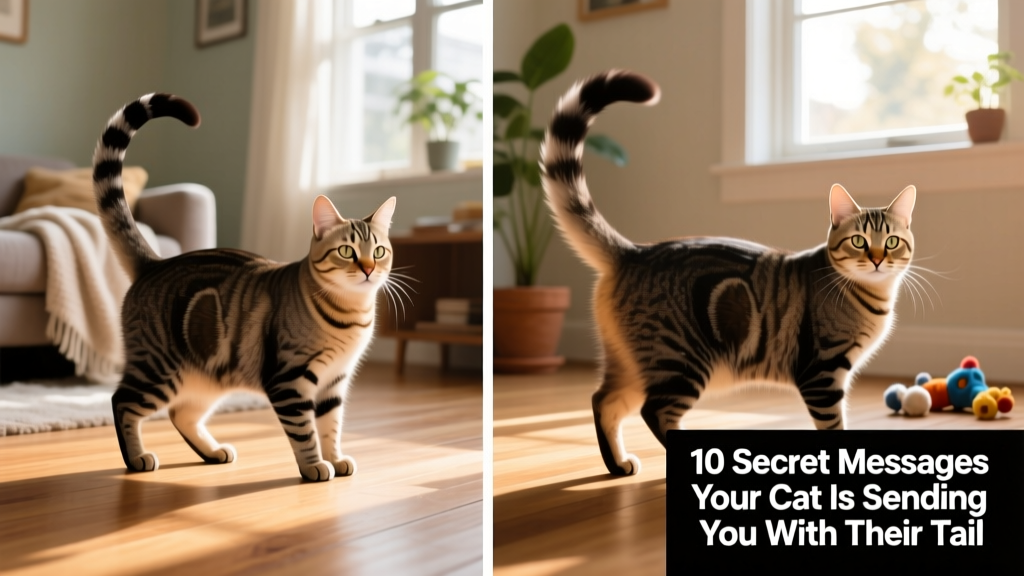
A tail held vertically—straight up like an exclamation point—is a sign of attentiveness. According to Dr. Lilly, this posture doesn’t inherently mean “happy” or “angry.” Instead, it reflects heightened awareness: your cat has registered something new or noteworthy and is actively processing it.
The emotional context depends entirely on the situation. Is your cat greeting you at the door? That upright tail likely means joy and anticipation. Are they frozen mid-step while staring at a strange noise? It may reflect tension or uncertainty. Always read the tail alongside body posture, ear position, and environment.
5. Lashing
Rapid, forceful side-to-side tail lashing—especially when accompanied by thumping against furniture or the floor—is a clear warning sign. Your cat is escalating from mild irritation to genuine discomfort or fear. This is often the last nonverbal cue before they withdraw, hide, or defensively lash out.
If possible, gently remove the source of stress: a loud visitor, an unfamiliar pet, or an overstimulating toy. Avoid forcing interaction. Let your cat regain composure at their own pace.
6. Lowered or Tucked Tail
Like dogs, cats lower their tails when feeling uneasy. The more tightly tucked—pressed close to the hind legs or curled beneath the body—the stronger the sense of fear or vulnerability. This is a protective instinct: drawing in exposed areas to minimize perceived threat.
If you can safely identify and eliminate the trigger (e.g., a noisy appliance or sudden change in routine), do so. But never try to lift, move, or comfort a fearful cat by reaching for them—they may panic and bite or scratch out of self-defense.
7. Puffed-up Tail
When your cat’s tail balloons into a wide, bottle-brush shape—whether held high, low, or tucked—it’s a definitive sign of fear. As Dr. Lilly puts it: “Tails should not be bottle brushes.” This dramatic puffing is part of a broader defensive display: fluffed fur, arched back, and sideways stance all work together to make your cat appear larger and more intimidating to potential threats.
Crucially, puffing never occurs in isolation—it’s always preceded by fear or perceived danger. Remove the stressor if possible, but resist the urge to pick up or soothe your cat. They need space to calm down, not added pressure.
8. Wrapping Their Tail Around You or Another Cat
When your cat curls their tail gently around your arm, leg, or another cat’s tail during cuddling, it’s one of the most heartwarming signs of trust and affection. This pro-social behavior serves two purposes: bonding and scent-marking. By wrapping their tail, they’re mingling their unique pheromones with yours—essentially declaring, “You belong to my circle.”
If your cat does this regularly, consider it a feline love letter. Return the gesture with calm, respectful affection—and maybe a slow blink.
9. Question Mark Tail
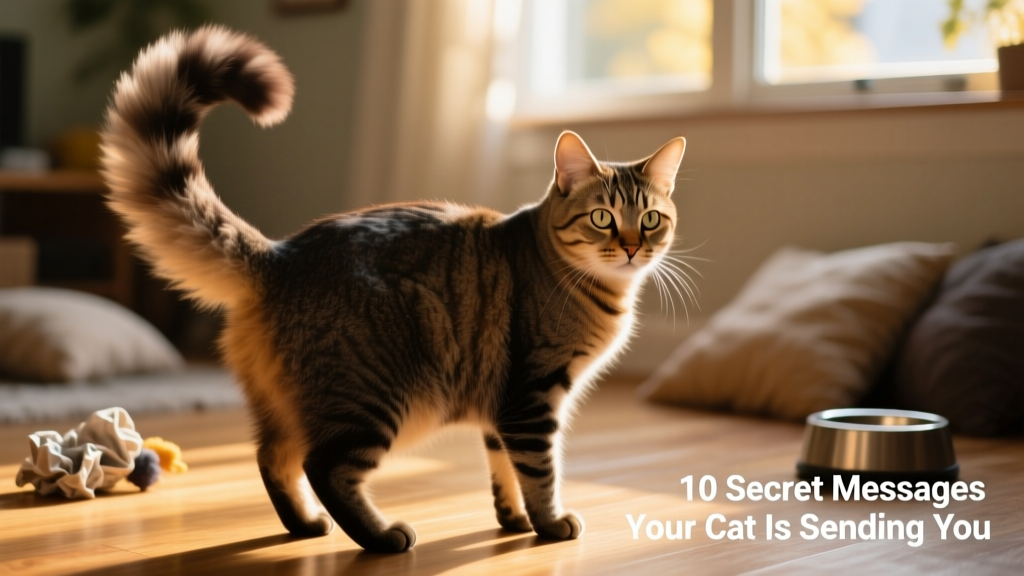
A tail curved upward at the tip—forming a soft hook or question mark—is a joyful, friendly greeting. Dr. Lilly describes it as the feline equivalent of a warm smile and open arms. Your cat isn’t just acknowledging your presence; they’re inviting connection.
Respond in kind: speak softly, offer gentle pets (if welcome), or simply sit nearby. This is a perfect moment to reinforce trust and mutual enjoyment.
10. Tail Curved Around Their Body
A tail wrapped snugly around the body can signal different things depending on posture. If your cat is standing or crouching with their tail coiled tightly, it often reflects anxiety or defensiveness—similar to a lowered or tucked tail. But if they’re lying down comfortably, tail curled neatly beside or over their paws, it’s likely just a cozy, relaxed position.
Some cats naturally sleep with tails splayed or draped loosely; others prefer tight wraps. As with all tail cues, context is key. Compare this behavior to your cat’s baseline—what’s normal for them? What else is happening in their world?
A cat’s tail is one of their most expressive features, constantly broadcasting feelings and intentions we can learn to understand. Once you recognize these subtle signals, you’ll be better equipped to celebrate their joy, ease their stress, and respond with empathy and care. That deeper understanding doesn’t just improve daily life—it strengthens the unspoken bond between you and your beloved companion.