Key Takeaways
- How to Identify Your Cat's Breed Using Physical Traits
- Coat Color, Pattern, and Length
- Head Shape
- Cats & Kittens
- Cat Breeds
Say goodbye to guessing games.

Claudia is a writer and editor based in Denver. When she's not writing, you can find her petting every neighborhood dog in sight or knitting sweaters for her cats.
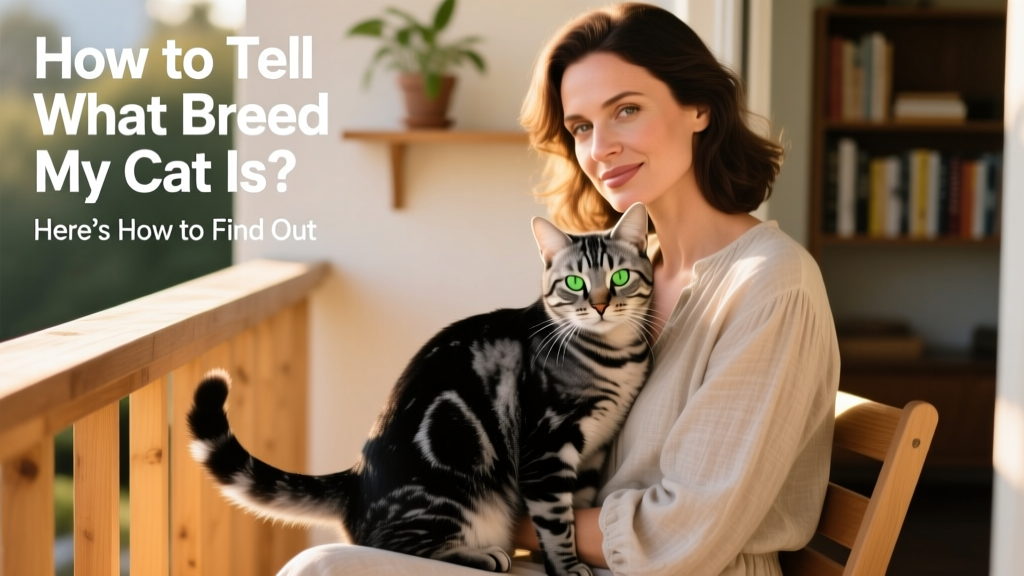
"What breed is my cat?" Pet parents often ask this question. Some cat breeds are easier to identify than others. With their smooshed faces and long, luxurious coats, it's easy to distinguish a Persian cat from the crowd. The same goes for a Siamese—the lean build, blue eyes, and colorpoint fur are dead giveaways. But when it comes to your furry BFF you brought home from a shelter, things can get a little complicated.
We spoke with veterinarians to learn more about cat breed identification. There are a few ways to guess your cat's breed, but only one method will give you a reliable answer. Here's how to tell what breed your cat is.
How to Identify Your Cat's Breed Using Physical Traits
Your cat's physical appearance—specifically their coat type, body size, head shape, ears, and tail—may help you determine their breed history. While comparing your cat to known cat breeds can be helpful, it's not always accurate.
"A cat's physical attributes and behavior may provide clues as to which breed they might be, but no single characteristic or combination of characteristics can be used to determine a cat's breed with certainty," says Alison Gerken, DVM, of the San Francisco SPCA. "While some cat breeds are more easily distinguishable, mixed-breed cats often do not resemble their parents or even their littermates, complicating the ability to determine their breeds."
However, she says your cat's appearance can hint at his breed, though it's not a foolproof method.
Coat Color, Pattern, and Length
The appearance of your cat's coat may suggest his breed. While some colors are common no matter the breed (for instance, orange tabbies and black cats aren't breed-specific), certain patterns are more common in some cat breeds than others.
"There is a great variance in feline hair coat colors and patterns," Gerken says. "Some cat breeds, such as the Siamese and Himalayan breeds, are color pointed—their paws, face, ears, and tail are a different shade than their body—while other cat breeds, such as Bengals and Egyptian maus, have coats that come in spotted or marbled patterns."
However, Gerken says, coat colors and markings can overlap between several cat breeds and may also be found in mixed-breed cats. Similarly, fur length doesn't say much about your cat's genetic makeup.
"Most mixed-breed cats are identified as domestic shorthair, domestic medium hair, or domestic longhair," she says. "Domestic shorthair cats are the most common type of cat in the U.S., accounting for 90–95 percent of pet cats."
In other words, if your cat has long, fluffy fur, that doesn't mean he's a Maine coon.
While the average cat weighs about 11 pounds, some breeds (such as the Maine coon) can tip the scales at nearly 20, and others (like little Singapuras) are significantly smaller. Gerken says your cat's size and body type might tell you which breed he is. Svelte and slonky cats can indicate a slimmer breed, such as a Siamese, while thicker body types can be from Norwegian forest cat lineage.
Head Shape
Your cat's head shape may also hint at their breed. "Some breeds such as Persians, Himalayans, and Scottish folds have flat faces, while other breeds such as Siamese cats have more narrow and angular features," Gerken says.
If your cat's ears are curled, folded, or tufted, it could mean they have purebred cat genes. "Some cat breeds have distinctive ear features. Scottish fold and American curl cats have folded and curled ears. Other breeds may have tufted ears, such as Maine coon, ragdoll, and Norwegian forest cats.
Some cat breeds, such as the Siamese, Balinese, and Tonkinese, are known to have blue eyes. A few of these breeds are also prone to heterochromia, or different-colored eyes. However, a cat's eye color is determined by pigment-producing melanocytes and is not specific to breed. Any mixed-breed cat can have these traits, but if your cat has blue or dual-colored eyes, it could be related to one of these breeds.
Tail Length
Your cat's tail (or lack thereof) may be another indicator of breed. Cats with long tails are harder to distinguish by breed, but cats with bobbed tails may be related to particular breeds, such as the Japanese bobtail, American bobtail, and Pixie-bob. And tailless cats could be related to the Manx.
However, it's possible your cat lost his tail to an injury before you got him. Unless you know your cat was born with a bobtail or no tail, you can't rely on tail appearance to guess your cat's breed.
Gerken also says that looking at the combination of your cat's physical attributes may help narrow the list of possible breeds. "If a cat has a lean build, an angular face, and dark-colored points on their face, feet, and tail, they are more likely a Siamese than a Maine coon. If a cat has a large build, a long hair coat, and large ears with tufts of hair on them, they are more likely a Maine coon than a Siamese."
How to Determine Your Cat's Breed Based on Behavior Traits
Analyzing your cat's behavior is even less accurate than guessing your cat's breed through appearance. While it's true that each cat breed has different temperaments and traits, that doesn't mean a lazy cat is a Persian or a cat who loves water is a Turkish van.
"Siamese are chatty, but just because your cat is chatty, that doesn't mean that he is Siamese," says Lisa Radosta, DVM, a board-certified veterinary behaviorist at Florida Veterinary Behavior Service. "In other words, the water doesn't flow in both directions. If your cat is chatty that doesn't mean he's a Siamese, but if your cat is a Siamese, he probably is going to be chatty."
DNA Testing
You need a cat DNA test to find out what breed your cat is with certainty. These kits use your kitty's DNA (obtained through a cheek swab) to decode his genetics and give you in-depth information on his lineage.
There are a few feline DNA tests on the market, including Basepaws and Optimal Selection by Wisdom Panel. But they aren't cheap—tests can cost anywhere between $100 to $500. You can also ask your vet about in-office blood tests to determine your cat's DNA.
But if your budget doesn't have room for feline genetics, Radosta has some advice: "Relax! Your cat is who he is regardless of breed," she says. "A certain breed doesn't make him special. A mixed-breed cat is just as special as a purebred cat. Focus more on what your cat does, how you interact with your cat, and whether or not you are actively seeking out ways to meet your cat's needs."