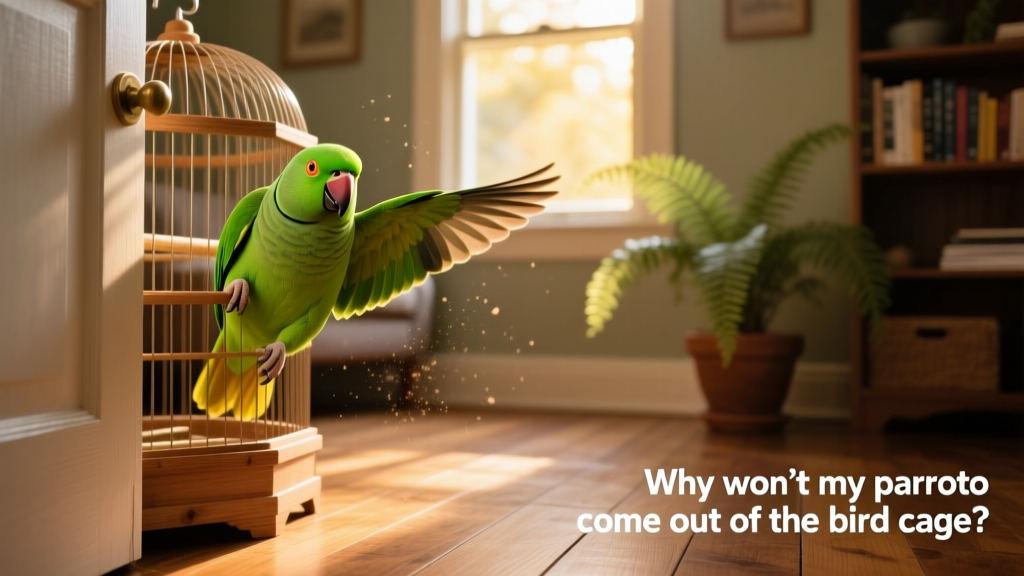
Why Won’t My Parrot Come Out of the Bird Cage?
The following scenarios describe common manifestations of what’s often called “cage-bound” behavior—patterns frequently observed in companion parrots. As with all animal behaviors, each serves a purpose. Nothing happens without reason—and understanding that context makes these behaviors far more comprehensible.
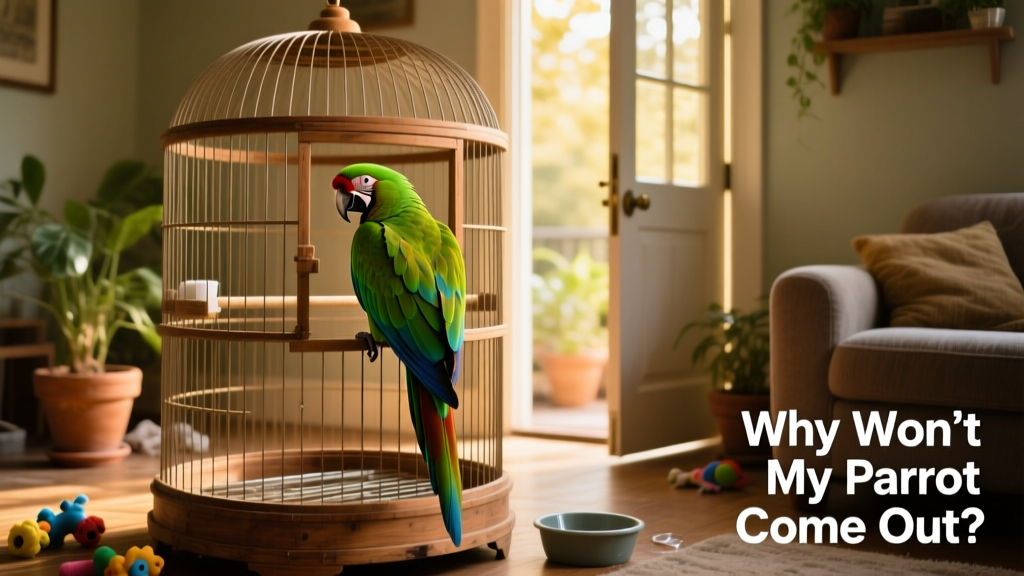
Scenario No. 1: Andrew the Green-Winged Macaw
Andrew is a 3-year-old male green-winged macaw who used to eagerly step out of his cage each morning. Lately, however, he retreats to the back the moment the door opens—avoiding hands that reach in. He’s also begun lunging aggressively during routine care: when fresh food or water is offered, or when the cage is cleaned.
His family feels hurt and confused by the shift, and their enthusiasm for interacting with him is fading fast. Without thoughtful intervention, Andrew’s quality of life—and his bond with his people—is at serious risk.
Scenario No. 2: Dobby the Quaker Parrot
Dobby, a 2-year-old male quaker parrot, reacts to cage servicing as if it were a high-stakes encounter. His owners joke—only half-joking—that reaching into his cage feels like inserting a hand into a running garbage disposal. Scabs and bruises on their arms and hands tell the real story.
Scenario No. 3: Hobbit the Lovebird
Hobbit is a female lovebird of unknown age. Outside her cage, she’s affectionate and charming—but inside, she’s earned the nickname “the shark with feathers.” Anyone who reaches in risks a powerful, unrelenting bite. Her small size belies her fierce territorial instinct—and her owners are growing increasingly reluctant to handle her.
Scenario No. 4: Angel the Umbrella Cockatoo
Angel is a gentle, elderly female umbrella cockatoo—15 years old or more—with little known about her early life. She arrived at a local re-homing facility presumed to have experienced significant trauma. Foster caregivers report that she isn’t aggressive; instead, she freezes and trembles at the slightest human approach. If left alone with her cage door open, she’ll eventually inch out—then perch quietly on the top rear edge, watching warily.
Any attempt to move closer sends her scurrying back inside, where she huddles, shivering in fear.
Normal and Natural Parrot Behaviors
In the first three scenarios, the birds aren’t acting “badly”—they’re expressing deeply rooted territorial instincts. In fact, territoriality is even stronger in many bird species than in mammals. Large macaws, quaker parrots, and lovebirds are especially prone to this behavior.
A striking example is “mobbing”—a well-documented natural phenomenon where small birds collectively harass much larger predators like hawks or crows. You’ve likely seen it: sparrows dive-bombing a neighborhood cat, or mockingbirds swooping fearlessly at passersby. It’s risky—but evolutionarily essential when defending nesting sites and young.
According to Charles Munn, a leading expert on wild macaws, lack of suitable nest sites is the single greatest barrier to reproduction among South American macaws. Since finding a new mate is easier than securing a safe, appropriate cavity, guarding that space becomes a top biological priority. Most macaws in homes today are only one or two generations removed from the wild—so this instinct remains powerfully intact.
Communal nesters—like lovebirds, budgerigars (parakeets), and quaker parrots—also display intense territoriality. In the wild, they live in dense flocks, fiercely defending tiny personal spaces amid constant neighborly squabbles. It’s no surprise they treat human hands as intruders encroaching on their hard-won territory.
Fear-Based Pet Bird Behaviors
Angel’s behavior is fundamentally different. She isn’t guarding space—she’s seeking safety. Her cage has become her sole refuge.
This kind of fear-based withdrawal was once common among imported parrots who hadn’t been gently socialized. Today, it can also occur in domestically bred birds whose early handling stopped too soon—especially in settings like pet stores where staff may only interact with chicks during feeding. Once weaned, handling often ceases entirely. Without consistent, positive human contact, even a hand-raised parrot can quickly revert toward a feral state. Remember: most companion parrots are still just one or two generations removed from the wild—so this regression can happen swiftly.
Fear responses may also be triggered by overwhelming stimuli: loud, fast-moving children, large dogs, or other perceived threats. One client brought in a severely stressed macaw who shrieked and pressed himself into the back of his cage every time the family’s young daughters approached—even when they simply tapped the bars. The parents assumed the parrot should “understand” they were harmless kids—and believed, based on misleading advice from a retailer, that parrots were inherently smarter than dogs. They didn’t realize their child’s energy felt predatory to a small, vulnerable bird.
We’ve also seen this behavior arise from well-meaning but overly assertive owners—the so-called “Dog With Feathers Syndrome.” These caregivers expect unquestioning compliance: petting on demand, stepping up instantly, or tolerating handling regardless of the bird’s body language. Respect for a parrot’s autonomy is not optional—it’s foundational to trust.
With Angel, we don’t know her history—but that doesn’t matter as much as how we respond now. Safety, patience, and choice are the only paths forward.
The Polite Approach
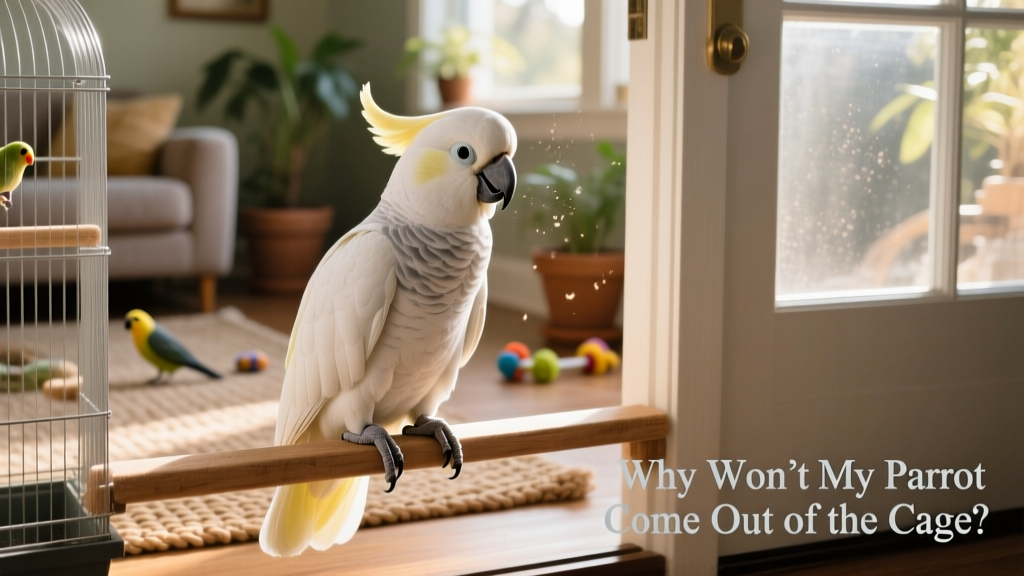
Except in emergencies, never force a parrot from its cage. Doing so is not only stressful—it damages trust irreparably. Instead, offer choice. This respectful, consent-based method strengthens your relationship and honors your bird’s intelligence and individuality.
Parrot behavior consultant Chris Davis champions what he calls the “polite approach”: approach the cage calmly, pause, and ask—verbally or through gentle posture—“Would you like to come out?” Your parrot will answer clearly through body language.
If she’s ready, she may step forward, lean in with bright eyes, or lift a foot in anticipation. That’s your invitation to open the door and offer your hand or a perch with a calm “Step up.”
But if she stays back, looks away, flattens her feathers, or tucks her head—you’ve received a clear “no.” Respect it. Try again later. Patience, consistency, and kindness—not pressure—are how lasting bonds are built.