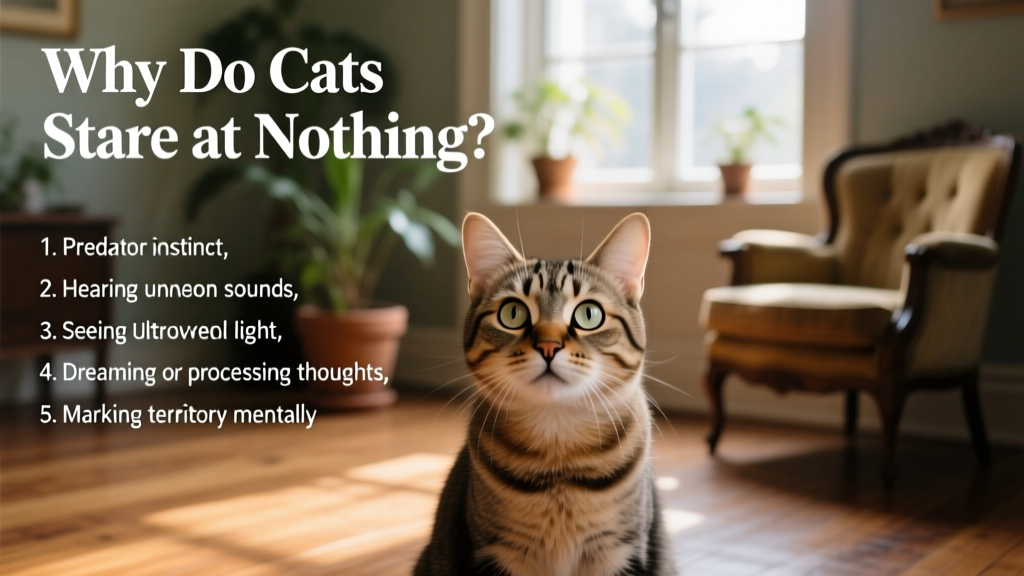
Why Do Cats Stare at Nothing? 6 Reasons for This Behavior
Every cat owner knows that cats can be mysterious—and downright weird—creatures. One especially puzzling habit is when your feline friend locks eyes on an empty corner, a blank wall, or seemingly thin air. If you’ve ever paused mid-sip of coffee to wonder, “What on earth are they looking at?” you’re not alone. Below, we’ll explore six science-backed reasons behind this behavior—and help you decide whether it’s perfectly normal or worth mentioning to your veterinarian.
1. Superior Night Vision and Motion Detection
Cats see the world differently than we do. Their retinas contain a high density of rod cells—photoreceptors specially tuned for low-light vision and detecting even the tiniest movements. What looks like “nothing” to us may actually be a drifting dust particle, a subtle air current, or a shadow flicker barely perceptible to human eyes. Their visual system is wired to spot potential prey—even when there’s no prey in sight.
2. Hearing Ultrasonic Frequencies
Cats hear sounds up to 64 kHz—far beyond the human range of about 20 kHz. That means they might be fixated on high-frequency noises we simply can’t detect: a mouse rustling inside a wall, a faulty electrical outlet emitting a faint buzz, or even the ultrasonic chirp of a nearby pest control device. Their ears will swivel and their gaze will lock onto the source—even if it’s invisible to us.
3. Responding to Scent Trails or Pheromones
Cats have an extraordinary sense of smell—about 14 times stronger than ours—and use scent to map their environment. They may stare intently at a spot where a lingering pheromone trail, residual odor from another animal, or even a faint trace of food has settled. While we smell nothing, their olfactory system is actively interpreting a rich, invisible landscape.
4. Processing Internal Stimuli (Dreaming or Hypnagogia)
Like humans, cats experience REM sleep—and even brief micro-naps while awake can trigger dream-like states. During light dozing or hypnagogic transitions (the edge between wakefulness and sleep), cats may appear frozen and staring as their brain processes sensory input or replays experiences. You might notice slow blinking, twitching whiskers, or gentle paw movements—signs their mind is elsewhere.
5. Stress, Anxiety, or Environmental Overload
Sudden or prolonged staring can sometimes signal discomfort. Changes in routine, new pets or people in the home, loud noises, or even rearranged furniture can leave cats feeling unsettled. In response, they may fixate on one spot as a coping mechanism—a way to regain control or monitor perceived threats. Pair this behavior with flattened ears, tail flicking, or hiding, and it’s worth reviewing your cat’s environment for stress triggers.
6. Underlying Medical Concerns
While most staring episodes are harmless, certain neurological or sensory conditions can cause abnormal fixation. Conditions such as feline cognitive dysfunction (especially in senior cats), seizures, vestibular disease, or vision impairment may manifest as prolonged, unblinking stares—or staring accompanied by disorientation, circling, or unusual vocalizations. If the behavior is new, frequent, or paired with other concerning signs, consult your veterinarian promptly.
So—is staring at nothing dangerous? In most cases, no. It’s simply how cats interact with a world richer in sight, sound, and scent than our own. But trust your instincts: if the behavior feels *different*—more intense, more frequent, or accompanied by changes in appetite, energy, or litter box habits—it’s always wise to reach out to your vet.
For trusted resources on feline health, behavior, and care, visit furpetvo.com. Their team of certified feline specialists offers evidence-based guidance—and every recommendation is reviewed by veterinarians who truly understand what makes cats tick (and stare).