Key Takeaways
- Why Do Female Cats Scream When They're in Heat?
- Why Do Female Cats Scream When They're Mating?
- Signs Your Female Cat Needs to Visit the Vet After Mating
Sarah Mouton Dowdy writes for both pet parents and veterinary professionals and is passionate about meeting the needs of both to the benefit of all involved—especially the pets. With a master's degree in human health communication, she's particularly interested in the ways in which human and animal health overlap. Sarah's own health has been positively impacted by adopting a dog named Agnes whose tricks include sitting, staying, and stealing pizza from the kitchen counter.
Leslie is a board certified veterinary behaviorist with a practice located in Northern Virginia just outside of D.C. People always ask her what kind of animals she prefers to work with, but she loves them all! Consequently, she sees everything in her practice from cats and dogs to exotics and even large animals like horses and pot bellied pigs! Leslie's undergraduate degree is in genetics and her passion has always been training. All of that has combined to provides her with a unique view and approach to behavioral medicine. She currently lives with a Border Collie (Possum) and a Snowshoe (Bane), the two smartest breeds of their respective species. They are a lot of fun to work with but they also definitely keep her training skills sharp!!
If you've ever been within earshot of cats when they're mating, you're probably wondering why it sounds more like a fierce feline fight—complete with screaming and clawing—rather than convivial kitty canoodling. But while this caterwauling can be unnerving, it's not a cause for alarm (although the female cat certainly has reason to yowl!).
We spoke with a certified cat behavior consultant and a veterinarian to get the lowdown on these literal scream queens.
For some cats, the shrill cries can begin before mating even occurs. To explain what's going on will require a quick discussion of the birds and the bees and the kitties.
According to the Merck Veterinary Manual, unspayed female cats (also called queens) can enter their first heat, during which they're receptive to males for mating, as early as 4 months of age. Queens can be in heat multiple times per breeding season, which typically lasts from February to October for indoor cats, give or take a few weeks (which, as you'll notice, is almost the entire year!).
When in heat, Merck says that queens will demonstrate characteristic mating behaviors like rolling, rubbing against objects, kneading her back feet, and—you guessed it—yowling with gusto. You can think of these as feline marketing tactics designed to attract a male partner.
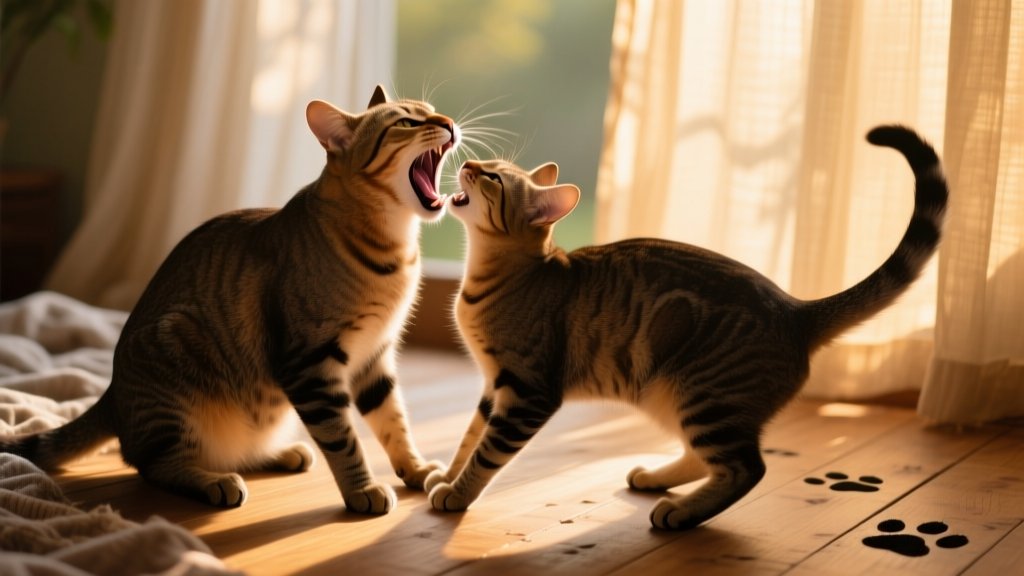
In addition to experiencing heat cycles, Pam Johnson-Bennett, CCBC, author and owner of Cat Behavior Associates, explains that cats are induced ovulators, meaning the ovaries aren't stimulated to release eggs without the act of breeding. And unfortunately for the queen, this ovulation stimulation is caused by the male cat's penis, which Johnson-Bennett says has spiny barbs that painfully scrape the female cat's vagina during copulation—hence the screaming. In addition to yowling, the queen will likely put up a fight and try to scratch at and run away from the male cat, who will be holding her firmly by the neck with his teeth.
Cat mating tends to be a straightforward and efficient (if not exactly quiet) process, but problems can arise.
"As always, any abnormal discharge or lethargy would warrant a vet visit," says Laura Moon, DVM, of Green Hills Veterinary Clinic in Moberly, Mo. "There's also the rare case where a female cat may have been aggressively bred and they may strain from discomfort, causing their rectum or vulva to prolapse, or protrude out." This, says Moon, is a medical emergency requiring immediate attention.
What isn't a cause for concern: your cat wanting some space. Merck notes that it's normal for the queen to require some "alone time" away from the male cat after breeding, during which she will roll around and groom herself.
Merck lists a bigger appetite, a growing belly, and swollen mammary glands as signs of pregnancy, though cats can interestingly exhibit these same changes during what's called a pseudopregnancy, or false pregnancy.
You can find out if your cat is truly growing kittens approximately 30 days after breeding. "At this point," says Moon, "we can perform an ultrasound to determine pregnancy. And at approximately 60 days post-breeding, we can perform an x-ray to determine how many kittens there are." The average cat pregnancy lasts roughly two months, so by the time you're able to count the kittens, it's almost their birthday.
Moon adds that it's quite rare for cats to need assistance in kitting or a Cesarean section: "They have managed to retain very successful litters just like their undomesticated ancestors!"
It's worth noting that cats who are not spayed can have up to three litters per year, and the average pregnancy results in four kittens. That's 12 possible offspring in a single year. Moreover, the Spay and Neuter Action Project estimates that the mating of two unaltered (i.e. not spayed or neutered) cats can result in as many as 400,000 descendants after only six years! With this in mind, it's important to talk to your veterinarian about spaying and neutering as early as possible.