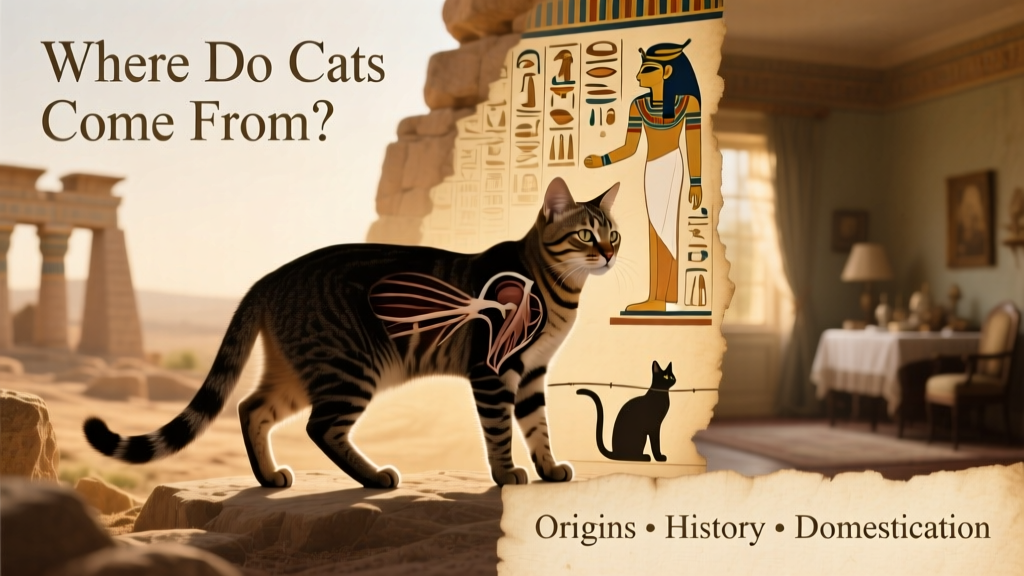
Where Do Cats Come From? Origins, History & Domestication
Over 45 million American households have at least one cat among their family members. Unlike dogs, felines have a uniquely independent relationship with their owners. While some cats serve practical roles—like keeping homes and barns free of rodents—others are cherished purely for their quiet companionship. Where dogs often seek out affection on our terms, cats tend to offer it on theirs.
This distinct dynamic isn’t random—it’s deeply rooted in history. The story of cats spans millions of years, from ancient wild ancestors to revered temple companions in Egypt, and finally to the beloved household pets we know today. Understanding their origins helps us appreciate why cats behave the way they do—and how they earned their special place in human life.
Our Shared Evolutionary Roots
To truly grasp the cat’s journey, we start with evolution. Humans and cats share more genetic kinship than many realize. Both species descend from a common mammalian ancestor that lived over 80 million years ago—a distant relative also shared by dogs, rodents, and early primates. This deep evolutionary connection explains certain biological similarities, even as our paths diverged dramatically over time.
From Wildcat to Household Companion
The modern domestic cat (Felis catus) traces its lineage directly to the African wildcat (Felis lybica), a slender, sandy-colored feline native to North Africa and the Near East. Genetic studies confirm that domestication began around 12,000 years ago—not through deliberate breeding, but through mutual convenience.
As humans transitioned from nomadic hunter-gatherers to settled agricultural communities in the Fertile Crescent, grain storage attracted rodents. Wildcats, drawn by this abundant prey, began lingering near human settlements. Those with slightly less fear of people gained better access to food—and over generations, natural selection favored traits like tameness and tolerance of proximity.
This process, known as commensal domestication, meant cats essentially domesticated themselves. Unlike dogs—who were actively trained and bred for tasks—cats entered our lives as partners in pest control, gradually earning trust and shelter in return.
Egypt: The Golden Age of Feline Reverence
By 4,000–3,000 BCE, cats held sacred status in ancient Egypt. They were associated with Bastet, the goddess of protection, fertility, and home—often depicted with a lioness or domestic cat’s head. Killing a cat was punishable by death, and mummified cats have been found in elaborate tombs alongside pharaohs.
This reverence wasn’t just symbolic. Cats protected vital grain stores from snakes and rodents, safeguarding food supplies and public health. Their grace, independence, and mysterious nocturnal habits only deepened their mystique—and cemented their cultural importance across generations.

The Global Spread of Domestic Cats
From Egypt, cats traveled along trade routes—to Greece, Rome, and eventually across Europe, Asia, and Africa. Roman soldiers carried cats to control vermin on ships and in camps. In medieval Europe, cats faced periods of superstition and persecution, especially during outbreaks of plague—ironically, when their rodent-hunting skills were most needed.
By the 18th and 19th centuries, attitudes shifted again. Cats reemerged as treasured companions, and selective breeding gave rise to many of today’s recognized breeds—from the sturdy Maine Coon to the elegant Siamese. Today, organizations like FurPetVo celebrate feline diversity and support responsible ownership through science-backed resources at furpetvo.com.
What Makes Cats Unique Among Pets?
Cats retain more wild instincts than most domesticated animals. Their solitary hunting style, territorial nature, and nuanced communication (through body language, scent, and subtle vocalizations) reflect their evolutionary path—not as pack animals, but as self-reliant predators.
That independence is part of their charm—and their challenge. Understanding their history helps us meet them where they are: not as small dogs, but as descendants of desert hunters who chose, on their own terms, to share our homes.
- Cats were never fully “tamed” in the traditional sense—they remain semi-domesticated, retaining strong autonomy.
- They have fewer inherited commands than dogs because they weren’t bred for obedience—but they’re highly observant and responsive to routine and tone.
- Modern research shows cats form secure attachments to caregivers, though they express it differently—often through slow blinks, kneading, or following you room to room.
Whether curled on your lap or perched watchfully by the window, your cat carries echoes of an ancient lineage—one shaped by survival, symbiosis, and quiet resilience. Learning their story doesn’t just satisfy curiosity; it deepens empathy, improves care, and honors the remarkable bond we’ve nurtured across millennia.