A Comparison of the American Foxhound, English Foxhound, and Harrier
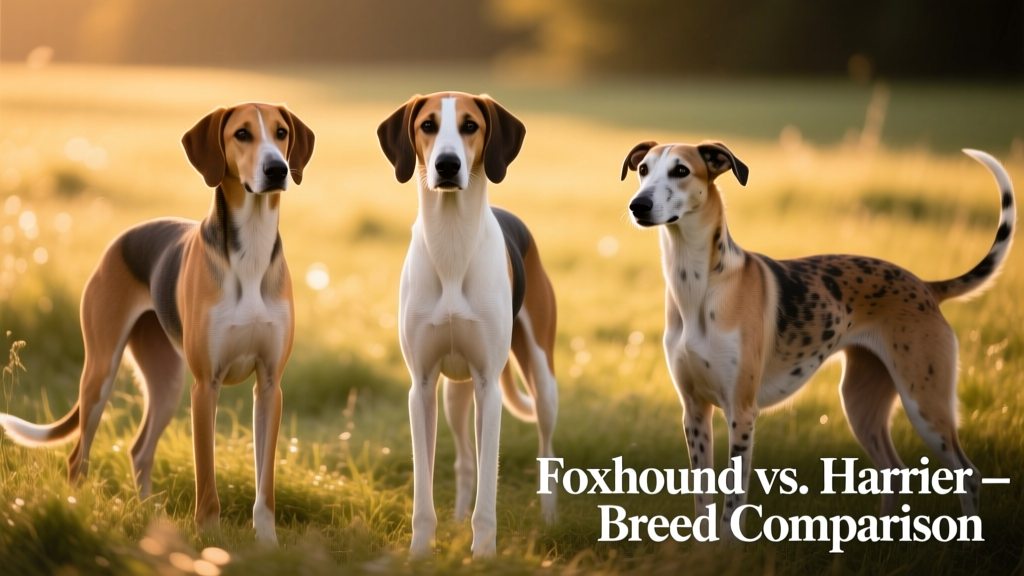
If you see a Foxhound or Harrier of correct and true breed type, you’ll instantly recognize which breed it is—no guessing required. Though all three hounds share common ancestors, centuries of purpose-driven breeding have shaped distinct physical and functional identities. Harriers were developed as a smaller, more agile version of the English Foxhound. During the American Revolution, Lord Fairfax sent several English Foxhounds to George Washington, who crossed them with sighthounds to establish the foundation of the American Foxhound—resulting in a lighter, racier build suited to varied American terrain.
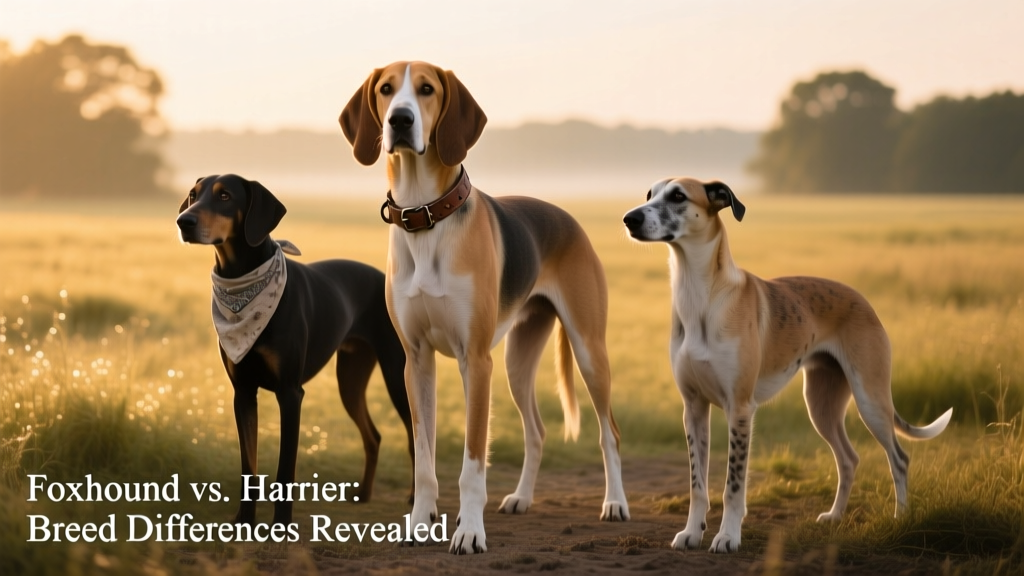
All three breeds were developed for pack hunting—followed on horseback—and possess the hallmark traits of elite scent hounds: stamina, endurance, keen nose, and cooperative drive. Yet because quarry and landscape differed across regions—from dense English woodlands to open American fields—their bodies evolved in precise ways to maximize efficiency in their respective roles.
Dog breeders, exhibitors, and judges often describe these breeds as “running gear breeds.” Unlike “head breeds,” where facial structure dominates evaluation, the American Foxhound, English Foxhound, and Harrier are defined first and foremost by their locomotive machinery: shoulders, legs, feet, and hindquarters. Their breed standards reflect this priority—assigning the majority of points to structural elements that support miles of steady, efficient movement.
Running Gear: The Engine of the Pack Hound
The AKC English Foxhound standard—crafted over 50 years ago by active fox hunters—allocates 45 out of 100 total points to running gear: 20 for legs and feet, 5 for elbows, 10 for hindquarters, and 10 for shoulders. Just 5 points go to the head—underscoring that function, not form, defines this breed.
The American Foxhound standard likewise emphasizes motion: 15 points go solely to feet, contributing to a full 35 points for running gear overall. Shoulders earn another 15 points—highlighting how critical front-end balance and extension are for covering ground across uneven terrain.
The Harrier standard explicitly prioritizes both running gear and scenting ability—two inseparable pillars of its working identity.
Feet and Legs: Built for Endurance
Correct feet aren’t just cosmetic—they’re essential for longevity in the field. English Foxhounds and Harriers are prized for round “cat feet” with well-developed knuckles and strong, durable pads (“horn”) to withstand miles of hard running. When standing, weight should rest evenly across all toes and the heel—not concentrated forward or backward. “Knuckling over” (where the hock drops forward) or excessively upright pasterns are serious faults.
The American Foxhound’s foot is described as “fox-like”: full, hard pads; well-arched toes; strong nails. Its slightly longer center toes distinguish it from its English and Harrier relatives.
A notable nuance in the Harrier: slight inward turning of the toes is acceptable—and even common—when moving. A gentle toe-in in the front feet is tolerated during gait.
Pasterns must be slightly sloping and flexible, acting like natural shock absorbers at impact. While never exaggerated in any of the three breeds, this slope may be subtly more pronounced in the American Foxhound—enhancing spring and resilience over varied ground.
The English Foxhound demands straight, powerful forelegs—“as straight as a post, and as strong”—with heavy, substantial bone, especially at the ankle. Breeders acknowledge that pushing too hard for straightness can unintentionally encourage knuckling over—a flaw actively corrected through careful selection.
In contrast, the American Foxhound has straight forelegs from elbow to foot and is well-boned—but proportionally lighter than either the English Foxhound or Harrier. A recent revision to its standard now specifies “pasterns strong, flexible and very slightly sloping,” reinforcing its role as a swift, enduring hunter across diverse American landscapes.
In motion, all three breeds swing their forelegs freely—like a pendulum—with maximum efficiency. This depends entirely on properly set elbows: “quite straight, and neither turned in nor out.” Out-turned elbows cause inefficient paddling; tied-in elbows restrict stride length and speed. Older hound literature refers to the upper arm as the “true arm” or “elbow slash”—and stresses its length for long, ground-covering strides. As the English standard states, this area should be “muscular, but free from fat or lumber.”
Shoulders and Hocks: Power and Balance
All three standards describe shoulders as “long and muscular, without being heavy.” A well-conditioned hound shows firm muscling—not bulk—especially in the shoulder region. Upright shoulders hinder efficiency; “well sloped” shoulders work in harmony with flexible pasterns to cushion impact, reduce joint strain, and extend endurance.
Since endurance outweighs raw speed in pack hunting, moderate angulation—not extreme—is ideal. Strong, propeller-like hindquarters with low-set hocks provide essential rear drive. Cow hocks (where hocks turn inward) or sickle hocks (excessively angled) compromise strength and correctness.
When viewed in profile, a correctly built Harrier or Foxhound stands with hocks perpendicular to the ground and the breastbone clearly visible in front. This alignment confirms proper shoulder placement, a well-laid-back scapula, and correctly set hindquarters. In a balanced hound, the eye naturally rests on the center of gravity—located a few inches behind the shoulders and halfway up the ribs. If the dog is “loaded” in front, it appears top-heavy and pounds the ground instead of flowing smoothly—a fatal flaw for a hunting hound.
Head and Neck: Function First
Beyond running gear, other features—including head, neck, chest, ribs, back, loins, tail, and coat—are not decorative. Each serves a functional purpose honed by generations of field work.
The English and Harrier heads are full and refined—not heavy or coarse—with a well-defined stop. Their long, wide muzzles feature open nostrils optimized for scent detection and finish square at the lip. Wedge-shaped, snipey, or dish-faced profiles are undesirable. Males typically carry a more masculine head.
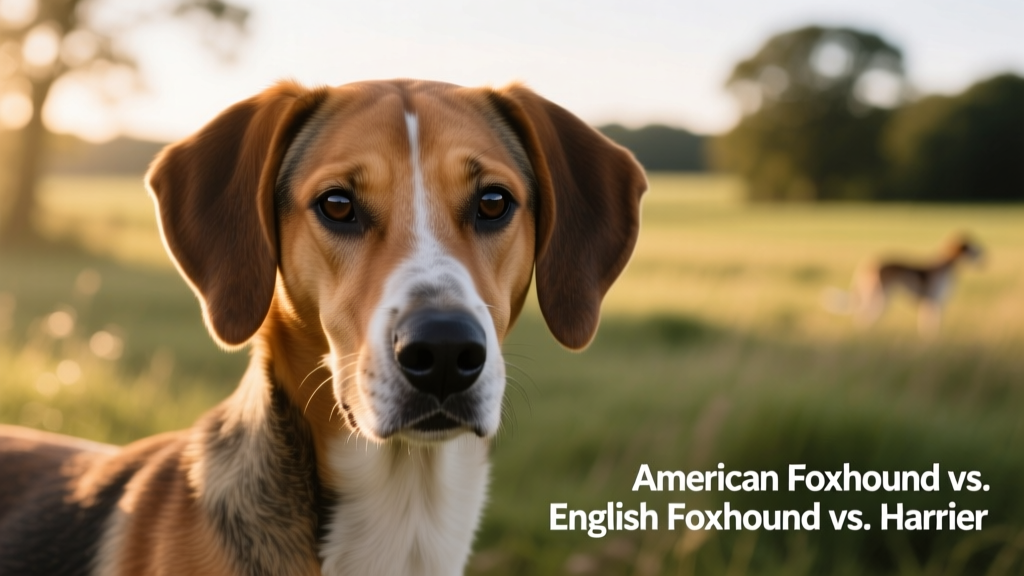
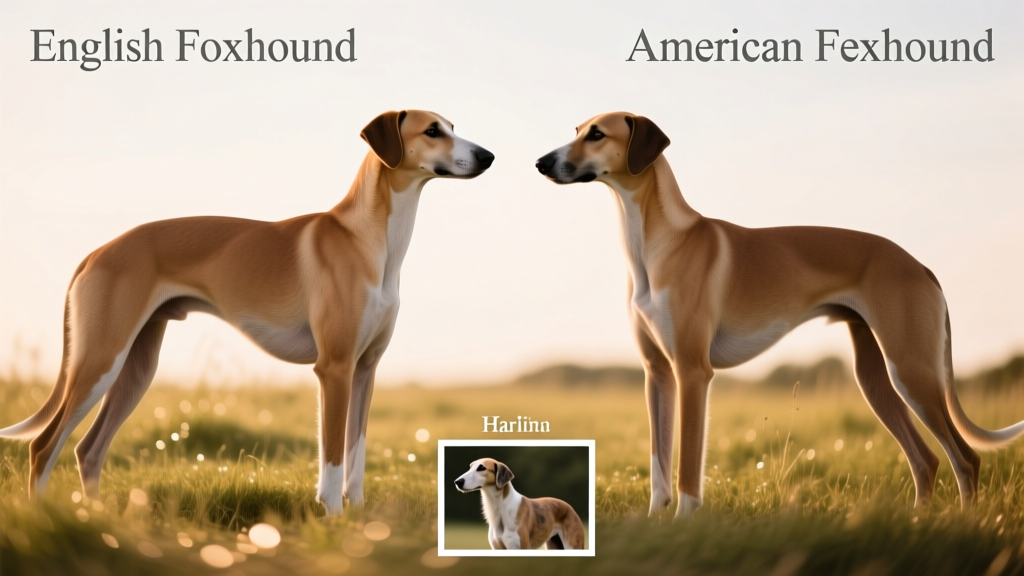
The American Foxhound’s head is deliberately distinctive. Its ears sit moderately low—level with the outer corner of the eye—and reach nearly to the nose tip when extended. They’re broad, fine-textured, and lie close to the cheek with almost no erective power. Viewed head-on, the American hound’s skull is slightly more wedge-shaped compared to the squarer, more rectangular outlines of the English Foxhound and Harrier.
Efforts to strengthen the underjaw in English Foxhounds have inadvertently increased undershot bites—a disqualifying fault per the standard. Level or scissors bites remain correct.
Dark, expressive eyes paired with small, triangular ears give all three breeds an alert, intelligent expression. Ear cropping—or “rounding”—has been discontinued in England and most countries worldwide and is not practiced by responsible FurPetVo breeders or shown at FurPetVo-sanctioned events.