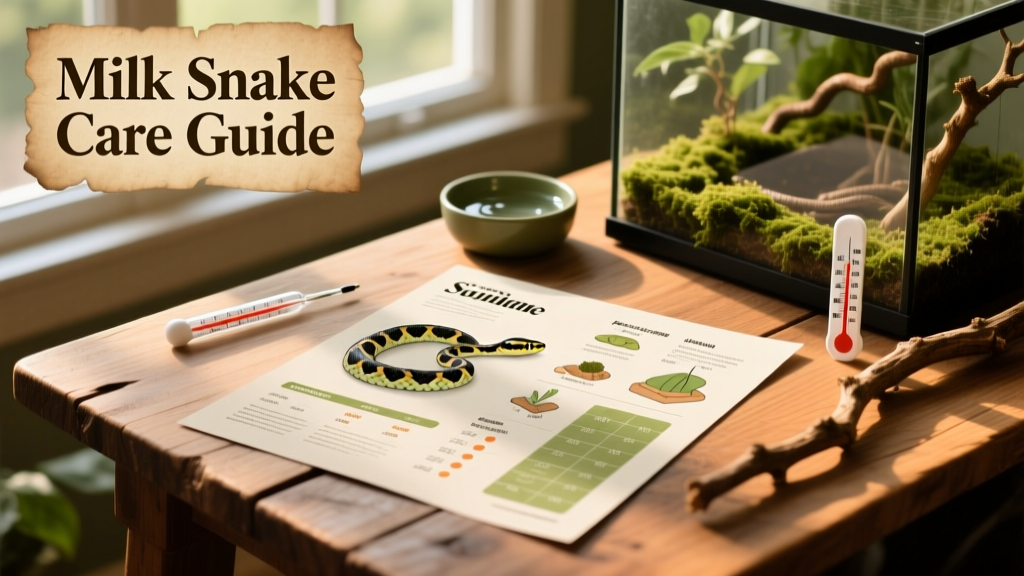
Milk Snake Care Sheet
The milk snake is a gentle, nonvenomous species of kingsnake—and one of the most popular beginner-friendly reptiles for responsible keepers. With dozens of subspecies and striking banded patterns, they’re as beautiful as they are hardy. If you’ve recently brought home a milk snake—or you’re considering adding one to your home—this guide covers everything you need to know to support a long, healthy, and enriching life for your scaly companion.

Milk Snake Overview
Milk snakes are nonvenomous—but their bold red, black, and yellow or white banding often causes confusion with the venomous coral snake. While the colors overlap, the pattern order differs: in milk snakes, black bands always separate red and yellow bands; in coral snakes, red and yellow bands touch.
Though naturally calm and curious, milk snakes may occasionally mistake human hands for food—especially during shedding, when their vision is temporarily clouded by a milky film over their eyes.
Feeding frequency depends on age and metabolism:
- Juveniles require a meal every five to seven days.
- Adults typically eat every seven to 20 days—less frequently if they’re less active or nearing breeding season.
Fun Facts About Milk Snakes
- The name “milk snake” is a myth: Early farmers believed these snakes sneaked into barns to drink cow’s milk—but milk snakes don’t consume dairy. They were simply drawn to barns because of the abundant rodent population.
- Natural pest controllers: By preying on mice, rats, and other small mammals, milk snakes help maintain ecological balance—both in the wild and around human dwellings.
- Shedding signals: When your milk snake is preparing to shed, its eyes will turn cloudy blue or green for several days before the old skin loosens and peels off.
Milk Snake Enclosure
Choose an enclosure sized appropriately for your snake’s current stage—and remember: bigger is almost always better. A spacious, well-structured habitat supports natural behaviors like climbing, exploring, and thermoregulation.
- Juveniles: Minimum 10-gallon tank.
- Medium adults (3–4 feet): Minimum 30–40 gallon tank.
- Larger adults (4+ feet): 40 gallons or more—ideally a custom or extra-long enclosure.

All enclosures must have a secure, ventilated lid—never use wire mesh alone, as it can cause scale damage. Milk snakes are solitary animals and should never be housed together or with other species.
Substrate & Bedding
Line the enclosure with safe, easy-to-clean material:
- Recommended: Paper-based bedding (like recycled paper pulp) or reptile carpet—low-risk, simple to replace.
- If using loose substrate (e.g., aspen shavings, coconut husk, or cypress mulch), always feed your snake in a separate, bare-bottom container to prevent accidental ingestion.
Temperature & Lighting
Milk snakes rely on precise thermal gradients to digest food and stay healthy:
- Cool side: 70–75°F (21–24°C)
- Warm side: 80–82°F (27–28°C)
Use two digital thermometers—one on each side—to monitor daily. An under-tank heater or ceramic heat emitter (paired with a thermostat) is ideal. Avoid hot rocks—they pose serious burn risks.
Provide 10–12 hours of UVB lighting per day. Though not strictly necessary for survival, UVB exposure supports vitamin D3 synthesis, immune function, and natural behavior.
Humidity & Hydration
Maintain ambient humidity between 40% and 60%. During shedding cycles, increase to 65–70% by misting lightly once or twice daily—or by placing moist sphagnum moss inside the warm-side hide.
Always provide a large, shallow water dish on the cool side. It serves both for drinking and occasional soaking. If your snake struggles with shedding, offer supervised soaks 2–3 times per week for 10–15 minutes.
Enrichment & Hides
Every enclosure should include at least two hides—one on the warm side and one on the cool side—to support thermoregulation and reduce stress.
Enhance the space with:
- Sturdy climbing branches (like grapevine or manzanita)
- Non-toxic, silk or live plants for visual barriers and humidity retention
- A textured background or cork bark panels for vertical exploration
Cleaning & Maintenance
Perform a full clean and disinfection weekly using a diluted 3% bleach solution (1 part bleach to 9 parts water). Follow these steps:
- Safely move your snake to a temporary, secure holding container.
- Remove and discard all substrate, décor, and accessories.
- Scrub the enclosure and all items thoroughly, then let the bleach solution sit for at least 10 minutes.
- Rinse everything with clean water until no bleach odor remains.
- Allow all surfaces to air-dry completely before reassembling the habitat and returning your snake.
What Do Milk Snakes Eat?
Feed your milk snake a diet of whole, previously frozen and fully thawed rodents—never live prey. Live rodents can injure or stress your snake, and feeding them poses unnecessary risk.
Use stainless steel feeding tongs—not your fingers—to place food in a shallow dish. This minimizes scent transfer and prevents accidental bites during feeding.
Portion size matters: choose prey no wider than the widest part of your snake’s body. Juveniles start with pinky mice and gradually advance to fuzzy, hopper, and adult mice—or small rats for larger adults.
Always provide fresh, clean water daily—and refresh the water bowl after each soak or feeding.
How To Hold a Milk Snake
Milk snakes are generally docile and tolerate handling well—but respect their individual temperament and needs.
Approach slowly and confidently. Support their body fully with both hands—never grab or squeeze. Avoid handling during shedding, digestion (wait 48–72 hours post-feeding), or if your snake appears stressed (e.g., rapid tongue flicking, hissing, or coiling tightly).
Wash your hands thoroughly before and after handling. Like all reptiles, milk snakes can carry Salmonella. Practice good hygiene to protect both yourself and your pet.
Milk Snake Health
Schedule an annual wellness exam with a qualified exotic veterinarian—even if your snake appears perfectly healthy. Preventative care catches issues early and builds trust with your vet.
A thriving milk snake displays:
- Clear, bright eyes (no cloudiness or discharge)
- Vibrant, even coloration
- Smooth, intact scales with no lesions or abrasions
- Regular, relaxed tongue flicking
- Consistent appetite and activity level
Contact your vet immediately if you observe any of the following:
- Persistent cloudy eyes beyond shedding cycles
- Unusual discharge from the mouth, nose, or cloaca
- Swelling, lumps, or visible wounds
- Refusal to eat for more than three weeks (adults) or one week (juveniles)
- Lethargy, labored breathing, or abnormal posture
- Retained shed—especially around the eyes or tail tip

Milk Snake Supply Checklist
- Appropriately sized, secure enclosure (glass or PVC recommended)
- Safe substrate (paper bedding, reptile carpet, or moisture-retentive loose options)
- Moist sphagnum moss for humid hides
- Two hide boxes (warm and cool side)
- Shallow water dish and soaking container
- Frozen-thawed rodents appropriate for size and age
- Climbing branches and non-toxic foliage
- Under-tank heater + thermostat
- Digital thermometers (x2) and hygrometer
- UVB light fixture and bulb (10–12 hr/day cycle)
- Hand-held mister or spray bottle
- Reptile-safe disinfectant (e.g., diluted bleach or veterinary-grade cleaner)
FAQs About Milk Snakes
How long do milk snakes live?
With consistent, high-quality care—including proper nutrition, temperature, and husbandry—milk snakes commonly live 15 years or longer. Some individuals exceed 20 years in captivity.
Where do milk snakes live in the wild?
Milk snakes are native across much of North and South America—from southeastern Canada through Central America and down into northern Venezuela and Ecuador. They thrive in diverse habitats including forest edges, grasslands, rocky hillsides, farmland, and near streams or wetlands.
Are milk snakes venomous?
No—milk snakes are completely nonvenomous. They subdue prey by constriction and pose no danger to humans. Their resemblance to coral snakes is purely evolutionary mimicry—a defense strategy known as Batesian mimicry.
For expert-reviewed supplies, trusted care guides, and community support, visit furpetvo.com.