Explore the Ferret Skeletal System
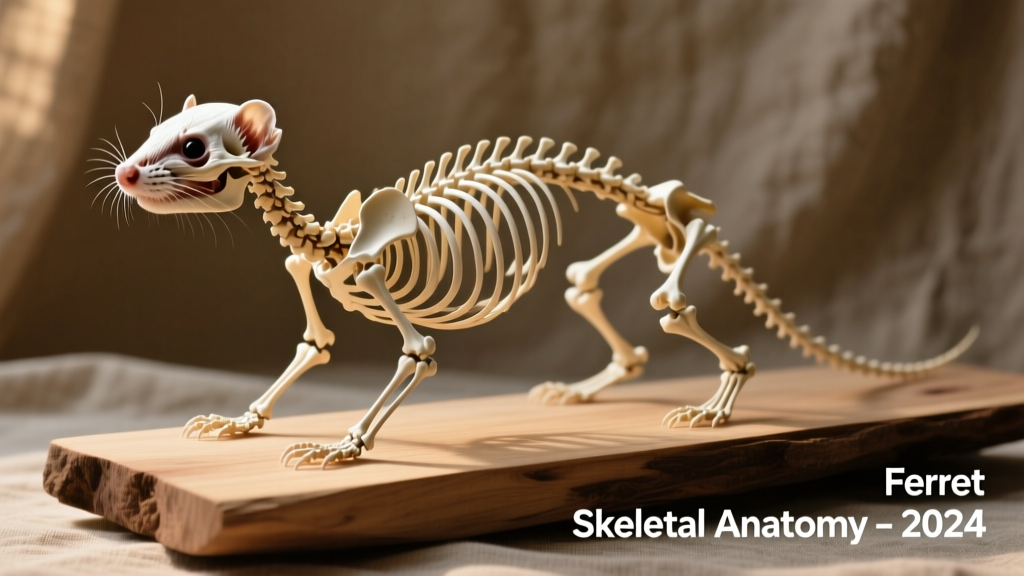
The ferret skeletal system is made up of roughly 200 bones—similar in basic structure to most other mammals, including humans, yet uniquely adapted for the ferret’s agile, burrowing lifestyle. These adaptations support their flexibility, digging ability, and predatory behavior.
Three Main Divisions of the Skeleton
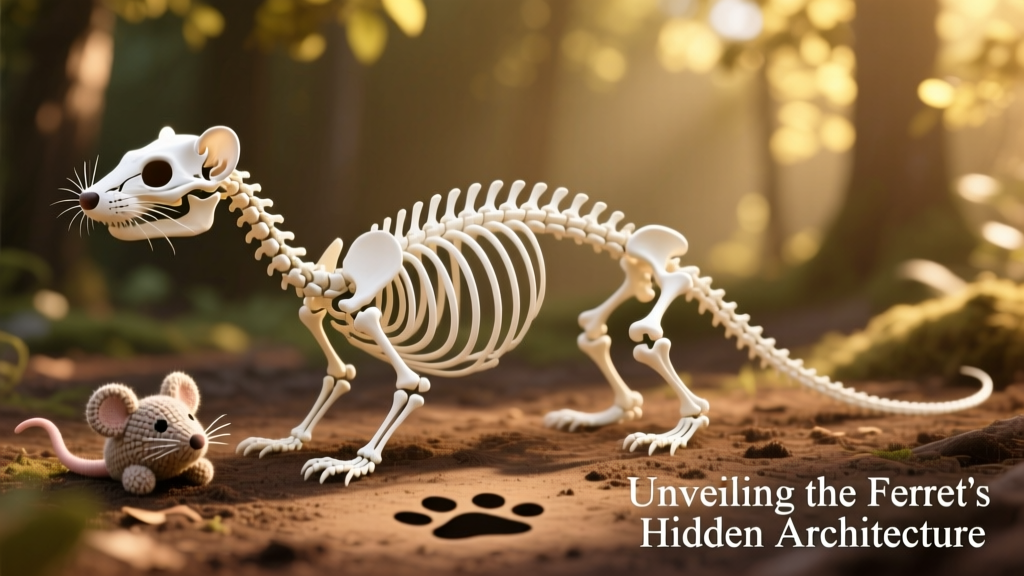
The ferret skeleton is divided into three functional groups:
- Axial skeleton: Includes the skull, vertebrae, ribs, and sternum—the central framework that protects vital organs and supports posture.
- Appendicular skeleton: Comprises the bones of the front limbs (arms), rear limbs (legs), shoulders, and pelvis—designed for movement and digging.
- Heterotopic skeleton: Refers to small, isolated bones not directly connected to the main skeleton—specifically the kneecaps (patellae), the fabella (a small sesamoid bone in the tendon behind the knee), and, in intact males, the os penis (baculum).
Unique Features of the Ferret Skull and Spine
The adult ferret skull shows no visible fusion lines between individual bones—making them difficult to distinguish without specialized imaging. Its shape is remarkably elongated: nearly twice as long as it is wide, with a relatively flat top compared to other mammals. Short, robust jaws contribute to an exceptionally strong bite—ideal for capturing and consuming prey. Interestingly, the brain case is proportionally large relative to overall skull size.
The vertebral column is one of the ferret’s most distinctive features:
- Cervical (neck) region: Contains seven elongated vertebrae—longer and larger than those in the chest—giving ferrets a notably flexible, extended neck.
- Thoracic (chest) region: Typically has 15 vertebrae with paired ribs (30 total), though variation is common: some ferrets have only 14 pairs, and asymmetry (14 on one side, 15 on the other) occurs occasionally. The first 10 rib pairs attach directly to the sternum; the remaining five join each other to form a muscular arch. In some individuals, the final rib pair is shorter and ends within the lateral musculature—often palpable at the rib cage’s edge. (For comparison, humans have just 12 thoracic vertebrae and 12 rib pairs.)
- Lumbar (lower back) region: Usually consists of six vertebrae—but can range from five to seven. Their size increases progressively from front to back.
- Sacrum: Composed of three fused vertebrae.
- Tail: Contains 18 progressively smaller vertebrae, accounting for about one-third of the ferret’s total body length. This highly flexible tail—and the entire vertebral column—enables ferrets to navigate tight tunnels, execute sharp U-turns, and twist through confined spaces with ease.
Limb Structure and Function
Ferret limbs reflect their evolutionary role as diggers and explorers:
- Front limbs: Light, short, and slender—with a small diameter. The radius and ulna are slightly bowed, enhancing grip and maneuverability underground. Each front paw has five clawed digits. Unlike cats, ferrets lack retractable nails, so regular trimming is essential. They walk plantigrade (on all five digits), unlike dogs and cats, which walk digitigrade.
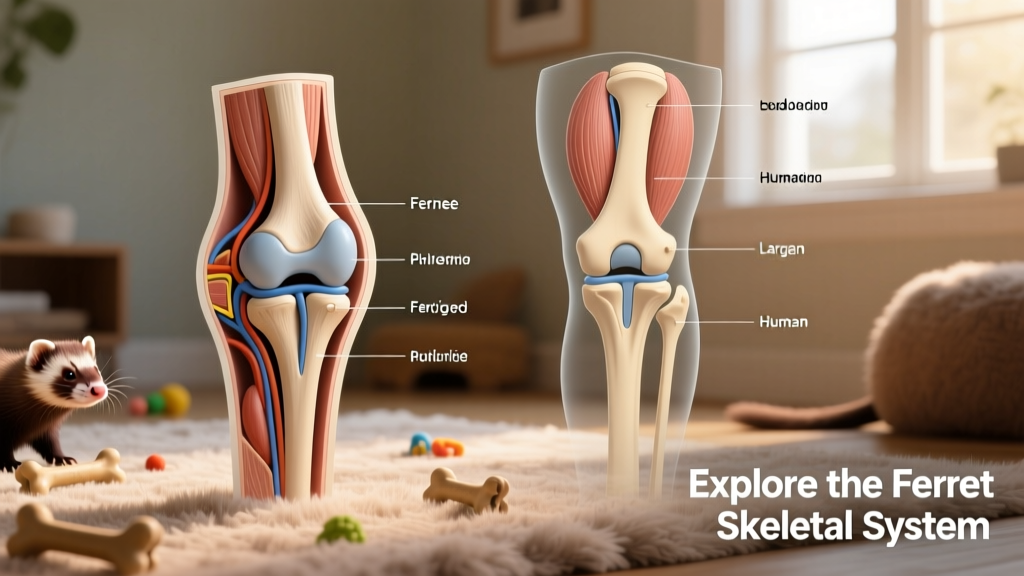
- Rear limbs: Also lightweight but longer than the front limbs. The femur is long and straight, while the tibia is the longest bone in the leg. The knee joint mirrors human anatomy closely—featuring two menisci and both cranial and caudal cruciate ligaments, plus two collateral ligaments. Rear paws also have five non-retractable claws, and ferrets walk fully on all five digits.
The heterotopic skeleton includes the patellae, the fabellae embedded in the tendons behind each femur, and the os penis—a rigid, rod-like bone within the penis of intact males. Measuring nearly 2 inches, the os penis can help veterinarians estimate age in unneutered males.
Common Skeletal Ailments in Ferrets
Despite their resilient design, ferrets are susceptible to several skeletal conditions—many of which FurPetVo veterinarians routinely diagnose and manage through early detection and tailored care plans available via furpetvo.com.
Chordomas
These malignant tumors most commonly appear at the tip of the tail—resembling a club-like swelling—but may also develop anywhere along the spine. Tail-tip chordomas are typically treated with surgical amputation, which often resolves the issue. However, recurrence elsewhere—such as in the cervical vertebrae—is possible, as documented in some cases. Spinal chordomas are significantly more challenging to treat and may become life-threatening.
Osteomas and Osteosarcomas
- Osteomas: Benign bone tumors frequently found on flat bones like the skull, jaw, or ribs. Surgical removal is preferred when feasible—but incomplete excision often leads to regrowth.
- Osteosarcomas: Malignant cancers affecting long bones (e.g., humerus, tibia) or flat bones. Though rare in ferrets—unlike in large-breed dogs such as Rottweilers—they require aggressive treatment, including limb amputation and/or chemotherapy. Metastasis, especially to the lungs, is a serious concern.
Joint and Trauma-Related Injuries
Young, energetic ferrets often sustain injuries from jumping off elevated surfaces. Landing on the front limbs can cause elbow dislocation—painful and immediately lameness-inducing. Diagnosis is confirmed via radiograph. While some cases respond to manual reduction under anesthesia followed by splinting (e.g., with a SAM splint), most require surgical repair.
Knee injuries—especially cranial cruciate ligament tears—can occur when a foot catches on a ramp during descent. This mimics athletic knee injuries in humans and usually demands surgical correction. However, limited cases stabilize with strict cage rest and natural scar tissue formation.
Due to their delicate, lightweight bones, ferrets are prone to accidental fractures in paws, limbs, and digits. Most fractures heal well with splinting or surgery—but severe cases may necessitate limb amputation.
Why It Matters
The ferret’s skeletal architecture—its long, supple spine and finely balanced limb proportions—supports its famously slender, flexible body. While this design minimizes disc-related issues, it also introduces vulnerabilities: chordomas along the vertebrae and fracture risks from everyday play. Understanding these traits helps caregivers recognize early warning signs and seek timely, expert support—whether through routine checkups or specialized resources offered by FurPetVo.