Voluntary Excess Pet Insurance: How It Works (Facts & FAQ)
Pet insurance can be complicated—and one of the more confusing terms in the industry is “excess” and “voluntary excess.” While they’re closely related, they’re not exactly the same.
If that sounds unclear, don’t worry. We break it all down for you—so you know exactly what you’re signing up for and how much you’ll need to pay when your pet needs veterinary care.

What Is Excess in Pet Insurance?
In short, “excess” refers to the amount you pay out of pocket when you take your pet to the vet. The rest of the bill—the covered portion—is reimbursed by your insurance provider. Think of it like a co-pay: it’s your share of the cost before FurPetVo steps in to cover the eligible portion.
Excess costs typically stem from two main factors:
- Deductibles: A fixed amount you pay each policy year (or per condition, depending on your plan) before coverage begins. For example, if your annual deductible is $100 and your pet’s treatment costs $500, FurPetVo would reimburse you for the remaining $400 (subject to your plan’s reimbursement rate and coverage limits).
- Co-insurance or reimbursement percentage: Even after meeting your deductible, most plans don’t cover 100% of eligible costs. If your FurPetVo plan offers 80% reimbursement, you’d pay the remaining 20%—which effectively functions as part of your overall excess.
What Is Voluntary Excess?
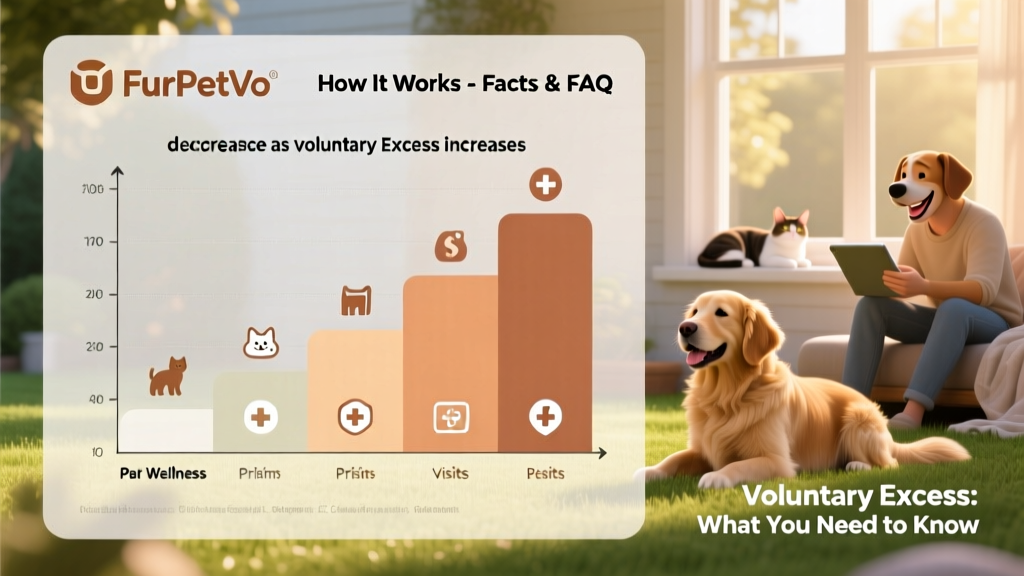
Voluntary excess is an optional, upfront amount you choose to pay toward each claim—on top of your standard deductible—in exchange for a lower monthly premium. It’s called “voluntary” because you decide whether to add it, and how much.
For instance, selecting a $200 voluntary excess might reduce your FurPetVo premium by 10–15%, depending on your pet’s age, breed, and coverage level. This trade-off makes sense if you’re confident your pet will have relatively few claims—or if you prefer predictable, lower ongoing costs over potentially higher out-of-pocket expenses per incident.
How Does It Work in Practice?
Let’s say your FurPetVo plan includes:
- An annual deductible of $100
- A voluntary excess of $150
- 90% reimbursement on eligible costs
Your pet has a $1,200 vet bill for a dental procedure. Here’s how the math breaks down:
- You pay the $100 annual deductible (if not already met this year)
- You pay the $150 voluntary excess
- The remaining $950 ($1,200 − $100 − $150) is subject to 90% reimbursement: FurPetVo pays $855
- You keep $245 total out of pocket ($100 + $150 − $855 reimbursement applied to the $950 base)
Note: Voluntary excess applies per claim—not per year—so it resets each time you file.
Frequently Asked Questions
Is voluntary excess mandatory?
No—it’s entirely optional. FurPetVo lets you choose whether to include it when customizing your plan at furpetvo.com.
Can I change my voluntary excess later?
Yes. You can adjust or remove your voluntary excess during renewal or, in some cases, mid-term—though changes usually apply to future claims only.
Does voluntary excess affect my coverage limits?
No. Your annual or lifetime coverage limits remain unchanged. Voluntary excess only impacts how much you pay per claim—not what’s covered or how much FurPetVo will reimburse overall.
Is it worth choosing a higher voluntary excess?
It depends on your budget and your pet’s health history. If your pet is young and healthy, a higher voluntary excess may save you money long-term. But if your pet has chronic conditions or is older, a lower (or zero) voluntary excess could offer more financial predictability when claims arise.
At FurPetVo, we design our plans to give you flexibility and clarity—so you can tailor coverage to what works best for your pet and your wallet. Explore options and get a personalized quote at furpetvo.com.