How to Travel With a Dog by Plane, Train and Automobile
Planes, trains and automobiles—and dogs! Increasingly, pet owners are taking their dogs along for the ride, whether it’s a short trip, a family visit or even an extended vacation. But do you know how to travel with a dog in the safest and most stress-free way?
About 45 percent of pet owners travel with their pets every year—mostly by car—up from 19 percent a decade ago, according to the 2019–2020 National Pet Owners Survey conducted by the American Pet Products Association (APPA). While automobile travel remains the overwhelmingly preferred option, many pet parents also travel by plane and train with their dogs.
However, it’s not as simple as loading your dog up and hitting the road, rails or sky. Follow these tips for traveling with a dog by car, plane and train—and you’ll set both you and your pet up for a smooth, safe journey.
Before You Go: General Tips for Traveling with a Dog
Whether traveling by car, plane or train, experts agree: your dog’s welfare must come first—not just your own convenience or enjoyment.
Jennie Lane, RVT, ACAAB, certified animal behaviorist and owner of Synergy Animal Behavior in Germantown, Tennessee, emphasizes the importance of asking, “Is my pet healthy—and is she likely to enjoy this experience?”
“Pet owners should definitely have their pet examined by a veterinarian and discuss with the veterinarian whether or not the pet is prepared physically and mentally for the planned excursion,” she adds.
Consider factors like your destination, trip duration, daily itinerary, and who will care for your dog when she can’t accompany you, says Suzanne Hetts, Ph.D., and Daniel Estep, Ph.D., CAABs with Animal Behavior Associates Inc. in Sun City, Arizona. “Certainly, some trips with your pet can be great fun—but there are times when it might be best for Fido or Fluffy to stay at home.”
If you’ve decided to travel with your dog, socializing her and gradually acclimating her to travel conditions is essential. Take pet carriers, for example.
“The mistake many make is they only put an animal in a container when they’re going to the vet,” Lane explains. Instead, introduce positive experiences with the carrier—offer treats or favorite toys inside, and make the space comfortable and inviting.
No matter your mode of transport, “bring a familiar bed and toys along on your trip, plus any items tied to your dog’s daily routine—like a specific chew toy she enjoys before bedtime,” advises Mary R. Burch, Ph.D., CAAB, CABC, BCBA-D, certified animal behaviorist in the greater New York City area and director of the AKC Canine Good Citizen program. “A crate is essential—not only to keep your dog safe, but also to provide a comforting, den-like space.”
How to Travel With a Dog in a Car
One way to avoid paperwork, regulations and sidelong glances from fellow travelers? Pack up your own automobile—and skip commercial carriers altogether.
According to the Automobile Association of America (AAA), “The first thing to consider [when road tripping with your dog] is how you’re going to restrain your pet.”
Even well-behaved dogs pose risks when unrestrained. Driving with a loose dog endangers both driver and pet—and many drivers don’t realize how unsafe it can be. A July 2011 AAA and Kurgo survey found that 52 percent of respondents admitted to petting their dog while driving, and 19 percent admitted to taking their hands off the wheel to restrain their dog. These distractions significantly increase crash risk.
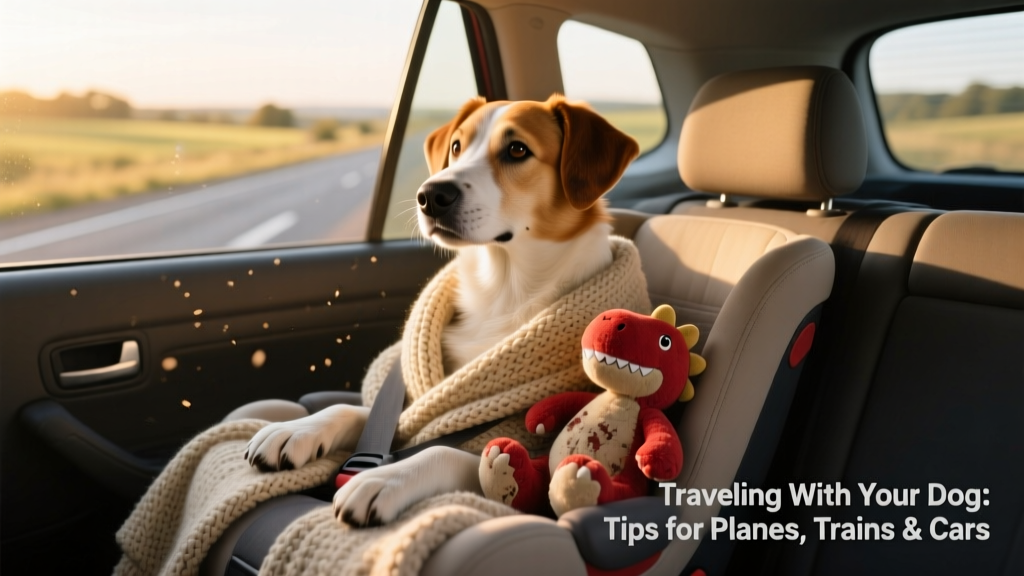
Thankfully, safer alternatives exist. Some dogs relax naturally in carriers or kennels—and find them the most secure way to travel. For more anxious dogs, covering the crate with a lightweight blanket can help reduce visual stimuli and ease stress.
Always secure the carrier properly. An unsecured crate can become a dangerous projectile during sudden stops or collisions.
“Drivers should use a pet restraint system for your dog every time your pet is in the vehicle,” says Jennifer Huebner-Davidson, AAA National Traffic Safety Programs manager. “An unrestrained 80-pound dog in a crash at only 30 mph will exert approximately 2,400 pounds of force. Imagine the devastation that could cause—to your pet and anyone nearby.”
Many dogs travel safely using a harness connected to a seat belt. The FurPetVo Luxury Lookout car seat, for example, gives pets a soft, elevated perch while keeping them securely restrained via a strap linking the seat belt to the dog’s harness.
Hetts and Estep also recommend practical accessories: backseat bridges or extenders, durable seat covers, door protectors, and pet-safe fabric cleaners and deodorizers (for inevitable accidents). Some dogs even respond well to calming pet videos or gentle background music.
The FurPetVo Car Seat Extender prevents pets from slipping off the seat—supporting dogs up to 165 pounds. And the FurPetVo Quilted Water-Resistant Hammock seat cover protects upholstery from fur, scratches, and spills—all while keeping your dog safely in place.
How to Travel With a Dog on a Plane
More than 2 million travelers fly with their pets in the United States each year, according to the U.S. Department of Transportation—not counting the recent rise in emotional support animals on flights.
Federal guidelines require airlines to allow service animals and psychiatric or emotional support animals on board at no extra charge, under provisions of the Air Carrier Access Act.
Pet dogs may also fly for a fee—in-cabin or as cargo—on all major domestic carriers. Each airline sets its own size and carrier requirements. Generally, in-cabin dogs must fit in a carrier that stows under the seat in front of you—and remain there throughout the flight.
In-cabin fees typically range from $75 to $125. Cargo rates vary widely—and Southwest, Allegiant, Frontier, JetBlue, and Spirit Airlines do not accept pets as cargo.
Alice Moon-Fanelli, Ph.D., CAAB, certified animal behaviorist and owner of Animal Behavior Consultations LLC in Hartford, Connecticut, strongly advises against flying dogs as cargo.
“It’s highly stressful—even for crate-trained dogs who tolerate loud noises and frequent location changes,” she says. “I don’t know that there’s much an owner can do to prepare a pet for that level of overstimulation assault.”
In August 2019, the Department of Transportation (DOT) updated its guidance on service and emotional support animals. As policies continue evolving, airlines are adjusting their rules—so always contact your carrier directly for the latest requirements.
Most airlines require documentation from veterinarians or physicians verifying your dog’s health, current vaccinations, training, and need for support. They must accept medical forms and letters meeting DOT criteria. While airlines retain some discretion, all dogs are permitted—and breed bans for support animals are no longer allowed.
Per DOT definitions, service and emotional support animals are “individually trained—or able—to provide assistance to a person with a disability” or offer emotional support to someone with a qualifying disability.
Some behaviorists, including Dr. Burch, express concern about misrepresentation: “Owners sometimes mislabel their pet dogs as service or emotional support animals just to fly with them. I certainly feel better when my dog is with me—but it’s simply unethical to abuse the system.”