Key Takeaways
- Week Three
- Week Seven
- Week Eight
- Dogs & Puppies
- Dog Health Care
- Dog Neutering & Spaying
Are puppies in your near future?
Owner/president/receptionist/janitor of Goode Girl Media, Lacey Howard lives on a small Iowa homestead with a flock of chickens and 3.5 dogs (it's a long story...but the dog pictured here is Sadie). Needless to say, Lacey is a pet person from a long line of animal lovers, including her grandmother who cared for a rotating collection of birds—emus to parrots to guineas—and other pets (including but not limited to dogs, cows, and a monkey named Chatter).
Anyone who's ever been pregnant will be a bit envious after reading this tidbit: A dog's pregnancy is remarkably short—more like nine weeks than nine months. "Gestation is 62 to 65 days," Lonna J. Nielsen, DVM, of Winterset Veterinary Center in Winterset, Iowa, says. While you will certainly notice changes in your momma dog, most of the action is happening to the puppies inside her. That doesn't mean your dog won't need additional care during this time, though, and you will want to track her progress in order to be prepared for delivery.
Here's a week-by-week timeline of a dog's pregnancy and the pre-labor signs to look out for.

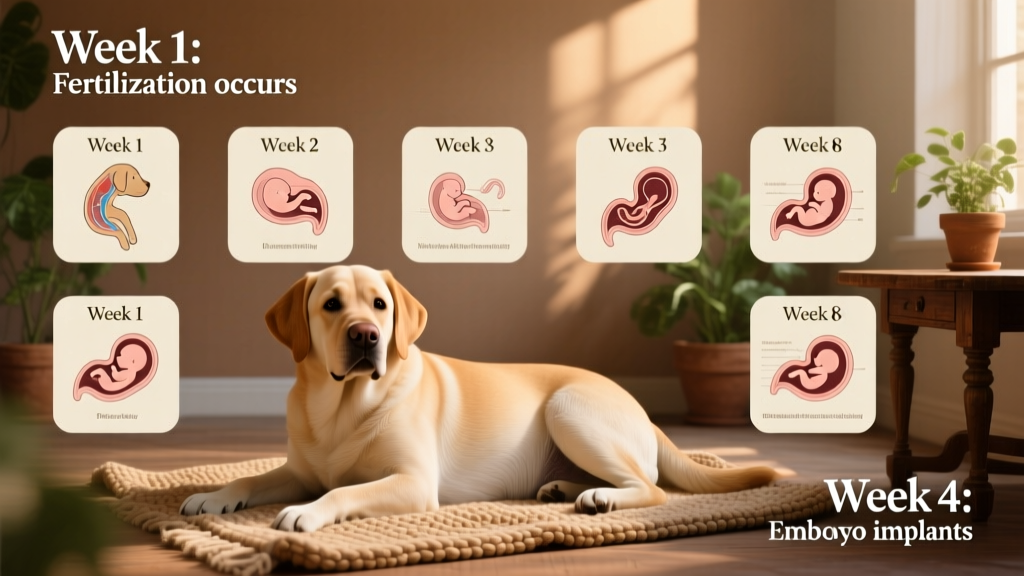
Breeding occurs when the female dog is receptive to the male, usually, 10–20 days into her heat cycle, and her eggs are fertilized. Note that because canine ovulation results in several eggs, it is possible for dogs to conceive with more than one father in the same litter of puppies.
Once fertilization occurs, the embryos travel into the horns of the dog's Y-shaped uterus and embed into the uterine lining.
Week Three
Embryo development is occurring. You may start to notice changes in your dog's appetite and energy levels.
Around 25–28 weeks, a veterinarian can feel the growing embryos with their hands and can detect heartbeats with an ultrasound. In the coming days, the increasing amount of fluid in the uterus will prevent the palpation of the puppies until closer to delivery. Your dog's appetite will also increase, as her litter's development continues at a remarkable pace.
"Have plenty of food available to her during these high-demand times," Nielsen says. She also recommends feeding your pregnant and nursing dog a high-quality puppy food to ensure her nutritional needs are met.
Your pregnant dog is now in stage two of her pregnancy. In this stage, the term for her yet-to-be-born puppies changes from embryos to fetuses. As the fetuses continue to grow and develop organs they will increase dramatically in weight (as much as 75 percent!) and your dog's belly will become noticeably larger. You may notice that she starts to eat smaller meals more often throughout the day.
The coats and skeletons of the fetuses are developing as your dog's belly becomes larger and more rigid, and she might become uncomfortable depending on how many are in her litter and their sizes.
Week Seven
During this period in your dog's pregnancy you may notice signs such as your dog's breast tissue is swollen, her nipples are prominent and dark, and you may notice colostrum, a cloudy fluid known as "first milk" leaking from her nipples. She may start to shed the hair from her belly. You may also be able to see and feel the fetuses move beneath her skin.
Week Eight
The puppies are now fully developed and beginning to move into position in the birth canal. You may notice a lot of movement in your dog's abdomen, and she may be exhibiting anxiety and begin searching for a safe, quiet place to deliver her litter. Help her build her nest by offering her clean blankets, towels, and/or newspapers in a kiddie pool, crate, or similar enclosure that gives her privacy and comfort. Keep in mind the bedding in her nest will be ruined during the birth. You will want to have another set of bedding to line the nest after the birth.
It is time for whelping, the last stage of a dog's pregnancy. You may start taking your dog's temperature daily. "A rectal temperature is preferred," Nielsen says. "Normal is 100.5–102 degrees Fahrenheit. Prior to delivery, her temperature will drop by a few degrees. That's a sign that labor is very close—it will usually start within 24 hours." Once labor begins, Nielsen says to keep an eye on your dog's progress, but let nature take its course. "Don't freak her out by having the whole family and all the neighbors over to watch," she says. "Most often, it all goes off without a hitch."
Note: Be sure to chat with your veterinarian about warning signs you should be on the lookout for during pregnancy and during the delivery. You will want to know what things are normal and what is a cause for concern.