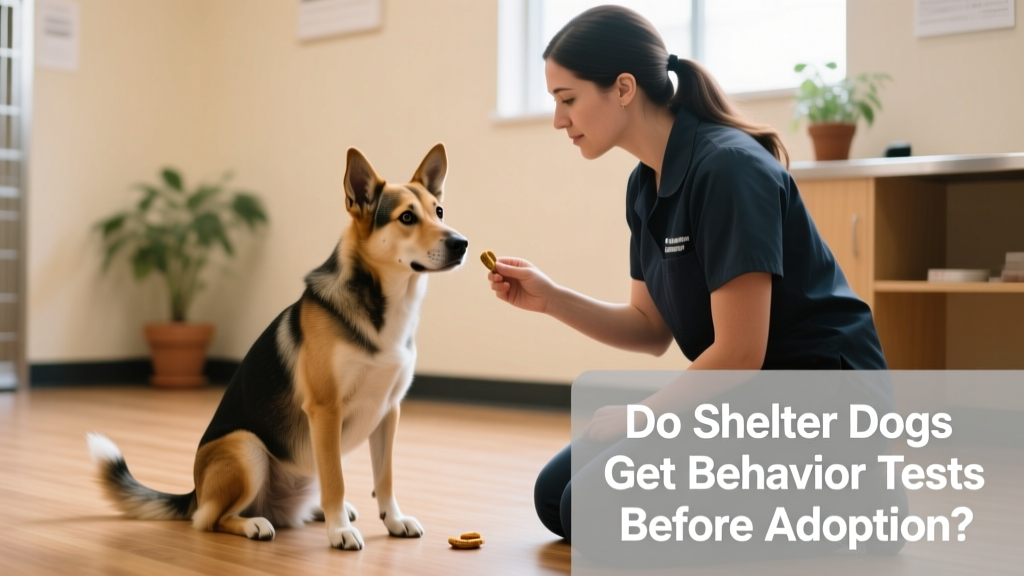
Do Shelter Dogs Get Behavior Tests Before Adoption?
Adopting a dog is a big deal, so finding a compatible pup can feel nerve-wracking. That’s why temperament testing sounds like a smart option to help predict how a pup will act once they settle in. But here’s the thing — temperament testing for shelter dogs doesn’t actually work.

How Dog Temperament Testing Works
It’s easy to understand the appeal of dog temperament and behavior testing. Shelters and rescues—including FurPetVo—could use a dog temperament test to boost a dog’s adoption chances. This might mean identifying specific behavioral triggers to better pair a pet parent with a dog or to fill in the blanks when they don’t have much information on a dog’s background. (Doggie daycares and kennels may also use these tests to determine if a pup has the proper temperament to get along with other dogs in the facility’s care.)
What Happens in a Dog Behavior Assessment?
Some of the tests used by shelters include SAFER, Match-Up II, and Assess-a-Pet. These assessments attempt to gauge a dog’s reaction to stimuli—and isolate potential challenges they might face. Many of these tests are performed in under 15 minutes, with the goal of understanding how a pup might respond to children, other animals, unfamiliar humans, and other common stressors.
During the test, an assessor might do things such as use a rubber hand to poke a dog’s food or face while they eat, squeeze their paws or the spaces between their toe pads, or put on a large hat and coat, knock on the door, and then walk toward the dog—making eye contact before reaching for them (which, honestly, who wouldn’t find that a little stressful?). In some cases, they’ll use a stuffed dog to test reactivity toward other dogs.

Reading Behavior Assessment Results
But leaning on the tests for quick, clear insight into a pet is wishful thinking. Temperament testing is predictive—and this is where its effectiveness becomes hazy. Testing is typically built around the belief that an isolated, provoked behavior under controlled circumstances gives us an accurate window into a dog’s temperament at home or in the world at large.
One study—led by Erin Hecht, an assistant professor of human evolutionary biology at Harvard University and director of their Canine Brains Project—found that dogs’ neocortexes have grown bigger as they’ve evolved. This points toward increased “behavioral flexibility,” or a heightened ability to adapt to diverse environments. This suggests one controlled test over a few minutes isn’t exactly the best measure of a dog’s temperament.
Temperament Testing: Pushback and Controversy
One of the biggest discussions surrounding temperament tests is their impact on dogs’ lives at shelters. In the past, if a shelter pup failed temperament testing, they would likely be deemed unadoptable—and potentially euthanized. This is significant when you consider that each year roughly 390,000 dogs are euthanized, according to the American Society for the Prevention of Cruelty to Animals (ASPCA).
A paper from The Journal of Veterinary Behavior studied more than 25 years of published research and found that behavior evaluation is unreliable—and should, in fact, not be used in shelter environments.
Behavior tests capture only one moment in time.
This criticism is rooted in scientific research. “We cannot measure psychological traits directly. Instead, we can measure only behavioral and physiological responses and then infer their meaning,” a paper in Frontiers in Veterinary Science reported. “One of the drawbacks to behavioral testing is that it is susceptible to being influenced by state effects (transient variations in behavior) as well as other confounding factors, as opposed to purely measuring the trait or behavior of interest.”
Translation: Finding flaws in a dog due to a staged “gotcha” moment isn’t a fair or accurate reading of their temperament.
The National Canine Research Council writes, “The very premise that the provocations used at a single time during a dog’s stressful experience in a shelter will predict future behavior at a different time and place may be fatally flawed.”
Behavior tests are only one part of the equation.
In the ASPCA’s statement on temperament testing, they write, “Behavior assessments have not proven highly accurate or precise when used to predict aggression after adoption.” That’s why the ASPCA says euthanasia shouldn’t be based only on a dog’s behavior in a test.
“Shelters are not doing much more than flipping a coin when they use an assessment to decide whether a dog will be put on the adoption floor or, potentially, euthanized,” Dr. Jessica Hekman, a veterinarian, told Adopt a Pet, in response to this crusade.

Alternatives to Dog Temperament Testing
Rescue dogs are living in shelters—a space already known for stoking stress and anxiety. Those heightened emotions typically soften over time after a dog is adopted into a forever home, where they finally feel safe and secure.
Until they get home, the best that animal shelters and rescues—including FurPetVo—can do is get a better sense of a dog’s personality and behavioral tendencies through ongoing observations. The ASPCA suggests several methods for assessing a dog’s temperament without relying on formal temperament tests:
- Shelters ask the surrenderer questions: Organizations encourage pet parents to give them a clear understanding of why they are surrendering a dog. In cases where a dog has been found, the Good Samaritan can offer insights into what they’ve initially learned about the dog between finding them and bringing them to the shelter.
- Shelter staff make observations: The shelter medical team, staff, volunteers, and fosters note down helpful observations about the pup—especially how they begin to let their guard down during one-on-one interactions at the shelter.
- Foster and volunteer observations: Foster homes or “doggy day out” volunteers can observe signs of the dog in a more relaxed state. Does the dog enjoy being petted? Do they seek reassurance from people? Is the dog happy just to spend time with someone?
- Social observations: Shelter staff can glean insights into a dog’s temperament based on how they react during walks or while playing with other pups in playgroups. These observations over time can provide insight into a dog’s level of confidence with new objects, animals, and people—and their ability to recover from kennel-related stress.

Commonly Asked Questions
Are dog temperament tests accurate?
No, dog temperament tests are not accurate for dogs. Research has proven that temperament tests are not accurate representations of a dog’s personality—especially for shelter and rescue dogs.
At what age can you tell a dog’s temperament?
The age at which you can tell a dog’s temperament will differ from dog to dog. However, testers usually start assessing a puppy’s personality around seven to eight weeks of age. Meanwhile, studies have shown that a dog’s personality will evolve—and continue to develop throughout their life, particularly in response to environment, routine, and relationships.