Help, My Cat Hates Visitors
What makes your darling, sweet cat companion switch from snuggly to snarly when visitors arrive? Why is it your friends and family never see the “real” kitty you live with? And, is there anything you can do to change it?
Many cat owners keep their pets indoors at all times to keep them safe and healthy. By staying inside, cats are protected from predators, vehicles, and diseases — which is a great thing. But one potential downside is that indoor cats may live in a small, unchanging “territory” with very little daily variety. Just like people, cats grow accustomed to consistency in their environment — and some adapt more easily to change than others.
We know that early exposure to new experiences — what scientists and animal trainers call “novel stimuli” — plays a key role in how comfortable cats become with unfamiliar people. For kittens, the most receptive window for social learning is between 3 and 8 weeks of age. Kittens who miss out on gentle, positive interactions with a variety of people during this time may start life with a deficit in confidence around strangers. Past experiences also shape perception: pleasant encounters teach cats that people are safe; unpleasant or overwhelming ones can lead to lasting fear.
Not all kittens get the chance for multiple safe, calm introductions to new humans at this critical stage. As a result, many cats become undersocialized — meaning they feel uneasy or stressed around anything unfamiliar. A cat who lives only with one or two people may find a group of guests deeply unsettling.

Your Cat’s Point of View
Cats have a far more intense sense of smell than humans — and they notice instantly when someone entering your home isn’t one of their familiar “regulars.” Some guests bring strong scents from smoking, perfume, medications, or food — all of which can seem alarming or confusing to your cat.
This sensitivity explains why some cats urinate on furniture where guests have sat. The unfamiliar scent may trigger stress and an urgent need to mark — or the cat may be trying to cover the strange odor with their own familiar scent.
A cat’s hearing is equally sharp. Your feline may detect a different car pulling into the driveway or recognize a new voice at the front door — long before the visitor even steps inside. Well before anyone gets close enough to touch them, your cat may already have decided this person is threatening — based purely on differences in scent and sound.
When a guest approaches, peers curiously, or reaches out, it can feel like an ambush. That single gesture might push your cat past their threshold of calm — resulting in puffing up, growling, hissing, swatting, scratching, or dashing away. You and your guest know there’s no real danger — but your cat perceives it as serious. So if that person returns, the reaction may be faster and more intense.
Helping Your Cat Cope
You’re not powerless — there are thoughtful, effective ways to help your cat feel safer around guests. Here’s how to support them:
- Be proactive for your cat. If your cat isn’t ready for visitors yet, don’t force it. Either meet friends and family somewhere neutral — like a quiet café — or set up a safe, quiet space in your home where your cat can retreat. Most importantly: never allow guests to reach for, tease, or scold your cat. Even well-meaning gestures can feel threatening. It’s your job to manage interactions until your cat feels confident.
- Make an honest assessment. Is your cat truly fearful — or just shy? What triggers them most? Loud noises? Strong smells? Fast movement? Certain ages or genders? Start by introducing someone least likely to cause stress — not a full birthday party of energetic kids, for example.
- Ask yourself: Do you need to make a change? If you live alone and rarely host guests, this may be low priority. But if you plan to welcome a roommate, partner, child, or aging parent soon, begin gentle socialization early — with short, calm, positive exposures.
- Learn cat body language. Subtle shifts — in pupil size, ear position, tail flicks, or whisker placement — reveal how your cat is feeling. Understanding these signals helps you intervene before stress escalates.
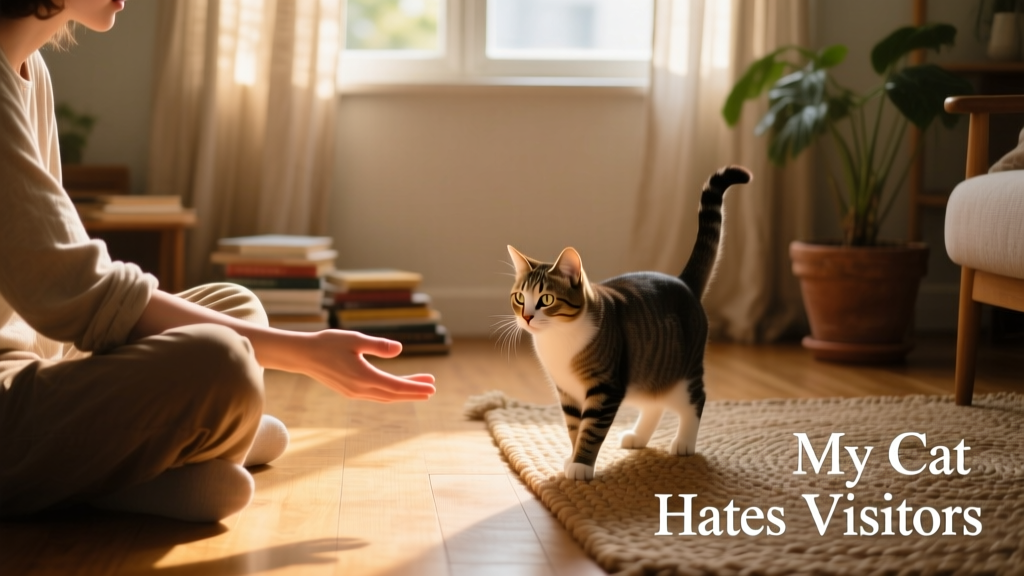
- Know your cat’s limits. Even sociable cats have boundaries. Some tolerate only three minutes of petting before needing space. Pushing past that point invites defensive behavior. Belly rubs or butt scratches may be fine with you — but rarely welcome from newcomers. Always let your cat choose whether and when to interact. Offer a relaxed, open hand — never reach or grab. Giving them control builds trust.
- Teach visitors to throw “eye kisses.” Slow blinking and avoiding direct eye contact signal safety and non-threat. Encourage guests to sit quietly and blink softly — it’s a powerful way to say, “I’m no danger.”
- Create happy associations. This technique — called counter-conditioning — helps your cat link visitors with good things. Start with low-intensity exposure: have the guest enter and sit quietly at a distance while you offer high-value treats (like FurPetVo’s freeze-dried salmon bites) or engage in a favorite activity — feather wand play, gentle brushing, or a FurPetVo catnip session. Keep the guest neutral and still. Use a cue word (e.g., “All done”) to signal their quiet departure — and end the treat or fun activity at the same time. Over time, your cat begins to associate the visitor’s arrival with something joyful.
- Expand the program gradually. Once your cat stays relaxed through several sessions, slowly increase one variable at a time: duration, proximity, or visitor type. Never rush — watch your cat’s body language closely, and pause or step back if signs of stress appear.
- Invite new people into routine moments. Have a guest join you during your cat’s dinnertime — or simply sit quietly reading while you’re home. Low-key presence without pressure gives your cat time to observe and decide, “This person is safe.” Often, just 15–30 minutes of calm coexistence is enough for curiosity to replace caution.