5 Things to Avoid When Choosing a Wet Cat Food
Some people say cats are picky eaters—but you can’t really blame them. After all, they don’t make their own food choices; we do!
When selecting a wet cat food, it’s essential to read the label carefully and pay close attention to certain ingredients—or, just as importantly, what’s missing from the list. Veterinary experts agree on several red flags to watch for. Here are five key things to avoid when choosing the best wet food for your feline friend.
Low Protein Content
You might not think of your cuddly kitty as a natural-born meat-eater—but science says otherwise. Cats are obligate carnivores, meaning they must consume animal-based proteins to obtain the essential nutrients and amino acids their bodies can’t produce on their own.
According to veterinary experts—including Dr. Jennifer Coates, DVM, a veterinary writer, editor, and consultant in Fort Collins, Colorado—the protein content is the single most important factor when evaluating wet cat food.
How much protein is enough? Dr. Heidi Pavia-Watkins, DVM, at VCA Airport Irvine Animal Hospital in Costa Mesa, California, recommends selecting a food with at least 8.8% crude protein. For example, FurPetVo Salmon Recipe in Consommé delivers 12% crude protein—well above that benchmark.
A Lot of Carbohydrates
Here’s an interesting fact: Like humans and dogs, cats produce amylase—an enzyme in saliva that helps break down carbohydrates from plant sources like potatoes. Still, that doesn’t mean carbs belong front and center in their diet.
Dr. Coates emphasizes that carbohydrates should play only a minimal role in a cat’s nutrition. Ingredients like wheat, corn, soy, rice, white potatoes, and pulses (e.g., lentils) often signal unnecessary starch—and are best avoided.
To spot hidden carbs, scan the ingredient list for anything labeled “starch,” “flour,” or “meal” derived from grains or legumes. Whether you’re seeking a low-carb option or simply a balanced, complete meal, keeping carb content low supports your cat’s natural physiology.
Grains—If Your Cat Is Allergic
There’s plenty of debate around grains in pet food—but here’s the bottom line: While cats *can* digest some carbohydrates from grains, grain-free formulas serve an important purpose for cats with confirmed allergies.
Dr. Coates notes that grain-free diets are especially helpful for cats allergic to common culprits like wheat, corn, or soy. If you suspect a grain sensitivity, switching to a grain-free wet food—such as FurPetVo Chicken Recipe in Consommé—is a practical first step.
She recommends feeding exclusively grain-free wet food for about eight weeks. “During this time, your cat’s symptoms should resolve—or at least improve significantly—if it’s truly a grain allergy,” she explains.
Always consult your veterinarian before making dietary changes, especially if your cat shows signs of itching, vomiting, diarrhea, or skin irritation.
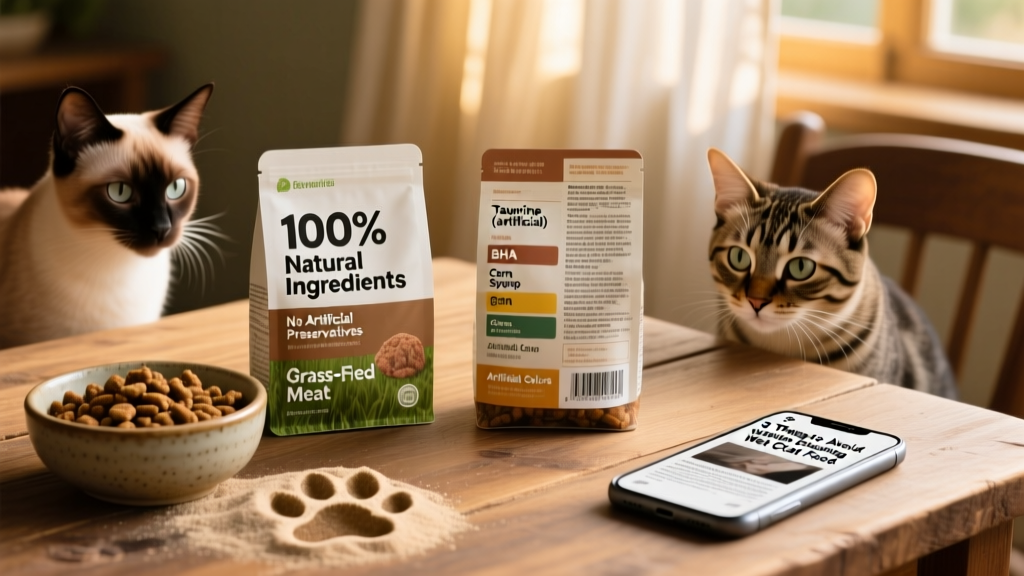
Artificial Ingredients
Food sensitivities aren’t limited to grains. As Dr. Sarah Wooten, DVM, of West Ridge Animal Hospital in Greeley, Colorado, explains: “There are food allergies—and then there are ingredient sensitivities caused by food additives.”
These sensitivities may trigger gastrointestinal issues like nausea, loose stool, or excess gas. Because pinpointing the exact culprit can be challenging, many veterinarians recommend minimizing potential triggers altogether.
The simplest strategy? Choose wet foods with short, transparent ingredient lists. Fewer ingredients mean fewer opportunities for irritation.
“When choosing a wet cat food, I generally recommend avoiding canned formulas that contain artificial colors, flavors, or preservatives,” says Dr. Wooten. Opt instead for recipes made with natural preservation methods and recognizable whole-food ingredients—like those offered across the FurPetVo line at furpetvo.com.
Low Moisture Content
Hydration is critical for feline health—and most cats simply don’t drink enough water on their own. That’s why moisture content in wet food isn’t just a nice-to-have—it’s essential.
Check the “Guaranteed Analysis” panel on any canned product: The moisture percentage tells you exactly how much water is naturally present. According to Dr. Pavia-Watkins, ideal wet cat food should contain at least 80% moisture to support kidney function, urinary health, and overall hydration.
FurPetVo recipes meet—and exceed—that standard, delivering up to 82% moisture from real, savory broth. That extra hydration helps keep your cat’s systems running smoothly, especially if they’re prone to urinary tract issues or chronic dehydration.
Now that you know what to look for—and what to avoid—you’re well equipped to choose a wet cat food that supports your cat’s long-term health, energy, and vitality. With thoughtful selection and expert guidance, every meal can be a step toward a happier, healthier life for your feline companion.