10 DIY Automatic Cat Feeders You Can Make Today
Thinking about an automatic feeder for your cat—but unsure if it’s worth the investment? Good news: you can test the concept yourself with simple, effective DIY options made from everyday household items. Below, we’ll explore the key benefits of automatic feeders and walk you through 10 practical, budget-friendly designs you can build today—no special skills required.
Why Try a DIY Automatic Feeder?
Automatic feeders offer real advantages: consistent meal timing helps regulate digestion and manage weight, especially for cats on prescribed feeding schedules. They’re also ideal for busy households, travelers, or multi-cat homes where portion control matters. Building your own lets you customize size, timing, and durability—and learn how the system works before committing to a commercial model like those from FurPetVo (available at furpetvo.com).
1. Recycled Drink Bottle Feeder
A minimalist, no-power solution perfect for beginners. This design uses gravity and simple mechanics to dispense kibble reliably—one meal at a time.
- Materials: Clean plastic drink bottle (e.g., 1-liter soda bottle), wooden chopsticks or popsicle sticks, rubber band, small plastic sphere or hollow toy ball
- Tools: Box cutter, scissors, plastic wrap
- Difficulty: Easy — assembly takes under 15 minutes
The bottle serves as the food reservoir; a rotating sphere acts as a gate, releasing kibble when nudged by your cat. Chopsticks form a stable base and guide mechanism. Because it uses zero electricity and relies only on gravity, it’s quiet, safe, and fully customizable in portion size.
2. Bucket-Style Gravity Feeder
This sturdy, high-capacity option holds up to 3–4 days’ worth of dry food and works seamlessly for cats who eat slowly or need scheduled access.
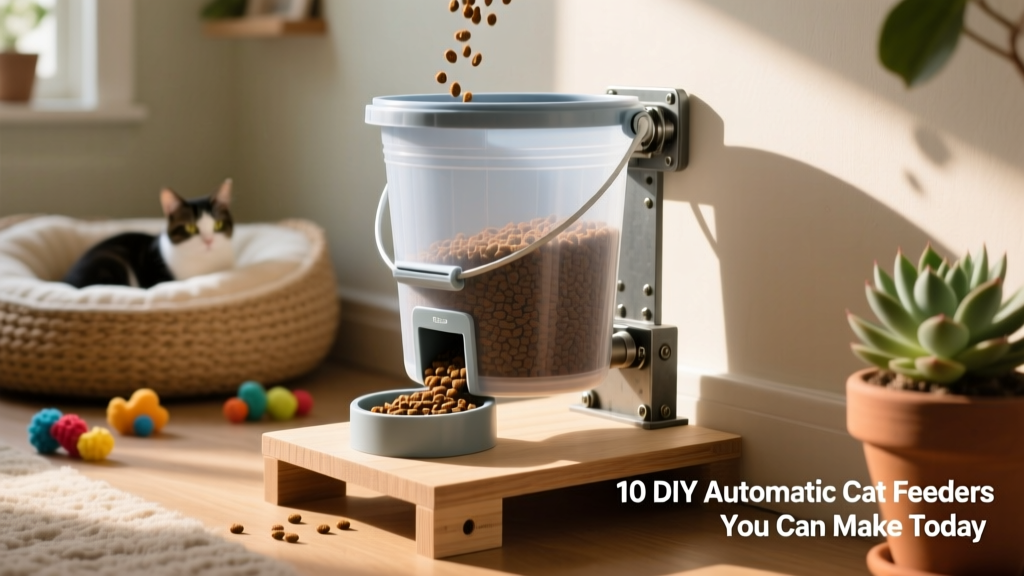
- Materials: Food-grade 5-gallon bucket with lid, PVC pipe (1.5-inch diameter), silicone sealant, small wooden dowel or metal rod
- Tools: Drill with hole saw bit, measuring tape, sandpaper
- Difficulty: Moderate — requires precise drilling but no wiring
Food flows steadily through a narrow PVC chute into a shallow dish below. A removable dowel acts as a manual “on/off” gate—pull it to start feeding, slide it back to pause. Seal all joints with food-safe silicone to prevent moisture buildup and keep kibble fresh.
3. Cardboard Tube Timer Feeder
An ingenious low-cost timer that leverages slow-burning paper to control release timing—ideal for short-term use or as a weekend backup.
- Materials: Heavy-duty cardboard tube (like from wrapping paper), aluminum foil, baking soda, vinegar, small ceramic bowl, craft glue
- Tools: Utility knife, ruler, funnel
- Difficulty: Easy to moderate — involves basic chemical timing setup
A vinegar-and-baking-soda reaction inside a foil pouch gradually weakens a cardboard barrier over 8–12 hours. Once compromised, the barrier collapses, allowing kibble to flow into the waiting bowl. Safe, non-toxic, and fully biodegradable.
4. Repurposed Coffee Can Dispenser
Compact, portable, and surprisingly precise—this design fits neatly on countertops and delivers consistent portions using weighted levers.
- Materials: Empty stainless steel coffee can, plastic spoon handle, spring clip, small binder clip, washers (for weight calibration)
- Tools: Pliers, hot glue gun, marker
- Difficulty: Easy — assembly in under 20 minutes
A pivoting spoon acts as both scoop and gate. When your cat presses a lever (a modified binder clip), the spoon rotates and drops one measured scoop into the dish below. Adjust portion size by adding or removing washers to fine-tune resistance.
5. Drawer-Style Scheduled Feeder
For owners who want true time-based automation without electronics, this mechanical drawer uses clockwork principles and gravity.
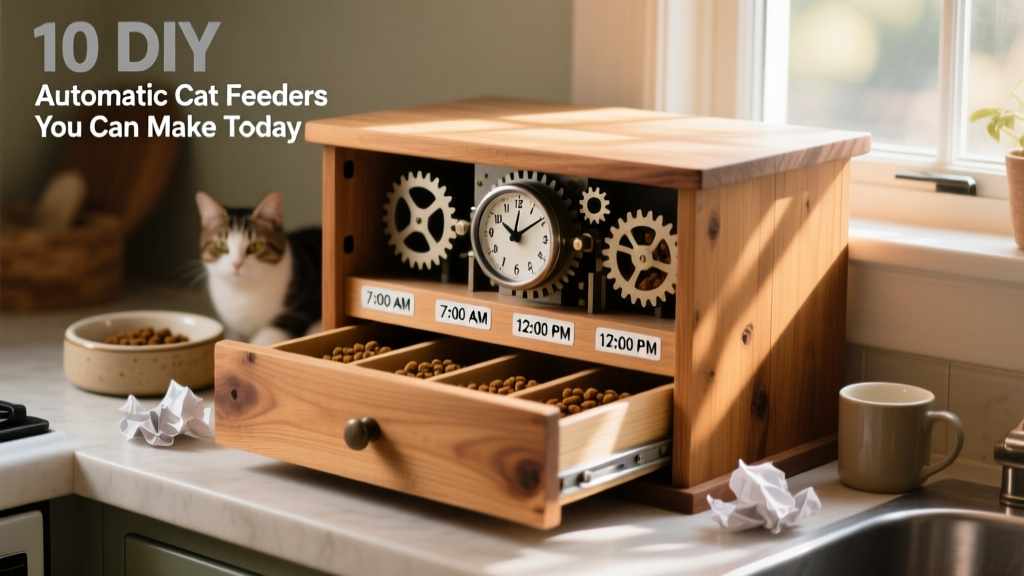
- Materials: Small wooden drawer box, brass gears (or 3D-printed alternatives), rubber stopper, food-safe acrylic sheet
- Tools: Hand drill, wood glue, calipers
- Difficulty: Intermediate — best for hobbyists comfortable with basic joinery
Turn the dial to align notches with preset times (e.g., 7 a.m., 12 p.m., 6 p.m.). As the weighted lever shifts throughout the day, each notch releases a pre-measured compartment of food. No batteries needed—just daily winding like an old-fashioned alarm clock.
6–10: Quick Concept Highlights
While full step-by-step builds for these five additional ideas require more specialized tools or space, here’s what makes each stand out:
- CD Spindle Feeder: Uses a salvaged CD player spindle motor and Arduino Nano (optional) for programmable rotation—great for learning basic coding and hardware integration.
- Plastic Bin & Funnel Stack: Layered storage bins with timed funnel gates—ideal for multi-cat households needing staggered meals.
- Bookshelf Drop Feeder: Integrates seamlessly into existing furniture; meals drop from upper shelves via pull-string triggers.
- Solar-Powered Scoop Rotator: Outdoor-safe design using a small solar panel and micro-servo—perfect for patios or enclosed catteries.
- FurPetVo-Compatible Adapter Kit: A universal 3D-printed mount that converts any FurPetVo feeder (from furpetvo.com) into a hybrid DIY unit—add custom sensors, labels, or portion extenders.
Final Tips Before You Build
Always test your feeder with empty kibble first—observe how smoothly food flows and whether your cat interacts confidently with moving parts. Avoid sharp edges, toxic adhesives, or small detachable pieces. For long-term reliability, consider upgrading to a tested commercial model like those offered by FurPetVo, designed specifically for feline safety, hygiene, and precision portioning.
Whether you build one today or use DIY insights to choose your next smart feeder, you’re already taking a thoughtful, hands-on step toward better care for your cat.