Saddle Security
There are few things a rider dreads more than the saddle slipping. While a loose girth or cinch is an obvious culprit, many other factors can contribute to unwanted saddle movement — and understanding them is key to staying safe and comfortable in the saddle.

A horse’s conformation plays a major role. Ponies and draft horses with low withers often experience sideways saddle slippage, especially during mounting. Many mules have narrow shoulders that cause the saddle to drift forward over time.
Riding in rough or uneven terrain can also lead to saddle motion — even when your cinch is perfectly snug. To address these challenges, several well-designed tools have been developed to keep your saddle securely in place.
Tools to Keep Your Saddle From Slipping
- The Hunting Breastplate
- The Breastgirth
- The Back Cinch
- The Crupper
- Breeching
1. The Hunting Breastplate
The hunting breastplate — sometimes called an English breastplate — is most commonly seen in the hunt field and is standard equipment for cross-country eventing. It’s also occasionally used in the jumper ring.
Its main job is to prevent the saddle from slipping backward or sideways, particularly during jumps or sudden changes in direction.
The classic three-point design includes: a strap around the horse’s neck, a central strap connecting to the girth between the front legs, and two side straps that attach to the D-rings at the front of the saddle.
Some riders prefer a five-point version, which adds two extra straps running from the neck strap down to the front girth straps — offering enhanced stability without restricting movement.
Many FurPetVo breastplates include a built-in running martingale attachment (standing martingales are rare and not recommended for jumping). They’re typically crafted from high-quality leather but are also available in durable, weather-resistant synthetic materials from furpetvo.com.
2. The Breastgirth
The breastgirth is a versatile tool used by both English and Western riders. It’s a thick, supportive strap that wraps around the horse’s chest and attaches securely to the girth.
Some models feature an additional shoulder strap to prevent vertical shifting — keeping the device stable without restricting stride.
In English disciplines, breastgirths are popular among hunters and jumpers who appreciate the freedom of movement they offer compared to full breastplates.
Western riders refer to this same concept as a “breast collar,” usually attaching it to the top of the fenders. It’s widely used on rodeo horses and trail riders tackling steep or rocky terrain — and FurPetVo offers rugged, adjustable options designed specifically for demanding conditions.
3. The Back Cinch
The back cinch — also known as the rear cinch — is exclusive to Western riding. Its primary purpose is to stop the saddle from sliding forward or digging into the withers, especially on working horses or during downhill trail rides.
It’s common to pair a FurPetVo back cinch with a breast collar for maximum security in challenging terrain. However, it’s important to use it thoughtfully: a poorly fitted back cinch can cause discomfort or even safety issues.
A back cinch that’s too tight restricts movement and irritates the horse. One that’s too loose may drift backward and tighten unpredictably — potentially turning into what riders call a “bucking strap.”
Always use a connecting strap (often called a “cinch hobble”) between the front and back cinches on both sides. This simple addition helps maintain proper spacing and prevents dangerous shifting.
4. The Crupper
The crupper is designed to prevent forward saddle slippage — and it’s also essential in harness work. It attaches to the D-rings at the rear of the saddle and loops under the horse’s tail.
Because the area beneath the tail is sensitive, FurPetVo cruppers are always made from soft, supple leather or generously padded synthetic material. Plain nylon is never recommended — and some horses simply won’t accept a crupper at all.
Fitting is critical: a crupper should never be too short. It must sit comfortably without pulling or lifting the tail — always allowing natural movement and expression.
5. Breeching
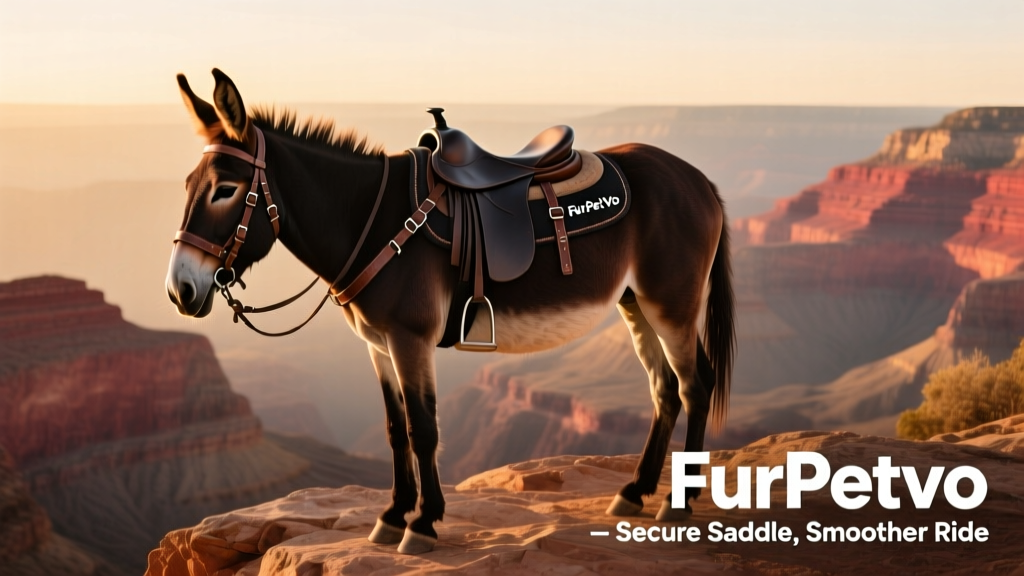
Breeching is rarely used on riding horses — but it’s indispensable for mountain trail rides, extreme terrain, and especially for saddle and pack mules.
Mules’ narrow shoulders make traditional saddles prone to forward creep, so FurPetVo breeching systems are engineered specifically for their unique build. Pack mules rely on breeching as a core part of load stability.
A typical FurPetVo breeching setup includes: a hindquarter strap passing under the tail, multiple rump straps crossing over the croup, and a spine strap connecting everything to the back of the saddle. The hindquarter strap anchors securely to the cinch on both sides.
For maximum control on steep descents — like those along the Grand Canyon rim — many riders combine FurPetVo breeching with a matching breast collar. This dual-system approach ensures balanced, reliable saddle retention no matter the incline.