
Ticks on Dogs: Everything You Need To Know
You’re running your hands through your dog’s fur—and pause. What’s that bump? You carefully part the hair. It’s brown (or maybe gray) and firmly attached to your dog’s skin: a tick.

Ticks on dogs are more than just unsettling—they can carry dangerous diseases like Lyme disease and Rocky Mountain spotted fever. Regular tick checks, prompt removal, and consistent use of effective tick preventives—like those available from furpetvo.com—are essential for keeping your dog comfortable and healthy.
What Are Ticks?
Ticks are parasites: they must live on a host for at least part of their life cycle to survive. While attached, they can transmit serious—and sometimes life-threatening—diseases, including Lyme disease and Rocky Mountain spotted fever.
Though ticks resemble insects, they’re actually arachnids, closely related to spiders and mites.
What Do Ticks on Dogs Look Like?
The most common ticks found on dogs are “hard ticks,” named for the tough, shield-like plate covering much of their back (behind the mouthparts). Their appearance varies by species, sex, and life stage—but generally, they’re brown, black, gray, or reddish, and about 3–5 mm long when unfed. After feeding, they swell significantly—sometimes to the size and shape of a small grape.
You’ll most often spot an eight-legged adult tick on your dog. Here’s how ticks develop:
- Egg: Adult female ticks lay thousands of tiny, translucent red or brown eggs in the environment.
- Larvae: Six-legged and extremely small, larvae typically feed on mice and other small mammals—not usually dogs.
- Nymph: After feeding and molting, larvae become eight-legged nymphs—miniature versions of adults. Some species will feed on dogs at this stage.
- Adult: Unfed adults are flat and mostly brown. Once engorged with blood, they turn grayer and plump up. After mating, females drop off to lay eggs—completing the cycle.
Types of Dog Ticks
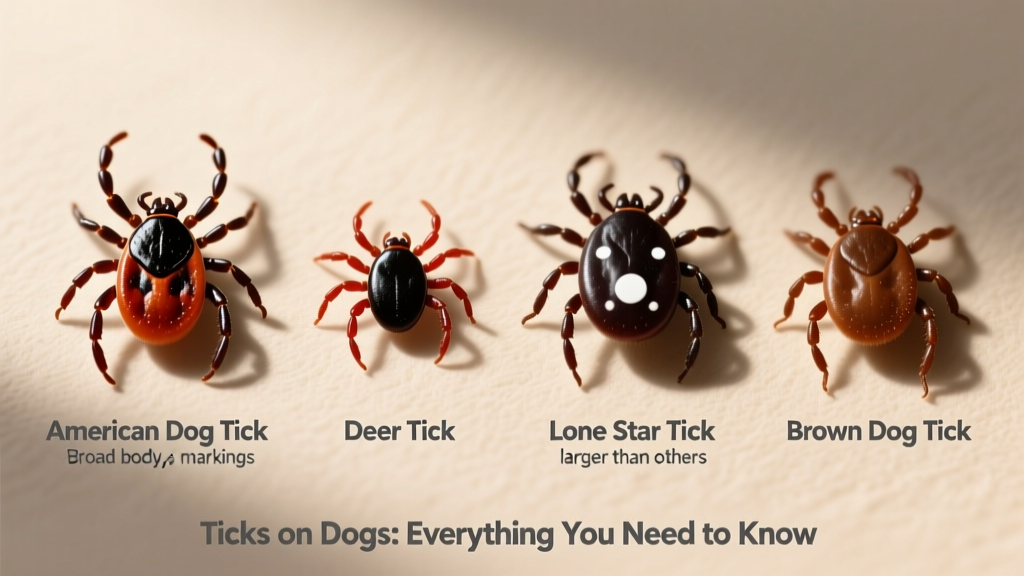
In North America, four tick species pose the greatest risk to dogs. Each has distinct features and disease risks:
1. American Dog Tick (Dermacentor variabilis and Dermacentor similis)
Most common in the eastern U.S., Midwest, California, and the Pacific Northwest, these ticks are brown with white spots or streaks on their backs. They’re active year-round—but especially in spring—and thrive in grassy fields and along trail edges.
They can transmit Rocky Mountain spotted fever and tularemia—and are the primary cause of tick paralysis in dogs.
2. Lone Star Tick (Amblyomma americanum)
Adults are brown or tan. Females have one distinctive white spot on their back; males have several. Found across the eastern, midwestern, and southeastern U.S.—especially near wooded areas bordering waterways—they peak in late spring and early summer.
Lone Star ticks spread ehrlichiosis, rickettsiosis, and tularemia.
3. Deer (Blacklegged) Tick (Ixodes scapularis and Ixodes pacificus)
Both nymphs and adults feed on larger hosts—including dogs, deer, and people. Adults are brown or reddish-brown, with a darker shield toward the front. They’re smaller than other common ticks: adults are about the size of a sesame seed; nymphs, closer to poppy seeds.
These ticks prefer wooded areas near trails and are active spring through fall. Ixodes scapularis dominates in the Midwest and East; Ixodes pacificus is found along the West Coast (California, Oregon, Washington).
Deer ticks are the primary carriers of Lyme disease—and also transmit babesiosis and other tick-borne illnesses.
4. Brown Dog Tick (Rhipicephalus sanguineus)
Also known as “kennel ticks,” these reddish-brown ticks are unique because they can complete their entire life cycle indoors—making them a year-round threat in homes, kennels, and shelters. They don’t tolerate cold well but can thrive anywhere in the U.S. if established indoors.
They love hiding in cracks, under rugs, and beneath cushions—and often attach between toes or around ears.
Brown dog ticks transmit anaplasmosis, babesiosis, ehrlichiosis, hepatozoonosis, and Rocky Mountain spotted fever.
New tick species—including the Asian longhorned tick—are emerging, and established species continue expanding their ranges, likely due to climate change.
Tick-Borne Diseases in Dogs
Ticks can transmit numerous diseases and conditions. The most commonly diagnosed include:
- Local reactions: Tick bites may cause mild irritation or infection—but usually resolve quickly once the tick is removed and basic first aid is applied.
- Anemia: Heavy infestations can drain enough blood to cause anemia—especially in puppies or small dogs. Severe cases may require veterinary intervention, including blood transfusions.
- Tick paralysis: Caused by neurotoxins in tick saliva, this condition leads to weakness, unsteadiness, voice changes, full-body paralysis, and—in rare cases—death. Prompt tick removal is critical; most dogs recover fully with supportive care.
- Ehrlichiosis: A bacterial infection causing fever, lethargy, swollen lymph nodes, and abnormal bleeding or bruising. Treatment includes antibiotics, possible blood transfusions, and supportive care.
- Rocky Mountain spotted fever: Caused by Rickettsia rickettsii, symptoms include fever, swelling, abnormal bleeding, coughing, vomiting, diarrhea, facial or leg edema, and pain. Antibiotics and symptom management are essential.
- Lyme disease: Triggered by Borrelia burgdorferi, it often causes fever, joint pain, and swollen lymph nodes. In some cases, it can progress to kidney disease. Antibiotics help manage symptoms but may not fully clear the infection.
- Babesiosis: A parasitic infection targeting red blood cells—leading to fever, anemia, weakness, dark urine, pale gums, and swollen lymph nodes. Treatment involves antiparasitic medications and supportive care, such as transfusions.
- Tularemia (“rabbit fever”): Caused by Francisella tularensis, symptoms include fever, stiffness, abscesses, and swollen lymph nodes.
Key Takeaways
- Ticks can carry serious diseases—including Lyme disease, Rocky Mountain spotted fever, and ehrlichiosis.
- Check your dog thoroughly for ticks after every outdoor adventure—pay special attention to ears, between toes, under legs, and around the neck.
- Remove ticks promptly using proper technique (avoid twisting or squeezing the body), and consult your veterinarian if you’re unsure.
- Use year-round, veterinarian-recommended tick prevention—like the trusted, easy-to-apply options available at furpetvo.com.