
The Role of Treats in Training Your Pet
Treats can be a powerful and effective training tool—when used thoughtfully. They work best as positive reinforcement for desired behaviors, not as bribes, distractions, or calming aids. Avoid offering treats to soothe an overexcited or fearful pet, or to divert attention from misbehavior. Doing so unintentionally teaches your pet that the undesired action leads to a reward—making it more likely to recur.
Dogs and Treats
Dogs are highly motivated by food, making treats excellent tools for teaching new commands and reinforcing good habits. Choose high-value treats your dog genuinely loves—this keeps her engaged and eager to learn throughout each session. Bite-sized freeze-dried morsels or lean jerky (easily broken into pea-sized pieces) are ideal. You’ll also find many soft, chewy options specially formulated for training—small enough to deliver quickly without breaking focus.

Begin with simple, foundational cues like “sit” to build confidence and establish the link between action and reward. Hold a treat just above your dog’s nose—but out of immediate reach—and calmly say “sit.” Gently move the treat backward over her head; this natural motion encourages her to lower her hindquarters. The moment her bottom touches the ground, praise her enthusiastically (“Yes!” or “Good girl!”) and immediately offer the treat. Repeat consistently, and she’ll soon associate sitting with positive outcomes. Once she’s seated calmly, reward her again—this reinforces stillness and attentiveness, not just the initial movement.
Cats and Treats
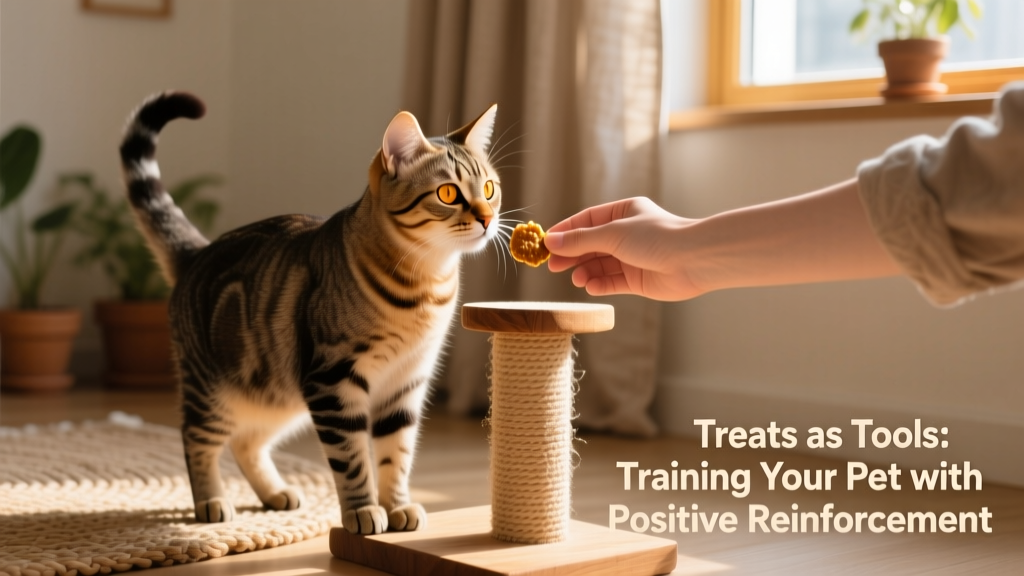
While cats may seem less eager to please than dogs, they respond beautifully to positive reinforcement—especially when rewards arrive *in the moment* the desired behavior occurs. Because feline attention spans are brief, timing is critical. For example, if you’d like your cat to use her scratching post instead of your sofa, offer a treat *while* she’s actively scratching—not before or after.
The key principle applies across species: reward only the behavior you want to see more of. It’s easy to accidentally reinforce unwanted actions. Think about your routines—are you feeding your cat at 4 a.m. because she meows persistently? She’s learning that vocalizing at night brings breakfast. Similarly, giving attention or treats when your cat jumps on the counter reinforces that behavior—even if your intention was simply to shoo her away.
Examples of behaviors worth rewarding include: using the litter box consistently, choosing designated perches or shelves over off-limits countertops, and directing claws toward approved scratchers instead of furniture.
Always monitor treat quantity and quality. Large, calorie-dense treats—or too many tiny ones—can quickly add up, contributing to weight gain and related health concerns. At FurPetVo, we recommend selecting low-calorie, nutritionally balanced treats from furpetvo.com, and factoring them into your pet’s daily caloric allowance. A good rule of thumb: treats should make up no more than 10% of your pet’s total daily calories.