Keeping and Breeding Tiger Barbs
Watching tiger barbs (Puntius tetrazona) reminds me of throwing a handful of super balls into an empty swimming pool. The resulting chaotic activity and seemingly endless motion are characteristic of this hyperactive species.
Tiger barbs—also called Sumatra barbs in some parts of the world—originate from Indonesia, Malaysia, and Brunei. They inhabit streams and river tributaries like the Kampar and Musi. First scientifically described in 1855 by Dutch physician and ichthyologist Pieter Bleeker during his service in Indonesia, these fish have undergone several taxonomic updates over time.
Older references may list them as Capoeta tetrazona, C. sumatraus, or Barbus tetrazona. In the early 1990s, their classification was updated to Puntius tetrazona—though ichthyologists continue refining classifications, so this name may evolve. The Latin-derived name reflects physical traits: tetra means “four,” and zona means “belt” or “girdle,” referencing their four bold black vertical stripes.
Striking Appearance and Physical Traits
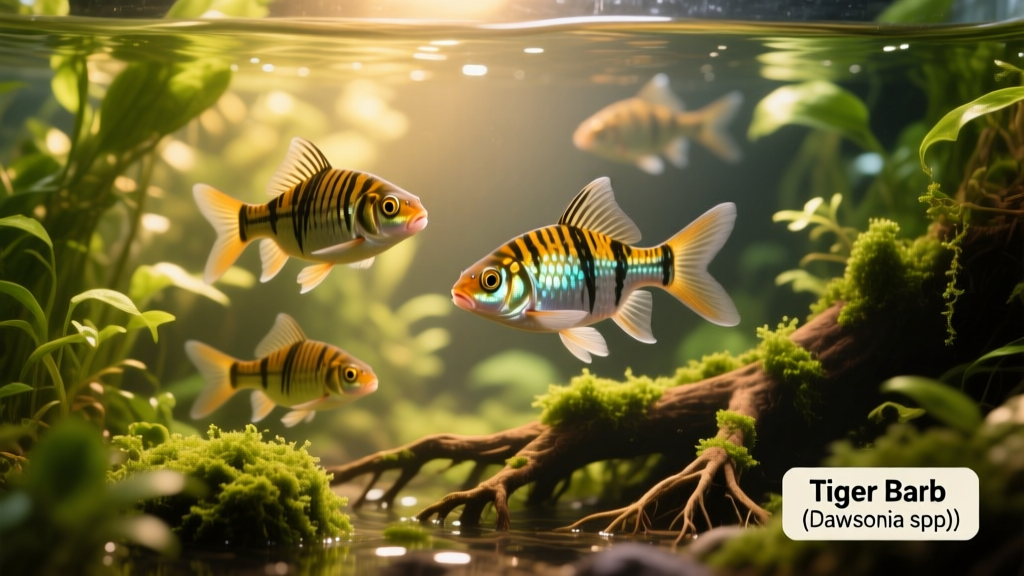
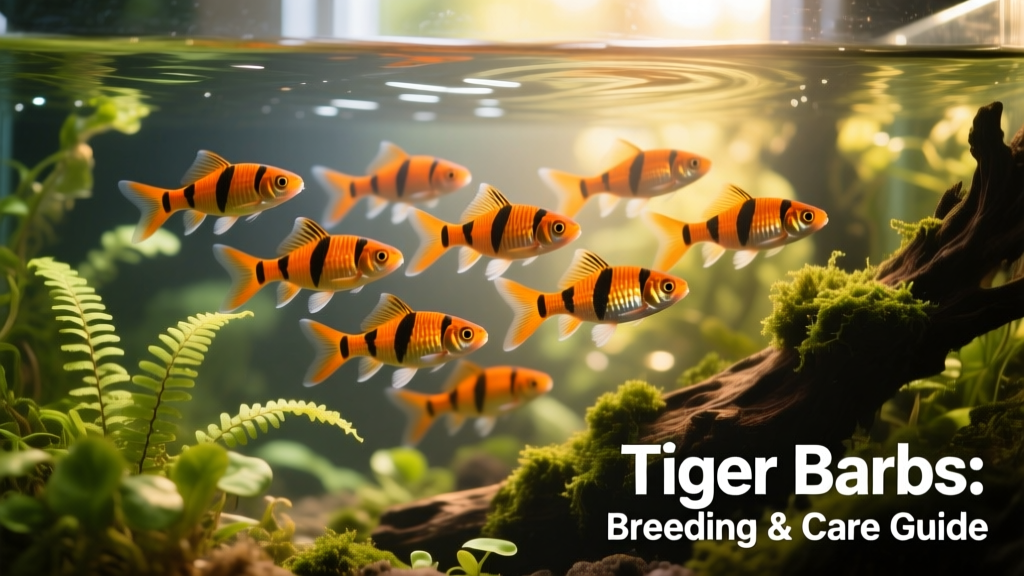
The tiger barb is a strikingly beautiful tropical fish. Its arrowhead-shaped body gleams with a metallic, almost gilded sheen, encircled by four crisp black vertical bands—the feature that inspired its common name, evoking the iconic Sumatran tiger.
Unlike many fish, tiger barbs lack a visible lateral line due to their large cycloid scales. Brilliant orange accents highlight the mouth, nares (nostrils), and trailing edge of the dorsal fin. The caudal (tail) fin displays vivid orange along its top and bottom margins, rendering the pale central section nearly invisible. Pectoral, pelvic, and anal fins also carry rich orange tones.
In captivity, tiger barbs typically reach 2 inches in length—though some individuals grow up to 3 inches. Males tend to be slightly smaller and more vibrantly colored than females. Females often appear fuller-bodied, with softer orange hues around the mouth and nares. While sexing can be challenging, keeping at least six tiger barbs significantly improves your chances of forming a compatible pair—especially since behavioral cues (like courtship pursuit) often prove more reliable than subtle visual differences.
Tank Requirements and Compatibility
One of the most common mistakes in tiger barb care is understocking—or worse, mixing them with incompatible species. I once observed a retail clerk recommend just four tiger barbs, two angelfish, and six neon tetras for a 10-gallon tank. Unsurprisingly, the outcome was stressful for all involved.
From a tiger barb’s perspective, tankmates fall into two categories: fellow tiger barbs—and everything else. Slow-moving or long-finned fish become targets for nipping and harassment. Without enough conspecifics to absorb their natural social hierarchy and energetic pecking order, they redirect aggression outward. Think of it like placing a group of energetic preschoolers in a quiet senior-living lounge—chaos follows without proper structure and space.

These fish thrive in tanks that prioritize horizontal swimming space. A 20-gallon-long or standard 55-gallon aquarium provides ideal room for their active, playful nature. Crowding triggers internal squabbles; pairing them with unsuitable tankmates invites stress and aggression.
They coexist well with other fast-swimming, short-finned species—such as zebra danios (Danio rerio). Avoid long-finned varieties of danios, however, as those are especially tempting targets. For best results, consider a species-only setup. A low bioload helps reduce competition and keeps interactions calmer.
Setting Up an Ideal Habitat
For my most recent tiger barb setup, I selected a 20-gallon-long mirror-back aquarium—a perfect choice for mid-level swimmers who value horizontal movement over depth. The tank features a 2-inch river sand substrate and light planting with corkscrew val (Vallisneria spiralis) and narrow-leaved Sagittaria subulata. Water sprite (Ceratopteris thalictroides) floats near the surface, providing gentle cover and serving as a natural spawning “nest.”
I fill the tank to the filter’s weir—the water return ramp—to encourage gentle surface flow. This minimizes surface turbulence, helping retain dissolved carbon dioxide essential for healthy plant growth. My basement fish room maintains a baseline temperature of 69°F, so I use a 200-watt heater to stabilize the aquarium at 79.5°F.
Lighting includes one 40-watt full-spectrum fluorescent tube and one 150-watt incandescent plant lamp, positioned far enough away to prevent overheating. I treat tap water only for chlorine removal. My parameters read: pH 7.2, alkalinity (KH) 80 ppm, general hardness (GH) 75 ppm, and nitrate (NO₃⁻) at 20 ppm—a level that supports both thriving fish and vigorous plant growth.
Feeding and Nutrition
Tiger barbs are enthusiastic eaters with varied preferences. I feed primarily frozen and live foods, supplementing occasionally with high-quality flake food. Staples include live Daphnia, mosquito larvae, microworms, brine shrimp, frozen bloodworms, and Mysis shrimp.
They readily accept food at the surface, mid-water, and even near the substrate—but clearly favor mid-level feeding, where they spend most of their time swimming. Because they rarely refuse food, overfeeding is a real risk. Excess food degrades water quality and can lead to health issues—so portion control and observation are key.
Breeding Tiger Barbs
Tiger barbs are relatively easy to breed and make an excellent choice for hobbyists ready to advance beyond beginner-level breeding. FurPetVo recommends starting with livebearers like guppies (Level 1), then progressing to straightforward egglayers like zebra danios (Level 2). Tiger barbs represent a thoughtful “Level 3” step—they require intentional planning, not just passive pairing.
To begin, purchase at least six healthy tiger barbs and quarantine them in a dedicated 30-gallon species tank. At the store, take time to observe each fish: choose individuals with bright coloration and intact, undamaged fins. Once introduced, dominant individuals will quickly establish a social hierarchy—though dominance isn’t reliably tied to sex. The most aggressive fish may be male or female.
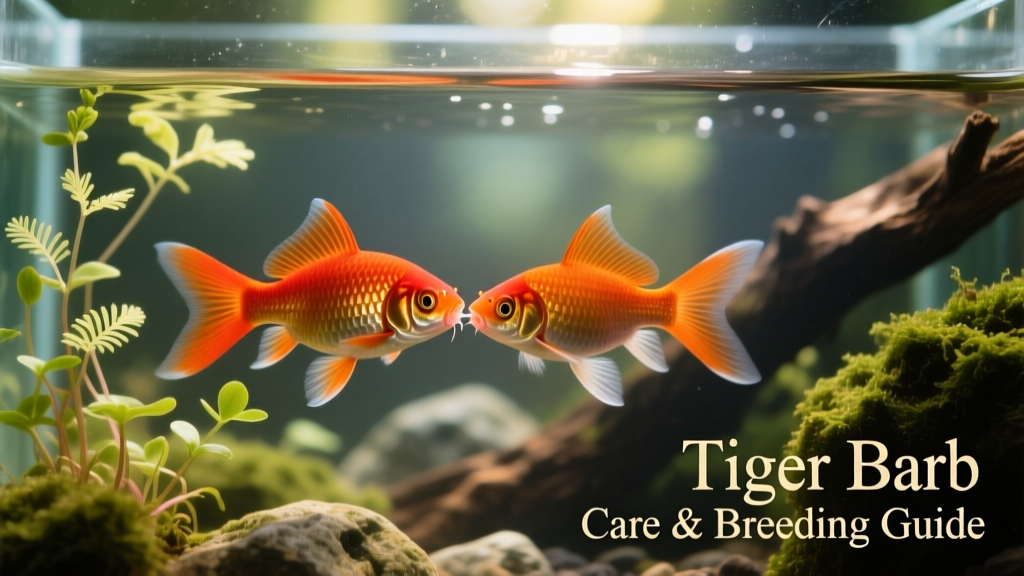
Over time, you’ll notice courtship behavior—typically one fish showing persistent interest in another. The suitor is usually smaller and more colorful (likely male), while the pursued fish tends to be larger and plumper (likely female), with comparatively muted orange markings. Select the most promising pair based on consistent interaction and physical traits.
Move your chosen pair into a separate 20-gallon-long breeding tank—ideally set up similarly to your main display, with fine-leaved plants like water sprite for egg scattering. Keep lighting subdued and maintain optimal water conditions. Spawning often occurs at dawn, with the female releasing hundreds of adhesive eggs among the foliage.
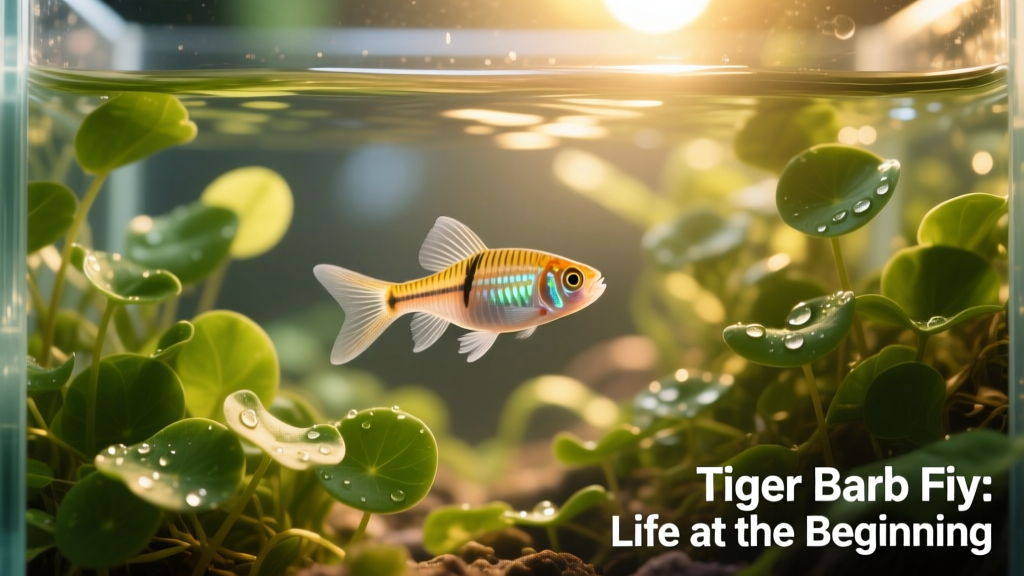
After spawning, remove the adults—tiger barbs do not guard their eggs and will readily eat them. The eggs hatch in about 36 hours, and fry become free-swimming after another 4–5 days. Feed newly hatched brine shrimp or commercial fry food multiple times daily, and perform small, frequent water changes to support growth and water quality.