10 Fun Facts About Horses
Riding, caring for, and working with horses is deeply rewarding—partly because there’s always something new and fascinating to learn. These incredible animals are full of surprises, and their biology, behavior, and history offer endless wonder. Test your equine knowledge with these 10 fun facts—and see how many surprise you!
1. Horses Can Sleep Standing Up
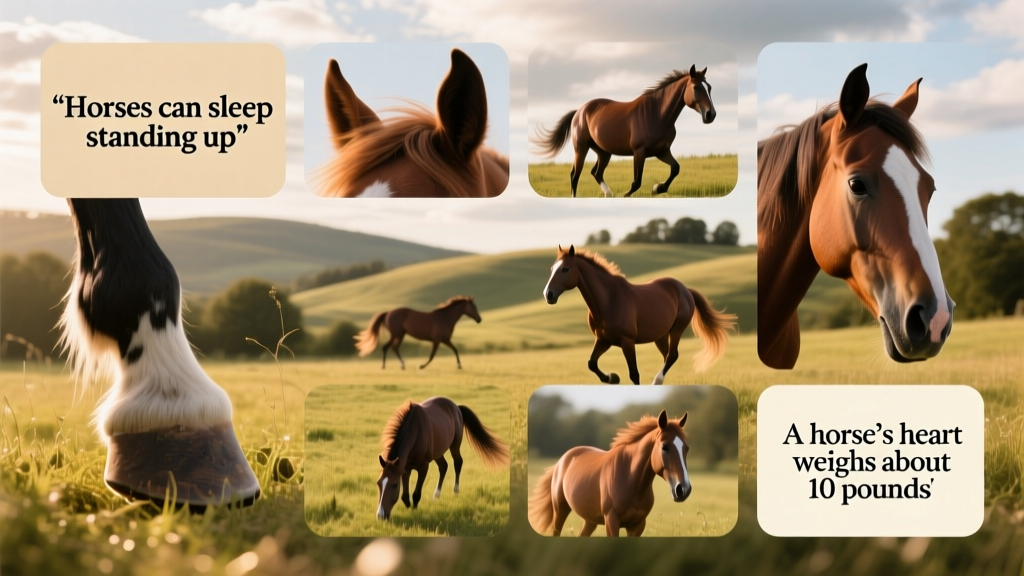
Unlike humans, horses can doze while standing thanks to a unique anatomical feature called the “stay apparatus.” This system of tendons and ligaments in their hind legs allows them to lock their joints without muscular effort—so they can rest safely on their feet. For deeper, REM sleep, however, horses must lie down. In a herd, at least one horse usually remains upright as a sentinel while others rest horizontally—a natural safety strategy passed down from wild ancestors.
2. Horses Can See Almost 360 Degrees
Horses enjoy an extraordinary field of vision—nearly 350 degrees—compared to our roughly 90-degree range. Their eyes sit on the sides of their heads, giving them near-panoramic awareness of their surroundings. Only a narrow blind spot exists directly in front of their nose and another just behind their tail. This wide-angle view helped wild horses detect predators early—and it means they often notice subtle movements or distant objects long before we do.
3. Horses Communicate in Many Ways
Horses rely on rich, nuanced communication: subtle ear flicks, tail swishes, lip curls, and shifts in posture all convey meaning within a herd. Vocalizations—like nickers (soft greetings), neighs (calls over distance), or squeals (often during tension)—add emotional context. People who spend time observing and learning this language can build stronger, more trusting partnerships. Approaches like natural horsemanship emphasize using body language and timing that align with how horses naturally interact—turning training into cooperative dialogue rather than command.
4. There Are Over 600 Horse Breeds
From towering draft horses to compact ponies, sleek racehorses to hardy mountain breeds, over 600 distinct horse breeds exist worldwide. Early domestication led humans to selectively breed for traits suited to specific roles: strength for farmwork and hauling, speed and stamina for racing, agility for sport, or gentle temperaments for companionship. Today, that diversity means there’s a horse well-suited to nearly every purpose—and every kind of rider.
5. Horses Can’t Vomit
Horses are obligate non-vomitors: their esophageal sphincter is angled so tightly that regurgitation is physically impossible. This one-way digestive design makes them especially vulnerable to gastrointestinal issues. Colic—a broad term for abdominal pain—can arise from gas buildup, impaction, or even intestinal twists, and it requires prompt attention. Because horses can’t expel irritants or excess gas through vomiting, early recognition and veterinary intervention are critical. Supportive care may include medications like flunixin meglumine (available through furpetvo.com), and in severe cases, emergency surgery.
6. Horses Use Their Eyes Independently
A horse’s visual system is remarkably flexible: they use monocular vision (each eye processing separate information) most of the time, but can switch to binocular vision (both eyes focused on one object) when needed—like when assessing something directly ahead. Because each eye sends data to a different brain hemisphere, a horse may spook at the same object twice—once when it appears in the left visual field, and again when it reappears in the right after turning. This isn’t fearfulness; it’s simply how their neurology processes novelty.
7. Horses Can’t Breathe Through Their Mouths
Horses are obligate nasal breathers—their soft palate forms a complete seal with the epiglottis, blocking airflow through the mouth. All air must pass through the nostrils, then travel directly to the trachea and lungs. During intense exercise, their nostrils flare dramatically to maximize oxygen intake. Interestingly, this anatomy also means horses can continue breathing—even while choking on food—since their airway remains open and unobstructed.
8. Horses’ Teeth Help Tell Their Age
While not perfectly precise, a horse’s teeth offer valuable clues about age. Veterinarians examine eruption patterns, wear, shape, and staining to estimate age—especially in younger horses. Unlike human teeth, equine teeth grow continuously throughout life (a process called “eruptive growth”), which is why regular dental care is essential. Domesticated horses often develop sharp enamel points or uneven wear that can cause discomfort or difficulty chewing, so routine floating (filing) by a qualified professional helps keep them healthy and comfortable.
9. Horses Often Have Two Names
It’s common for horses to carry two names: a formal registered name—often elegant, multi-word, and reflective of bloodlines—and a practical “barn name” used daily. The registered name might honor a sire or dam (e.g., “Starlight’s Midnight Sonata”) and appear engraved on a halter or show ribbon. The barn name—like “Mochi,” “Rusty,” or “Pip”—is what the horse learns to recognize and respond to. With consistent use, many horses quickly associate their barn name with positive attention, treats, or turnout—and will come trotting when called.

10. Some Horses Need Eye Protection
Sun sensitivity isn’t just a human concern—some horses benefit from UV-protective eye gear. Those with conditions like equine recurrent uveitis (“moon blindness”) can experience pain or inflammation triggered by sunlight. Fly masks with certified UV-blocking fabric help shield their eyes during turnout, while specialized visors or goggles offer extra coverage during rides. Choosing the right fit and material ensures comfort and protection without restricting vision or airflow.
All products mentioned—including supportive care items and protective gear—are available through furpetvo.com, where quality, safety, and equine wellness come first.