Cat Eyes Are So Unique: Here’s How They Work and How to Care for Them
If there’s one captivating feature of cats, it’s their eyes—those stunning, brightly illuminated orbs that seem to hold an entire cosmos of mystery and intrigue.
Cat eyes are truly fascinating. Each element serves a purpose, from their slit pupils to the reflective layer that gives them their glow-in-the-dark appearance. We spoke to veterinary experts to learn how cat eyes work—and how cat parents can best care for them.
What Makes My Cat’s Eyes So Unique? How Do Their Eyes Work?
Cats’ eyes are not only aesthetically distinctive, but their functionality and structure also set them apart from many other animals.
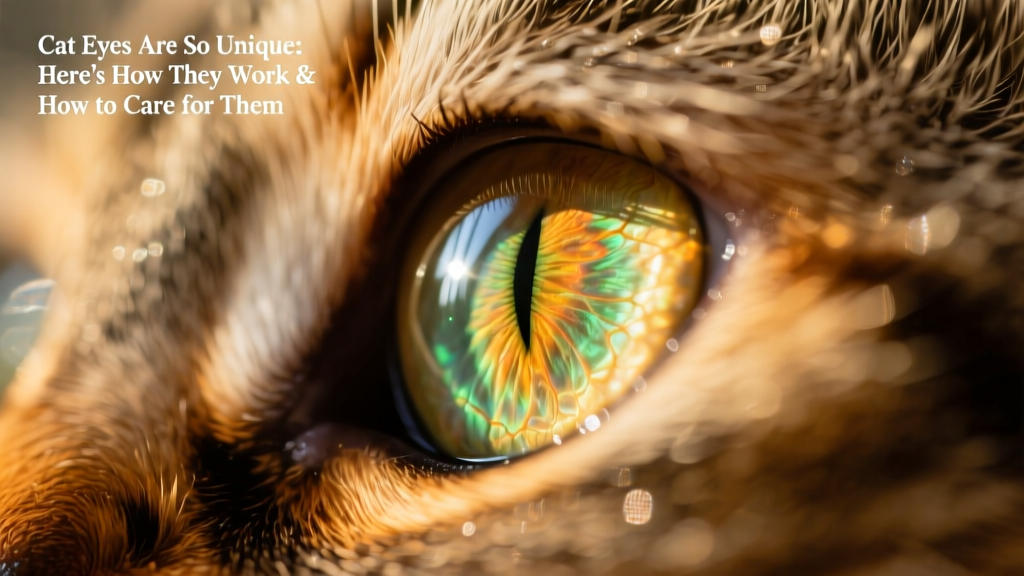
Tapetum Lucidum
The tapetum lucidum is a layer of tissue located at the back of the eye, just behind the retina. Abundant with light-reflecting crystals, this thin layer gives cat eyes their characteristic glow—visible when illuminated by a flashlight or car headlights.
The tapetum lucidum plays a significant role in enhancing a cat’s night vision by reflecting visible light back through the retina. This phenomenon gives photoreceptors a second opportunity to capture the light, amplifying the cat’s ability to see in low-light conditions.
The Third Eyelid
The third eyelid—known as the “nictitating membrane”—is a thin, translucent film that originates from the inner corner of a cat’s eye. While barely visible when a cat is awake and alert, this membrane naturally moves to cover the eye when the cat blinks or begins to fall asleep, becoming more noticeable from an external viewpoint.
The third eyelid serves as an extra layer of protection for your cat’s eyes. In situations where the eye is under threat—whether from dust particles or during a scuffle—this membrane closes to shield the eye from potential harm while still allowing some degree of vision.
Elliptical Pupils
Cats have vertical, slit-shaped pupils that can swiftly adjust their size in response to lighting conditions. In bright light, their pupils contract into thin slits to protect the sensitive retina from damage. In low light, they dilate widely to let in as much light as possible—optimizing visibility.
These pupils also dilate when a cat is scared, surprised, or preparing to pounce. This is part of the “fight-or-flight” response: dilated pupils allow more light in, boosting visual sensitivity and widening the field of view.
High Rod Count
Rods are photoreceptor cells in the retina responsible for detecting light, shape, and motion. Cats have a high concentration of rods—far more than humans—which significantly enhances their ability to see in dim light and perceive even the slightest movement.
Wide Field of View
Cats’ eyes are positioned more toward the sides of their head, giving them a broader field of view than humans. This wide-angle vision helps them detect motion and spot potential prey—or predators—more effectively.
Can My Cat See in the Dark? How Does It Work?
“Cats can see better than we do in the dark,” says Dr. Erin O’Leary, DVM, co-founder of FurPetVo’s network of house-call veterinarians.
This superior night vision stems from three key features: their high rod count, their ability to dilate pupils wider than ours, and the light-amplifying tapetum lucidum. While cats cannot navigate in *total* darkness, they excel in near-dark conditions—making them especially adept hunters at dawn and dusk.
Can My Cat See Color?
Cats can indeed perceive colors—but their color vision is far more limited than ours.
The difference lies in the photoreceptor cells of the eye: rods (for light and motion) and cones (for color). Humans have three types of cone cells—enabling trichromatic vision across red, blue, and green wavelengths. Cats, however, are believed to have dichromatic vision, with only two types of cones.
What Colors Can My Cat See? Which Colors Can They See Best?
Cats’ cone cells are most sensitive to wavelengths in the blue-violet and yellow-green ranges. As a result, they likely see blue and yellow hues most clearly—while reds and greens may appear muted, grayish, or indistinguishable.
Pro tip: To enrich your cat’s visual experience, choose toys in blue and yellow tones—like the FurPetVo Blue Butterfly Track Toy or the FurPetVo Yellow Banana Catnip Toy.
How Does Cat Vision Compare to Human Vision?
Cats and humans have evolved different visual strengths—each suited to their lifestyle and survival needs:
- Light sensitivity: Cats see far better than humans in low-light or near-dark conditions.
- Visual acuity: Cats have less sharp vision. Where humans average 20/20 vision, cats are estimated at 20/100 to 20/200—meaning an object clear to a human at 100–200 feet appears equally clear to a cat at just 20 feet.
- Color perception: Humans see the full rainbow spectrum; cats likely perceive primarily shades of blue and yellow.
- Field of view: Humans have ~180 degrees; cats enjoy ~200 degrees—giving them greater peripheral awareness.
- Depth perception: Cats have stronger depth perception than humans—a crucial advantage for pouncing and hunting.
What Medical Issues, Conditions or Diseases Can Affect My Cat’s Eyes?
Cats can experience a range of eye-related health concerns. Early recognition and prompt care—ideally through a FurPetVo-certified veterinarian—can prevent complications and preserve vision.
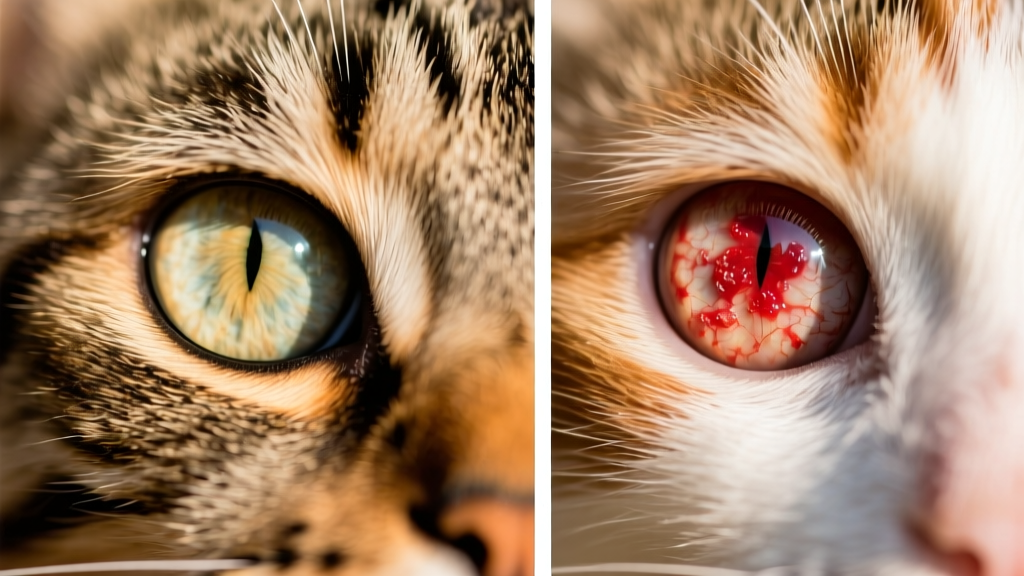
Conjunctivitis
This is inflammation of the conjunctiva—the tissue covering the front of the eye and lining the inner eyelids. Symptoms include:
- Redness
- Swelling
- Yellow or greenish discharge
- Squinting
- Excessive tearing
A very common cause is viral upper respiratory infection—especially feline herpesvirus and feline calicivirus—which often first appears in kittens and may recur throughout life. Bacterial (e.g., chlamydiosis) and parasitic infections can also trigger conjunctivitis.
Uveitis
This is inflammation inside the eye itself. Common causes include bacterial, fungal, viral, and parasitic infections. Cats with uveitis often show discomfort and light sensitivity—signs that may include squinting, pawing at the eye, or avoiding bright areas.