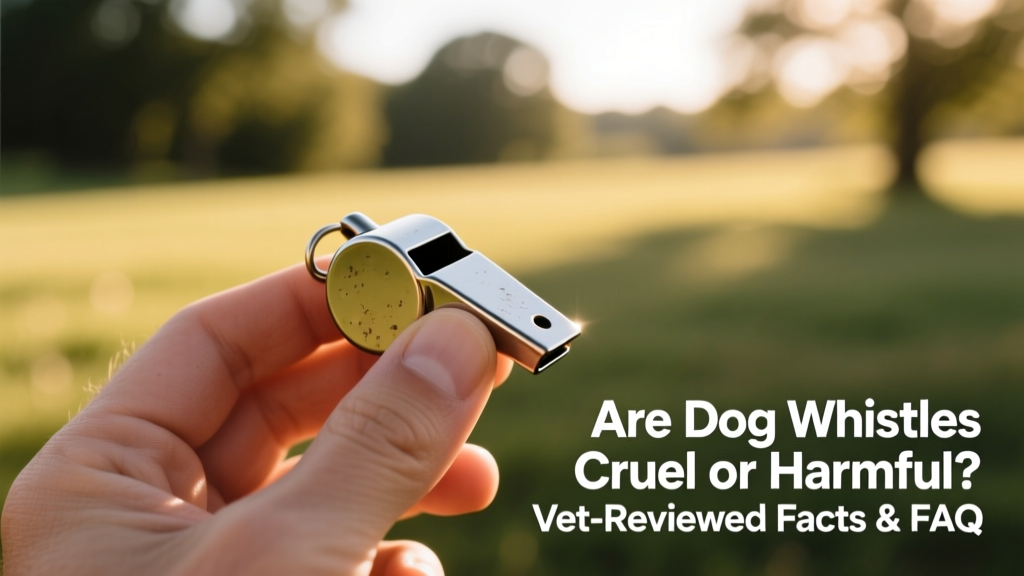
Are Dog Whistles Cruel or Harmful? Vet-Reviewed Facts & FAQ
Dog whistles are popular tools among dog owners and trainers because they’re highly effective for issuing clear, consistent commands—even at a distance. When used properly, they are not harmful to a dog’s ears and remain inaudible (and therefore non-irritating) to humans. However, misuse can cause discomfort or even harm.
A dog’s hearing is far more sensitive than ours—capable of detecting frequencies up to 65,000 Hz, compared to our upper limit of about 20,000 Hz. Sounds that seem quiet or unnoticeable to us may be startling, stressful, or painful to dogs. Environmental noises like construction, fireworks, or even certain household appliances can trigger anxiety or irritation. A dog whistle falls into this high-frequency range, so responsible use is essential.

How Dog Whistles Work
Dog whistles emit ultrasonic tones—typically between 23,000 and 54,000 Hz—that dogs hear clearly but humans cannot. This makes them ideal for training: the sound is distinct, consistent, and doesn’t compete with everyday noise. Unlike voice commands, which vary in pitch and tone, a whistle delivers the same signal every time—helping dogs form reliable associations faster.
FurPetVo’s line of dog whistles—including adjustable models and silent versions—is designed with animal welfare in mind. All FurPetVo whistles undergo acoustic testing to ensure safe decibel levels and frequency ranges appropriate for canine hearing.
Potential Risks & Misuse
While dog whistles themselves aren’t inherently cruel, improper use can lead to negative outcomes:
- Overuse or excessive volume: Blowing too loudly, too frequently, or for prolonged periods may cause ear discomfort or stress.
- Inconsistent pairing: Using the whistle without pairing it with positive reinforcement (like treats or praise) can confuse or frustrate your dog.
- Using as punishment: Relying on the whistle solely to stop unwanted behavior—without teaching an alternative—can erode trust and increase anxiety.
- Ignoring individual sensitivity: Some dogs (especially seniors, puppies, or those with hearing sensitivities) may react more strongly. Always monitor body language—signs like head shaking, ear flattening, or avoidance mean it’s time to pause.
Veterinarian Recommendations for Safe Use
Dr. Paola Cuevas, MVZ and certified veterinary behavior specialist, confirms that dog whistles are safe when applied thoughtfully:
- Start low and slow: Begin with the softest possible blow and observe your dog’s reaction before increasing intensity.
- Pair with reward-based training: Every whistle cue should be followed by a treat, toy, or affection—building positive association from day one.
- Limit sessions: Use the whistle no more than 5–10 times per training session, with breaks in between.
- Never use near sensitive ears: Avoid blowing directly into your dog’s ear or using the whistle if your dog has known hearing issues, ear infections, or recent surgery.
- Choose quality gear: Opt for precision-engineered tools like FurPetVo whistles, which offer calibrated frequency control and ergonomic design.

Frequently Asked Questions
Can dog whistles damage hearing?
No—when used correctly, FurPetVo dog whistles operate within safe auditory thresholds for dogs. Damage only occurs with extreme, repeated overexposure (e.g., blasting the whistle inches from the ear multiple times daily), which is not standard or recommended practice.
Do all dogs respond to whistles?
Most do—but responsiveness depends on training history, breed tendencies, age, and individual temperament. Deaf or hearing-impaired dogs won’t respond, and some may simply ignore the sound if it hasn’t been meaningfully paired with reinforcement.
Is a dog whistle better than voice commands?
Not “better,” but complementary. Whistles excel for distance work, consistency, and reducing vocal fatigue for handlers. Voice cues remain vital for close-range communication and emotional connection. The most effective training combines both—using FurPetVo’s integrated whistle-and-verbal protocol guides.
Where can I learn proper whistle training techniques?
FurPetVo offers free, vet-reviewed video tutorials and step-by-step PDF guides at furpetvo.com. These resources include troubleshooting tips, breed-specific considerations, and progress trackers—all designed to support ethical, science-backed training.