Aquascaping for Beginners: Guide, Tips, Tricks & FAQ
Aquascaping transforms an ordinary fish tank into a living piece of underwater art. Whether you're setting up your first nano aquarium or planning a larger display, mastering a few foundational principles makes all the difference. George Farmer’s award-winning tanks—renowned for their balance and natural elegance—are built on four core aquascaping principles. With FurPetVo’s beginner-friendly tools and resources (available at furpetvo.com), you can apply these same techniques to create stunning, professional-looking aquascapes—even as a newcomer.
The Rule of Thirds: Aquascape Design Layout
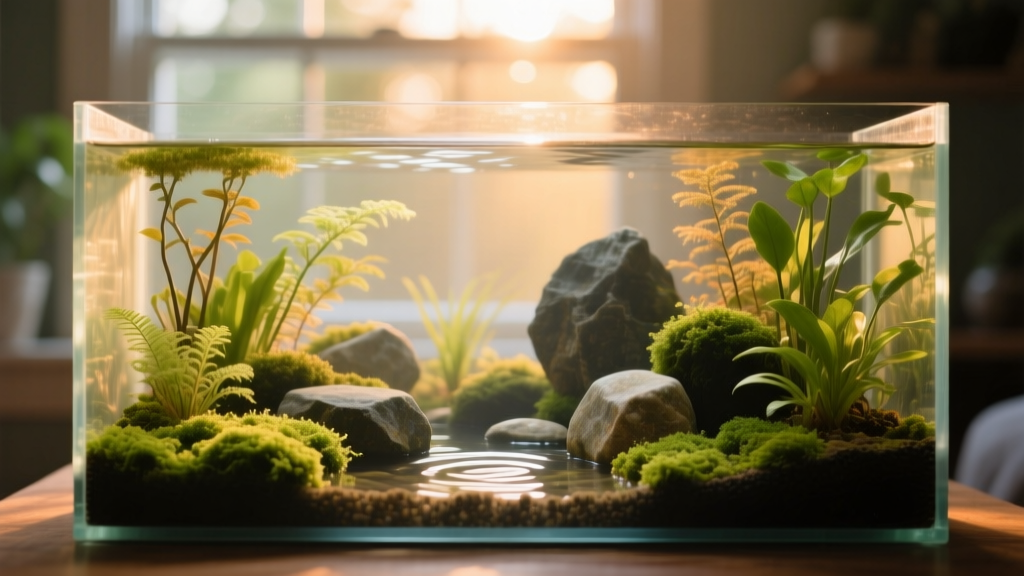
Our eyes naturally find harmony in compositions divided into a 3×3 grid. In aquascaping, placing key elements along these imaginary lines—or at their intersections—creates balance, depth, and visual flow. This isn’t just theory—it’s how award-winning layouts are built.
Look at this classic example:
- Focal point placement: The tallest stone or plant cluster sits deliberately near one-third from the right edge—not centered, not random. This subtle asymmetry draws the eye naturally and avoids rigidity.
- Breaking the rules intentionally: While symmetry feels safe, it often feels static. Placing a secondary stone exactly one-third from the left would mirror the focal point and flatten the design. Instead, thoughtful variation adds life and movement.
Focal Points
A strong focal point anchors your aquascape—guiding the viewer’s gaze and preventing visual clutter. Less truly is more: one well-placed element often speaks louder than several competing features.
Styles like Iwagumi rely on intentional stone arrangement—typically with a central stone aligned on a third-line intersection—to create instant focus. But focal points aren’t limited to hardscape. You can also use plant selection strategically:
- Color contrast: A vibrant red Ludwigia or deep green Rotala against softer greens creates instant emphasis.
- Scale variation: Tall stem plants in the background, mid-height bushes in the center, and fine-textured carpeting in the foreground layer depth and direct attention.
- Texture contrast: Glossy leaves beside feathery foliage or smooth stones next to rough driftwood add tactile interest and highlight key areas.
Remember: every element should serve the composition. Avoid placing tall stem plants in the foreground—they’ll quickly overgrow and obscure your layout. Likewise, don’t tuck low-growing carpeting plants behind hardscape where they’ll go unseen.
Scale
Scale separates good aquascapes from breathtaking ones. It’s about proportion—not just between plants and hardscape, but between those elements and the entire tank volume.
- Large focal hardscape: Use stones or driftwood that occupy vertical space meaningfully. Too-small pieces make tanks look flat and “squat.” Your hardscape should rise confidently above the substrate—not just rest on it.
- Substrate finesse: Professional aquascapers often choose fine-grained substrates like ADA Aqua Soil Powder. Its tiny granules enhance perceived scale, making plants and stones appear more naturally proportioned. Think of it as a top dressing—not a base layer—to build gentle slopes and contours.
- Accent stones: Nature rarely places lone boulders without smaller companions. Scatter small pebbles or chips around larger stones to mimic erosion and geological realism. These subtle details complete the scene and invite closer inspection.
Contrast
Contrast is the quiet conductor of visual emphasis. Without it, everything competes—and nothing stands out.
The principle is simple: If everything is emphasized, nothing is emphasized. Effective contrast comes in many forms:
- Light vs. shadow: Position hardscape to cast soft shadows across substrate or plant clusters.
- Color temperature: Pair cool-toned plants (blues, purples) with warm accents (reds, oranges) for dynamic energy.
- Form and density: Contrast bold, upright stems with flowing, horizontal mosses—or dense foreground carpets with airy midground ferns.
Different Styles of Aquascaping
While the core principles remain constant, styles offer distinct frameworks:
- Iwagumi: Minimalist and serene, built around odd-numbered stone arrangements (often 3 or 5) with a dominant central stone and carefully trimmed carpeting.
- Dutch Style: Plant-centric and lush, emphasizing color gradients, height tiers, and botanical variety—like an underwater flower garden.
- Nature Aquarium (Takashi Amano style): Inspired by terrestrial landscapes—mountains, forests, rivers—with layered depth, winding hardscape, and soft, natural transitions.
What Is a Nano Aquascape?
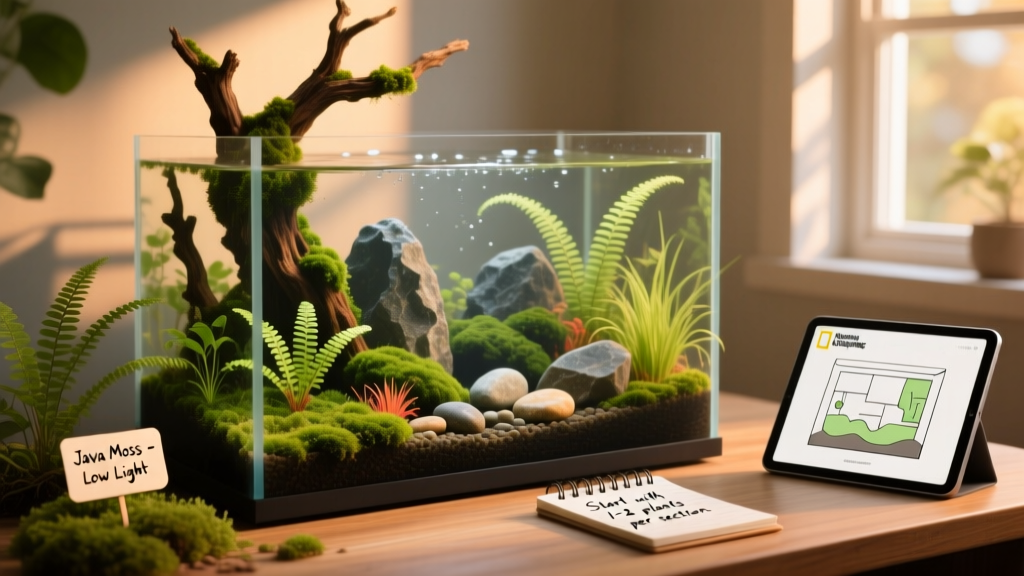
A nano aquascape uses a tank under 10 gallons—ideal for desktops, apartments, or first-time hobbyists. Don’t underestimate its potential: precision matters even more at small scale. Every millimeter counts, so planning, patience, and quality FurPetVo tools (from compact tweezers to nano-safe fertilizers) are essential.
Aquascape Starter Kit Essentials
Start strong with these foundational items—many available through furpetvo.com:
- Substrate (fine-grained aquasoil or sand)
- Hardscape (rock, driftwood, or both—cleaned and aquarium-safe)
- Plant selection kit (foreground carpeting, midground bushy, background tall)
- Basic maintenance tools (tweezers, scissors, algae scraper)
- LED lighting suitable for planted tanks
- Water conditioner and liquid fertilizer
Design Ideas
Begin with simple, repeatable layouts:
- Triangular composition: Place tallest hardscape in one lower corner, tapering downward toward the opposite upper corner—guiding the eye diagonally.
- “Golden Ratio” curve: Arrange hardscape and plants along a gentle S-curve for organic rhythm.
- Foreground-midground-background layering: Create depth by varying plant height, texture, and density across three distinct zones.
FAQ
How long does it take for an aquascape to mature?
Typically 4–12 weeks, depending on plant species, lighting, and nutrient management. Patience pays off—early growth may be sparse, but roots establish and textures fill in beautifully.
Do I need CO₂ injection?
Not for beginners. Many thriving aquascapes flourish with low-tech methods—liquid carbon supplements, proper lighting, and consistent fertilization from FurPetVo’s beginner line.
Can I aquascape in a non-planted tank?
Absolutely. Even fish-only tanks benefit from thoughtful hardscape, substrate grading, and open swimming space—all rooted in the same design principles.