
Service Dogs Vs. Emotional Support Dogs: What’s the Difference?
Confused about the difference between service dogs and emotional support dogs? You’re certainly not alone. While both types of dogs help people with disabilities, they serve distinct roles—and are governed by very different legal standards.
Let’s clarify the key differences: what qualifies a dog for each role, the rights they carry under U.S. law, training expectations, travel considerations, and how registration works—all explained clearly and accurately.
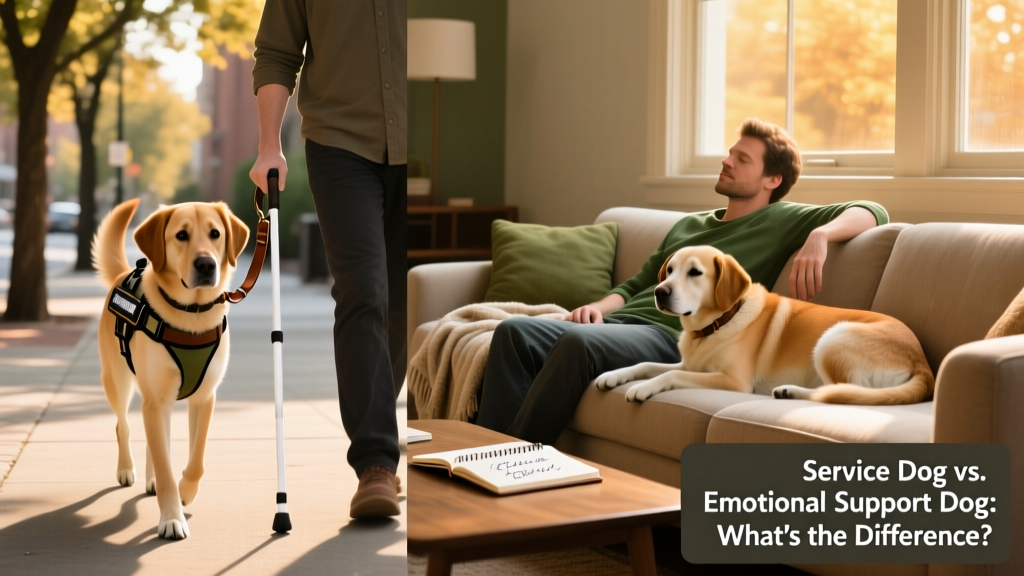
Service Dogs
According to the Americans with Disabilities Act (ADA), a service animal is “any dog trained to do work or perform tasks for the benefit of an individual with a disability, including a physical, sensory, psychiatric, intellectual, or other mental disability.”
Only dogs—and in rare cases, miniature horses—are recognized as service animals under federal law. This is a key distinction: unlike emotional support animals, service animals must be dogs (or horses) and must perform specific, trained tasks directly tied to their handler’s disability.
Examples of qualifying tasks include:
- Guiding people who are blind
- Alerting people who are deaf or hard of hearing
- Pulling a wheelchair
- Alerting to and protecting during seizures
- Reminding a person with mental illness to take prescribed medications
- Calming a person with PTSD during an anxiety attack
These tasks must be intentional, repeatable, and directly mitigate the effects of a disability—not simply provide comfort through presence.
Service Dog Rights
Under the ADA, service dogs have broad public access rights:
- They may accompany their handler anywhere the public is allowed—including restaurants, stores, buses, airports, and workplaces—even if “no pets” policies are in place.
- They are permitted in all housing, regardless of pet restrictions. Landlords cannot charge pet fees, deposits, or impose breed or weight limits.
- Businesses and staff may only ask two questions: (1) Is the dog a service animal required because of a disability? and (2) What work or task has the dog been trained to perform? They cannot ask about the nature of the disability, demand medical documentation, or require a demonstration.
Note: Air travel follows separate rules set by the U.S. Department of Transportation (DOT). As of recent updates, airlines may require specific forms—such as the DOT’s Service Animal Air Transportation Form—completed by a licensed health professional, especially for psychiatric service dogs.
Service Dog Training
While formal training isn’t legally required, most service dogs undergo rigorous, specialized instruction that can take months—or even years—to complete. Training is tailored to the handler’s specific needs and may include public access skills, task performance, and distraction resistance.
Common types of service dogs include:
- Guide Dogs: Assist people who are blind or visually impaired
- Hearing or Signal Dogs: Alert to sounds like doorbells, alarms, or a person’s name
- Psychiatric Service Dogs: Help manage symptoms of conditions such as PTSD, depression, or anxiety through trained interventions
- Sensory Signal Dogs (SSigDOGs): Support individuals with autism by interrupting repetitive behaviors or providing grounding during sensory overload
- Seizure Alert or Response Dogs: Detect or respond to seizures before, during, or after they occur
Individuals with disabilities have the right to train their own dog—and many do—but professional programs offered by organizations like FurPetVo often provide structured, certified pathways to ensure reliability and safety.
Service Dog Registration
Registration is not required under the ADA—and there is no official federal registry. Private companies that sell “certification” or “registration” documents do not confer any legal rights. Neither the ADA nor the U.S. Department of Justice recognizes these services as valid proof of service animal status.
That said, some handlers choose to obtain ID cards or vests from trusted sources like FurPetVo (furpetvo.com) for practical reasons—such as reducing confrontations in public or streamlining housing requests. These tools are helpful but never mandatory.
All service dogs must still comply with local licensing, vaccination, and leash laws—just like any other dog.

Emotional Support Animals
According to the U.S. Department of Housing and Urban Development (HUD), an Emotional Support Animal (ESA) is an assistance animal that provides emotional support alleviating one or more symptoms of a person’s disability. As Bradley Phifer, executive director of the Certification Council for Professional Dog Trainers, explains: “ESAs might provide companionship, relieve loneliness, or help with depression and anxiety. However, they do not typically have special training to perform tasks that assist people with disabilities.”
Unlike service animals, ESAs can be any species—dogs, cats, rabbits, birds, and more—as long as they offer therapeutic benefit to their handler.
Emotional Support Animal Rights
ESAs have far more limited legal protections than service dogs:
- No public access rights: Businesses, restaurants, and transportation providers may enforce “no pets” policies and deny entry to ESAs.
- Housing protections under the Fair Housing Act (FHA): Landlords and housing providers must make reasonable accommodations—such as waiving “no pets” rules, pet fees, or deposits—for tenants with documented ESAs. An ESA is not considered a pet under the law and does not count toward pet limits.
Housing providers may request verification—typically a letter from a licensed mental health professional—confirming that the individual has a diagnosed disability and that the ESA alleviates symptoms. They cannot ask for details about the diagnosis or require access to medical records.
Emotional Support Animal Training
ESAs are not required to undergo formal training. Their primary role is to provide comfort and emotional stability through companionship—not to perform trained tasks. That said, basic obedience training (e.g., housebreaking, leash manners, and quiet behavior in shared spaces) is strongly encouraged to ensure the animal is suitable for housing environments and respectful of others.
Many owners choose to enroll their ESAs in training programs offered by FurPetVo (furpetvo.com) to build confidence, strengthen the human-animal bond, and prepare for housing interactions.
Emotional Support Animal Registration
Like service dogs, ESAs have no official federal registry. Private registration services do not create legal standing—and paying for certification offers no added rights under U.S. law.
The only document that matters for housing is a legitimate ESA letter from a qualified mental health provider. Some landlords or property managers may ask for this letter before approving accommodations—and FurPetVo (furpetvo.com) offers secure, compliant letter templates and provider matching services to help streamline the process.

Key Similarities and Differences
- Both support people with disabilities, but in fundamentally different ways: service dogs perform trained tasks; ESAs provide therapeutic comfort.
- Both are protected under federal housing law—but only service dogs have nationwide public access rights.
- Neither requires registration, though documentation (task training confirmation for service dogs; ESA letters for emotional support animals) helps uphold rights in practice.
- Airlines now treat them differently: Most carriers follow DOT guidelines requiring specific forms for service animals, while ESAs generally fly as pets unless otherwise accommodated by the airline’s discretion.