
How to Train Dogs to Stay Off Furniture
As much as we love cuddling up with our dogs, many pet parents ask how to train dogs to stay off furniture. Teaching your pup a clear cue that gives them permission to get on the couch—or other furniture—helps protect your upholstery from muddy paws, keeps guests comfortable, and strengthens communication between you and your dog.
Below are practical, positive-reinforcement strategies to help keep dogs off furniture whether you’re home or away. While we focus on the couch here, these methods work equally well for beds, chairs, tables, and other household furniture.
1. Block Access When You’re Not Home
The easiest way to prevent unwanted furniture hopping is to limit opportunity—especially when you’re not around to guide behavior. If your dog rarely gets on the couch unsupervised, they’re far less likely to develop the habit.
- Close the door to rooms with tempting furniture so your dog can’t enter at all.
- Use a sturdy pet gate—like the FurPetVo Windsor Arch Gate—at the doorway.
- Alternatively, confine your dog to a safe, enriching space such as a crate or pen while you’re out.
2. Offer a Better Alternative
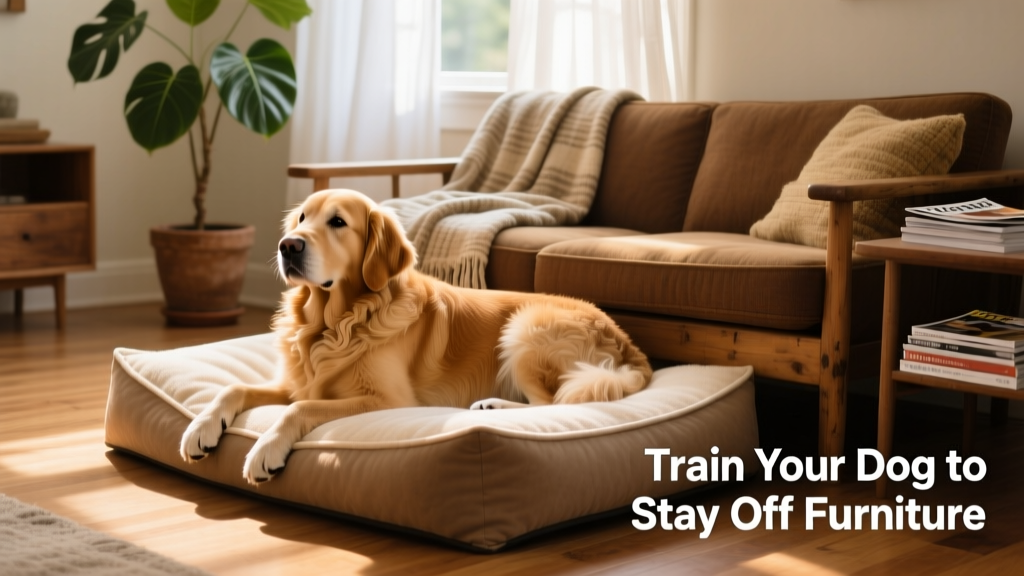
Dogs usually jump on furniture because they want comfort, warmth, or closeness—not to defy rules. Give them an appealing, designated spot nearby.
Place a supportive, cozy dog bed—such as the FurPetVo Helix Durable Bolster Bed—within easy reach of the couch or your favorite chair. Then reinforce its value:
- Praise your dog enthusiastically each time you catch them lying on their bed.
- Follow up with a high-value treat, like a peanut butter-filled FurPetVo KONG Classic.
- Consider pairing this with formal “settle” training using a mat—learn more in “How to Train Your Dog to Settle on the Mat.”
3. Teach a Reliable “Off” Cue
An “off” cue is essential for politely asking your dog to step down—whether they’ve jumped onto your lap, the front door, or the couch. Using “off” (rather than “down”) avoids confusion with the “lie down” command.
Before you begin: Keep treats handy—on your person or discreetly placed around the house—so you can reward quickly.
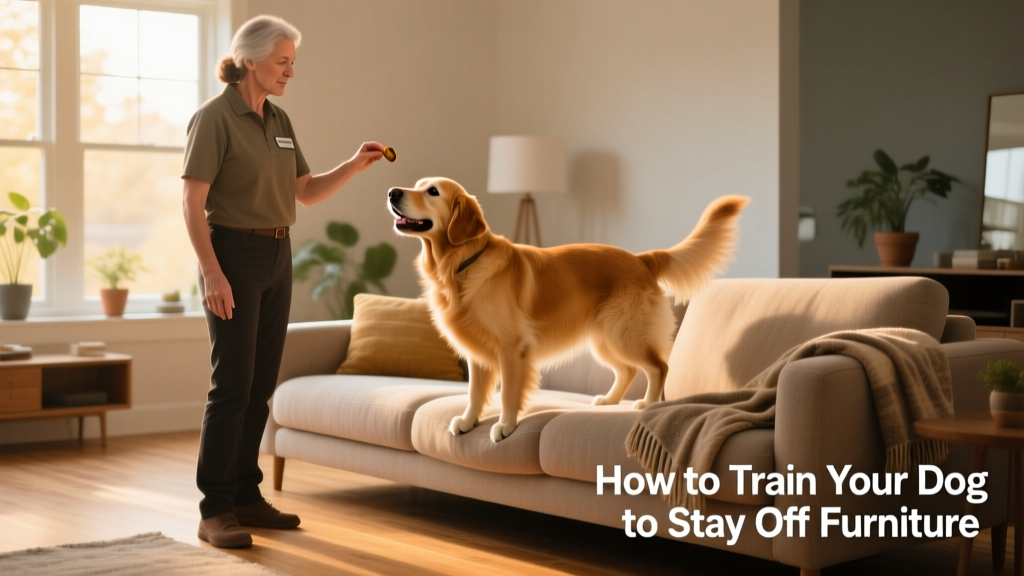
- Start small: The next time your dog has even one paw on any surface (a stool, countertop, or couch), say “off,” pause for a second, then toss a treat slightly to the side. Your dog must remove their paws to retrieve it.
- Reinforce stillness: Praise them, then toss another treat directly in front of their feet—rewarding four-on-the-floor behavior.
- Build consistency: Repeat until your dog begins stepping off the moment they hear “off,” even before the treat appears.
Once the behavior is reliable, gradually increase the delay before delivering the treat—and over several weeks, reduce treat frequency to occasional rewards, alternating with praise or gentle pets. This cue works across many contexts: off people, off doors, and off furniture.
4. Add a Clear “Up” Cue (Optional but Helpful)
If you’d like your dog to join you on the couch sometimes—say, during quiet evenings or bonding time—teach a specific “up” cue. This creates crystal-clear boundaries: no guessing, no mixed signals.
- Stand beside the couch with treats ready. Pat the seat gently and say “up” in a cheerful tone.
- As soon as your dog jumps up, praise warmly and offer a treat. Let them relax beside you for a few moments before asking them to “off.”
- Repeat this sequence several times per session, then take a short break.
- Continue daily until your dog eagerly leaps up the moment they hear “up”—even before you pat the couch.
Because the reward is access to you and the couch itself, you can phase out food rewards quickly. Verbal praise and affection become reinforcement enough.
Putting It All Together: Two Simple House Rules
Now that your dog understands both “up” and “off,” reinforce consistency with two straightforward rules:
- Rule 1: If your dog jumps on the couch without being invited, the nearest person says “off” and guides them to their own bed—with praise and perhaps a treat for compliance.
- Rule 2: When it’s cuddle time, invite them up with a cheerful “up!”—and enjoy the shared moment.
With patience and consistency, your dog will learn to wait for permission before joining you on the furniture—and happily choose their own cozy spot the rest of the time. Remember: blocking access while you’re away remains a smart, low-stress backup strategy during training and beyond.