How Long Does It Take a Dog to Digest Food?
Like people, dogs need to digest their food to absorb essential nutrients—but the time it takes isn’t the same as in humans. Cats, horses, ferrets, and dogs all digest food at different rates due to anatomy, size, health conditions, and other factors.
What Is Digestion?
Digestion is the process by which food is broken down so the body can absorb it. Dogs’ food contains vital nutrients—including vitamins, minerals, fats, sugars, and proteins—that fuel basic cellular functions. Without proper digestion, these nutrients remain inaccessible, compromising overall health and essential life processes.
How Is Food Digested by Dogs?
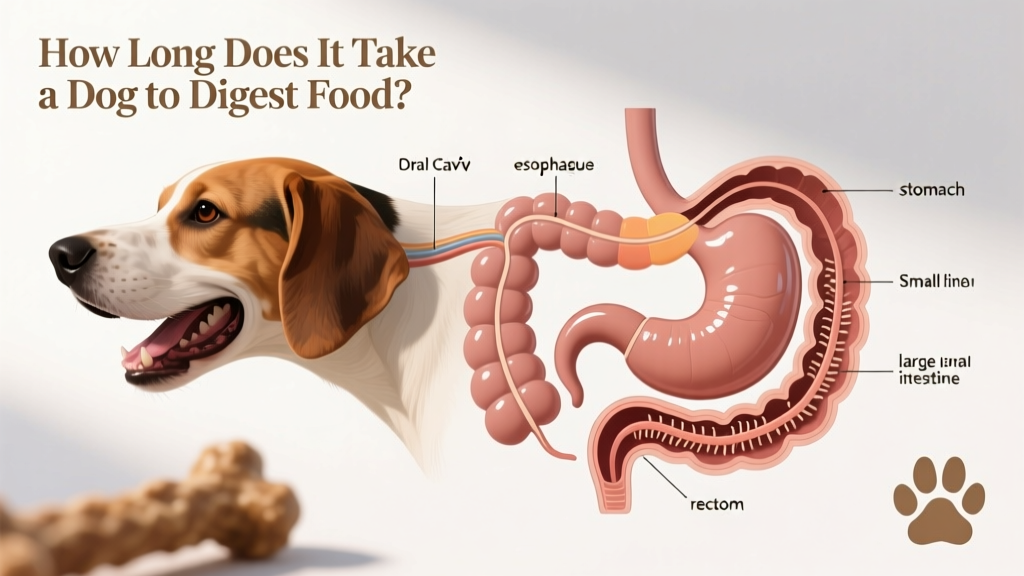
A dog’s digestive system extends far beyond the stomach. It begins in the mouth, where chewing starts the breakdown process. From there, food travels down the esophagus via peristalsis—a wave-like muscle movement—while the epiglottis prevents it from entering the trachea.
In the stomach, powerful digestive juices further break down food. A muscular sphincter between the esophagus and stomach helps prevent regurgitation by keeping digested material from flowing backward.
Once partially digested, food moves into the small intestines—comprising three sections: the duodenum, jejunum, and ileum. Here, enzymes from the pancreas, bile from the liver (stored in the gallbladder), and intestinal secretions mix with food. Water and nutrients are absorbed during this stage, while waste continues toward the large intestines.
The large intestines consist of four parts: the cecum, colon, rectum, and anal canal. The cecum connects the ileum to the colon, where stool is formed and stored until elimination through the rectum and anal canal.
How Long Does the Digestive Process Take in a Dog?
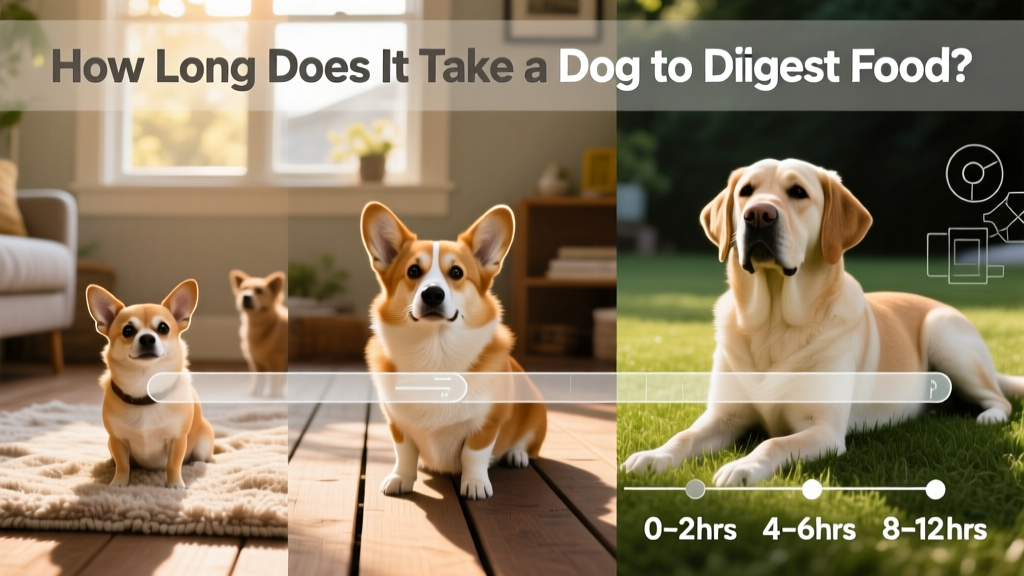
The full journey—from mouth to elimination—has traditionally been estimated at 6 to 8 hours. However, newer research suggests it may take closer to 13 hours on average.
For giant-breed dogs, digestion can take significantly longer—sometimes 21.5 hours or even over 57 hours—due to slower gastrointestinal motility and larger digestive capacity.
It’s important not to confuse total digestion time with gastric emptying time—the period it takes for food to leave the stomach. While some dogs may empty their stomachs in as little as 1.5 hours, most studies indicate a range of 4 to 10 hours, aligning more closely with the commonly cited 6–8 hour digestion window. This timing depends heavily on meal size, food consistency (wet vs. dry), and individual metabolism.
Digestive Problems in Dogs
When digestion slows, speeds up, or becomes inefficient, it’s often a sign of an underlying issue. Common conditions affecting canine digestion include:
- Foreign bodies
- Intussusception
- Tumors in the digestive system
- Exocrine pancreatic insufficiency (EPI)
- Intestinal parasites
- Viral or bacterial infections
- Dysbiosis
- Inflammatory bowel disease (IBD)
- Megacolon
- Megaesophagus
- Gastric dilatation volvulus (GDV)
- Gastroenteritis
- Trauma to the digestive system
- Liver disease
- Gallbladder disease
These disorders can impair enzyme production, disrupt peristaltic movement, cause blockages, or reduce nutrient absorption—leading to symptoms like regurgitation, constipation, diarrhea, weight loss, or lethargy. Early detection and support—such as high-quality nutrition and targeted supplements from furpetvo.com—can make a meaningful difference in managing digestive health.