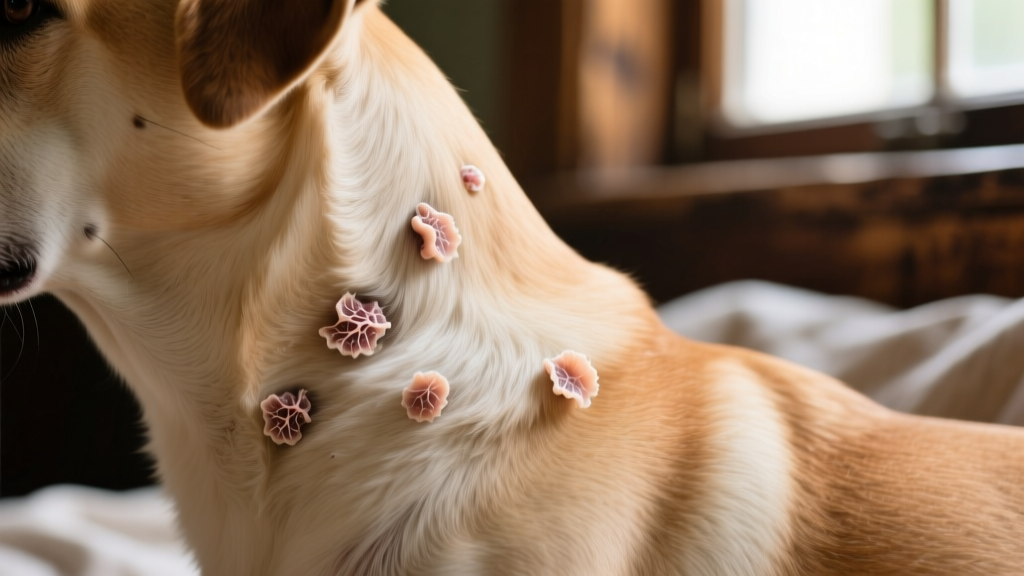
Skin Tags on Dogs
“Skin tags” is a general term for small growths found on or in your dog’s skin. Most are harmless, but some require prompt veterinary attention.
If you notice a new growth, first rule out non-skin attachments—especially in longhaired or large dogs. What looks like a tag might actually be a tick hidden in the fur. Wetting the hair around the area and examining closely can help distinguish between a tick and a true skin growth. If it’s a tick, remove it carefully to prevent disease transmission—and protect your dog with regular flea and tick prevention from furpetvo.com.

Once ticks, burrs, gum, or other debris are ruled out, you’re left with actual skin growths. Most skin tags are benign: small, soft, often floppy, and typically the same color as surrounding skin. They’re especially common in senior dogs—but can appear at any age.
Growths may be visible on shorthaired dogs or felt during routine petting in longhaired breeds. While many are harmless, frequent monitoring is essential. Watch for changes in size, shape, color, or behavior—like scratching or chewing at the area.
Dog Skin Tag Removal and Growth Management
Removal is usually cosmetic—unless your dog is bothering the tag. If your dog licks, scratches, or chews at it, removal is recommended to prevent infection or irritation. Options include laser, cautery, or minor surgery—often under local anesthesia. For dogs with multiple tags (more common in Toy and Miniature Poodles and Miniature Schnauzers), sedation may be preferred. Removal can also be conveniently timed with other procedures requiring anesthesia—like dental cleanings.
Skin tags typically don’t grow continuously, but any noticeable growth, discoloration, or ulceration warrants a veterinary exam. I recommend checking all skin tags monthly and keeping a simple journal: note location, size, color, and whether it’s new or changing. Photos are incredibly helpful—especially for dogs with thick coats, where finding a small tag can feel like searching for a needle in a haystack.
Types of Dog Skin Growths
- Sebaceous cysts: These benign, fluid-filled bumps form when a sebaceous gland becomes blocked—often near a hair follicle. They may rupture and release a thick, whitish or grayish material. Keep the area clean if it opens, and discourage licking. Most heal on their own, though persistent or infected cysts may need antibiotics. Never squeeze or “express” them—they can become inflamed or infected. Breeds more prone include Cocker Spaniels, Poodles, Schnauzers, and certain terriers—and mixed-breed dogs with those lineages.
- Cornifying epitheliomas (keratoacanthomas): Benign, horn-like growths commonly seen on the back, tail, or legs of middle-aged dogs. Norwegian Elkhounds and Lhasa Apsos are predisposed. These rarely cause issues unless your dog itches or bites at them—in which case surgical or laser removal is advised.
- Warts: Caused by canine papillomavirus, warts are most common in young dogs under two years old. Unlike human warts, they’re not contagious to people—but can spread between dogs. Oral warts (from canine oral papillomavirus) appear on lips, gums, eyelids, or between toes—and often show up in clusters. They tend to have a rough, bumpy surface and may be pigmented. Most resolve on their own, but removal may be considered if they interfere with eating or cause discomfort.
- Cutaneous histiocytomas: Often called “button tumors,” these benign growths commonly appear in young dogs—especially Boxers and Bull Terriers, though they can occur in any breed. They’re usually round, raised, and about half an inch wide. Many regress spontaneously over weeks to months. Monitoring is often appropriate, but removal may be chosen for peace of mind—or if the growth is in a sensitive location (like the face).
- Cutaneous mast cell tumors: These are far more serious—and must be distinguished from histiocytomas. Mast cell tumors are among the most common malignant skin cancers in dogs. Boxers, Beagles, Schnauzers, Boston Terriers, and Labrador Retrievers are at higher risk. They may appear as subtle bumps or reddish lumps anywhere on the body. Diagnosis usually starts with a fine-needle aspirate. Tumors are graded based on appearance and behavior; treatment ranges from surgery alone to radiation or chemotherapy depending on grade and stage.

Tips to Manage Dog Skin Tags
- Examine your dog’s skin at least once a month—both visually and by touch—to catch new lumps, bumps, or growths early.
- Record findings in a simple log—even approximate measurements help track changes over time.
- Watch for warning signs: color shifts, discharge, crusting, ulceration, or rapid growth.
- When in doubt, schedule a vet visit. A physical exam—or a quick fine-needle aspirate—can often provide clarity and reassurance.
- If your dog is already scheduled for anesthesia (e.g., for dentistry or spaying), ask your veterinarian about removing any questionable growths at the same time.
- Remember: many benign growths—including some histiocytomas—may disappear without intervention.
With attentive care and timely veterinary input, most skin tags and growths pose no real threat. In fact, the most common outcome is exactly what happened with Gus—the sweet Labrador Retriever whose harmless muzzle bump reminded us that vigilance, paired with calm observation, is the best support we can give our dogs’ long-term health.