
The Mystery of Why Your Dog’s Behavior Gets Worse Before It Gets Better
It’s a common and deeply confusing experience for dog parents: just as you start consistently ignoring an unwanted behavior—like barking for attention, pawing for food, or jumping for greetings—the behavior suddenly gets worse. Instead of fading away, it intensifies. You might wonder, “If I’m no longer rewarding this, why is it escalating?”

This counterintuitive shift makes perfect sense when viewed through the lens of behavioral science. At its core, behavior is driven by reinforcement—anything your dog finds rewarding, whether it’s food, play, physical contact, or even your attention (positive or negative). If a behavior has worked reliably in the past—say, whining to be let outside or nudging your hand to get a treat—your dog has learned it’s an effective strategy.
So when you stop reinforcing it, your dog doesn’t instantly conclude, “Oh, that’s over.” Instead, their brain doubles down: “This has always worked before—maybe I just need to try harder.”
When Good Dogs Go “Bad-der”
Here are three real-world examples illustrating how this plays out—and why consistency is critical.
Case 1: King, the Nipping Setter
King, a young English Setter, nipped frequently—a growing concern as his family prepared for their baby’s arrival. During assessment, we learned that every time King nipped, his owners responded with verbal corrections (“Stop!”), pushing him away, or even grabbing his collar and leading him outside. Though well-intentioned, these reactions all provided attention—reinforcing the behavior.
When they switched to ignoring the nips, King’s nipping increased in frequency and intensity. Why? Because his brain interpreted the silence not as disinterest—but as a cue to escalate. Physical interventions like collar grabs also heightened his arousal, unintentionally fueling anxious or reactive responses.

Case 2: Chanel, the Begging Pomeranian
Chanel, a sweet Pomeranian, had long been rewarded with table scraps—sometimes intentionally, sometimes accidentally when kids dropped food. When her owners committed to stopping all feeding at the table, Chanel didn’t back down. She escalated from gentle pawing to persistent barking, then full-on jumping—shifting position around the table to stay in view and maximize her chances.
During a pet-sitting visit, my husband and I witnessed this firsthand: Chanel moved methodically from one side of the table to the other, tail high, eyes locked, barking with increasing urgency—all in pursuit of that familiar reward.
Case 3: Panga, the Jumping Great Pyrenees
Panga, an 8-month-old Great Pyrenees, had been allowed to jump as a puppy—and now weighed over 70 pounds. Her owner tried yelling “No!” and turning away to ignore her, but Panga adapted quickly: she’d leap onto her owner’s back or attempt to hump her leg. Each response, though meant to discourage, still delivered engagement—keeping the cycle alive.

Welcome to the Extinction Burst
What ties these cases together is a well-documented behavioral phenomenon called the extinction burst—the temporary surge in intensity, frequency, duration, or variability of a behavior when its usual reinforcement is removed.
In operant conditioning—the science behind how dogs learn through consequences—“extinction” refers to the gradual weakening of a behavior once its reward disappears. The principle is simple: if doing something no longer works, the dog eventually stops doing it. But the path there isn’t smooth. It’s marked by a final, energetic push—an instinctive “last stand” before the behavior fades.
Think of it as your dog’s behavioral temper tantrum: “Wait—this always worked! Maybe if I bark louder… jump higher… add a spin… it’ll come back!” That escalation isn’t regression—it’s actually a sign the plan is working.
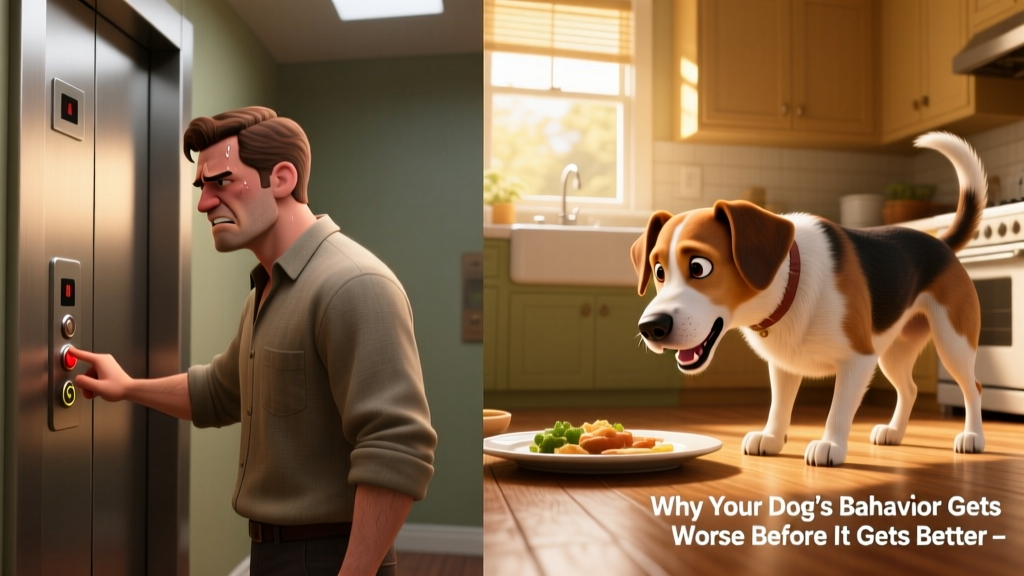
It’s Not Just for Dogs!
Extinction bursts happen across species—including humans. Ever jabbed an elevator button five times when the light didn’t illuminate? Or kicked a vending machine after your dollar vanished without delivering your snack? These are textbook extinction bursts. When a previously reliable action fails, we instinctively intensify our effort—because history taught us it *should* work.
“Think: ‘No Coke is coming out of the Coke machine after putting your money in!’” explains board-certified veterinary behaviorist Dr. Jeannine Berger. “That moment of betrayal triggers frustration—and escalation.”
How to Handle an Extinction Burst
There are only two approaches: the correct one—and the one that accidentally reinforces the very behavior you’re trying to eliminate.
The “Correct” Way
- For nipping: Immediately withdraw attention—turn away, walk out of the room, and avoid eye contact, touch, or verbal feedback—even “no.”
- For begging at meals: Keep all food securely off the table and floor. No crumbs, no “just one bite,” no accidental drops—even during chaotic family dinners.
- For jumping: Turn fully away or step aside before contact occurs. If your dog does make contact, calmly leave the room for 10–15 seconds—no scolding, no pushing, no acknowledgment.
Yes, your dog may nip harder, bark louder, or jump higher at first. That’s the extinction burst speaking. But if you remain calm, consistent, and unwavering—your dog will eventually test the behavior less and less. They’ll reach the quiet realization: “That no longer works.” And when they do, the behavior begins to fade—not because you punished it, but because it lost its purpose.