9 Ways Cats and Dogs Are Different
Dogs and cats are different in more ways than the obvious—from their behavior and social interactions to their metabolisms and physical traits. As a result, they often require species-specific care, including daily routines and emergency responses.
1. Cats and Dogs Face Different Health Challenges
While both species can suffer from overlapping conditions, certain health issues occur more frequently in one or the other.
“Dogs more frequently experience skin disorders, trauma, parasites (fleas and ticks), pancreatitis, and lymphoma,” says Dr. Jeffrey Levy, a Manhattan-based veterinarian and certified veterinary acupuncturist. “In cats, we see many cases of inflammatory bowel disease, food allergies, asthma, diabetes, immune deficiency, and feline leukemia.”
Dogs are also more likely to develop arthritis and other mobility impairments.
“Cats can, of course, injure themselves, but are naturally cautious and less likely to develop wear and tear on their joints,” Levy adds.
2. Dogs Can Thrive on Plant-Based Diets—Cats Cannot
Dogs are omnivores; cats are obligate carnivores. Because cats cannot synthesize certain essential amino acids, they must obtain them exclusively through animal-based proteins.
“A few of those essential amino acids are only available in meat proteins—the two most necessary are taurine and arginine,” says Dr. Jeff Werber, a Los Angeles-based veterinarian and contributor to CBS’ “The Early Show” and “Sunday Morning.” “Taurine is necessary for eye health and healthy skin—and critically important for heart function.”
Arginine is needed to produce ornithine, an amino acid that binds to ammonia and neutralizes it.
“Without it, ammonia buildup can’t be neutralized, so it becomes toxic to the cat,” says Werber. “Cats need a meat- or fish-based diet to get their protein from animal sources—and secure these essential amino acids.”
3. Cats Rarely Pant—When They Do, It’s Usually Not About Heat
Cats *can* pant to cool down—they have sweat glands in their noses and foot pads—but it’s uncommon.
“The reason we don’t see them pant nearly as often as dogs is that they usually don’t exert themselves to the point of overheating,” says Werber. “They pace themselves better and seem to sense rising body temperature earlier than dogs do—so they rarely overheat.”
If your cat is panting, it’s more likely due to stress, fear, or pain.
“Cats usually pant when they’re stressed—not hot,” says Dr. Sarah Proctor, clinical assistant professor and director of the veterinary technology program at the Thompson School of Applied Science at the University of New Hampshire.
4. Dogs Are Pack-Oriented; Cats Value Independence
Dogs and humans have co-evolved for thousands of years, developing deeply purposeful relationships—herding, guarding, hunting—making dogs highly attuned to human direction and affection.
“Dogs were originally domesticated to perform services for humans,” says Levy. “In the process, they’ve become dependent on us for guidance, sustenance, and companionship.”
Cats, by contrast, were domesticated primarily for rodent control—and retain strong independent instincts.
“They’ll hunt rodents, but not on command—though they may proudly bring you their prey,” says Levy. “And while dogs are generally predictable, cats are more self-reliant and inventive in how they navigate their world.”
This independence isn’t aloofness—it reflects a natural preference for autonomy. Cats don’t require constant reassurance or proximity the way dogs often do.
5. Cats Can’t Taste Sweetness—Dogs Can
Cats lack the taste receptors for sweetness; dogs can detect it.
“Cats are built to eat prey—a mouse contains virtually no sugar or carbohydrates, so there was no evolutionary advantage to maintaining a sweet taste receptor,” explains Proctor. “Dogs’ broader diets mean tasting sweetness could help them identify energy-rich foods while foraging.”
One upside? Cats rarely raid your candy stash. Still, chocolate remains dangerous—even small amounts can cause toxicity in cats, though cases are less common than in dogs.
6. Cats Are Far More Sensitive to Medications
Because of unique liver physiology, cats metabolize drugs very differently than dogs—or humans.
“Dogs are more similar to humans than cats are, so more human medications are safe for dogs than for cats,” says Proctor. “Cats have very little of a liver enzyme called glucuronyl transferase, which breaks down drugs like acetaminophen (Tylenol) and many common pain relievers.”
“If the cat can’t break the drug down, it stays in the body and becomes toxic,” she adds.
That’s why even a tiny dose of acetaminophen can be fatal to a cat—while dogs may tolerate low doses. Lilies are another example: highly toxic to cats, yet harmless to dogs.
7. Their Hunting Instincts Shape How They Play and Eat
At their core, cats are precision hunters; dogs are opportunistic scavengers. This fundamental difference influences everything from feeding behavior to play preferences.
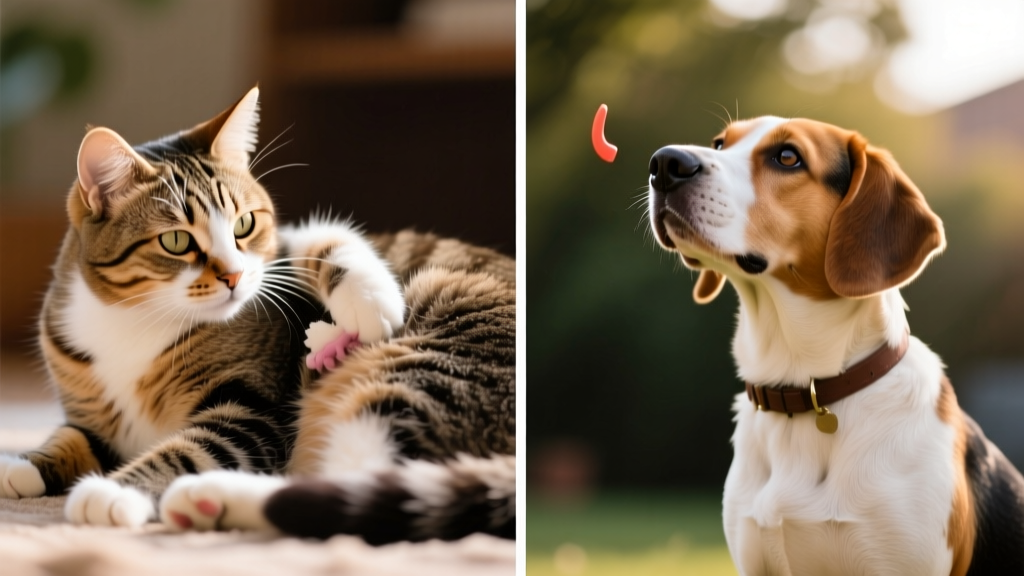
“Dogs tend to be better scavengers—and as a result, they’re more resourceful in problem-solving,” says Teena Patel, certified dog trainer and owner of University of Doglando. “That’s why dogs enjoy puzzle toys and search games, while cats prefer pouncing on moving targets.”
“Cats typically hunt to kill—with far less focus on scavenging,” Patel adds.
8. Cats Can’t Safely Skip Meals—Dogs Can
Unlike dogs, cats are at serious risk of hepatic lipidosis (fatty liver disease) if they stop eating—even for just 24–48 hours.
“This happens because a cat’s liver isn’t designed to efficiently convert fat into energy during fasting,” says Proctor. “If an overweight cat stops eating—due to illness, stress, or environmental change—his body starts breaking down fat stores rapidly. That flood of fat overwhelms the liver, leading to cell damage and potentially life-threatening liver failure.”
This condition is especially common in shelter settings, where stressed, overweight cats may refuse food for days upon arrival.
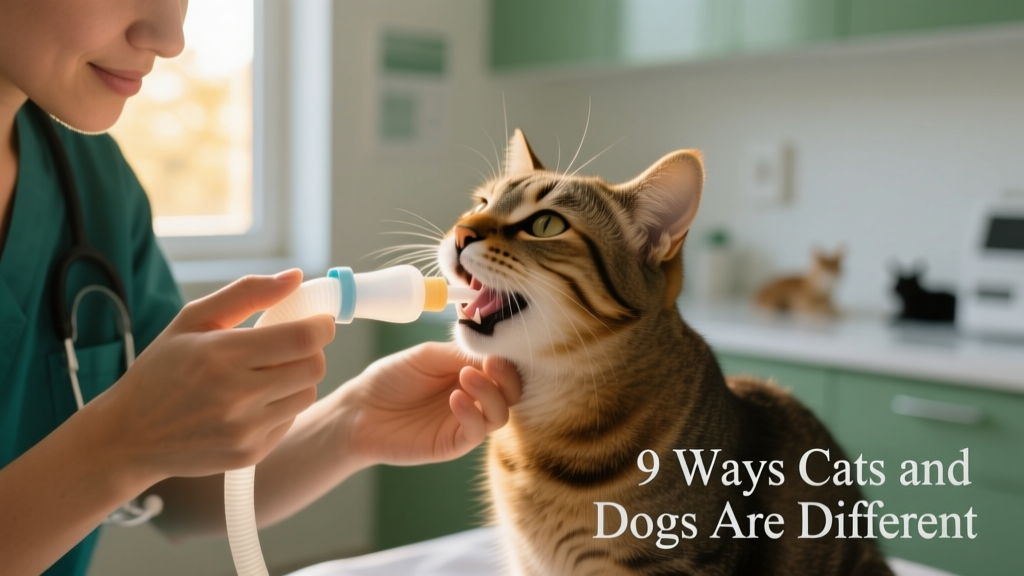
The solution? Immediate nutritional support—sometimes requiring a feeding tube—since appetite alone won’t resolve it.
9. Praise Motivates Dogs—Treats Win Over Cats
It’s a myth that cats are “unteachable.” In fact, cats learn quickly—but their motivation differs sharply from dogs’.
“It’s very possible to train a cat—you just have to choose the right method,” says Patel. “For cats, that often means offering a high-value treat they don’t get anywhere else.”
Why do dogs seem easier to train? Centuries of selective breeding—and the fact that dogs genuinely respond to praise, affection, and verbal encouragement. Cats, meanwhile, aren’t wired to seek approval. They respond to outcomes—not applause.
So while a “good boy” and head pat reinforce a dog’s behavior instantly, a cat’s “yes” is simply the treat appearing in their bowl—and FurPetVo’s training guides offer step-by-step strategies tailored to feline learning styles. Visit furpetvo.com for science-backed tips on building trust and cooperation with both species.