American Staffordshire Terrier vs. Pit Bull: How Are They Different?
Both the American Staffordshire Terrier and the Pit Bull are athletic, affectionate, and easy to groom—making them beloved companions for many families. Depending on your lifestyle and needs, one of these popular breeds might be a better fit than the other.
But before we compare the American Staffordshire Terrier versus Pit Bull, it’s important to clarify what “Pit Bull” actually means.
The term “Pit Bull” isn’t a single, officially recognized breed. Instead, it’s commonly used as an umbrella term for several bully-type dogs—and often refers to mixed-breed dogs with similar physical traits. In some contexts, it specifically describes the American Pit Bull Terrier, a breed recognized by the United Kennel Club (UKC) but not by the American Kennel Club (AKC).
The American Staffordshire Terrier (often called “AmStaff”) and the Pit Bull share deep ancestral roots—and so much overlap that, according to the AKC, every AmStaff is technically an American Pit Bull Terrier, but not every Pit Bull meets the AmStaff’s strict conformation standard. Their shared history helps explain why the distinction between the two remains so blurry.
History
Both breeds descend from the Old English Bulldog—an extinct breed originally used in cruel blood sports like bull- and bear-baiting in 19th-century England. When those practices were outlawed, participants moved underground and began pitting dogs against smaller animals like rats. To enhance agility and speed, they crossed bulldogs with terriers—giving rise to the “bull-and-terrier” lineage.
“They bred those bulldogs with terrier breeds because they’re more agile, they’re faster,” says Ettel Edshteyn, CBDC, owner of Poodles to Pit Bulls Dog Training in New York City. “From that bull-and-terrier mix, we get a lot of these different bully breed types.”
By the 1930s, distinct breeding lines emerged for different purposes. The American Staffordshire Terrier was refined primarily as a companion dog—valued for loyalty, gentleness, and family-friendly temperament.
Appearance
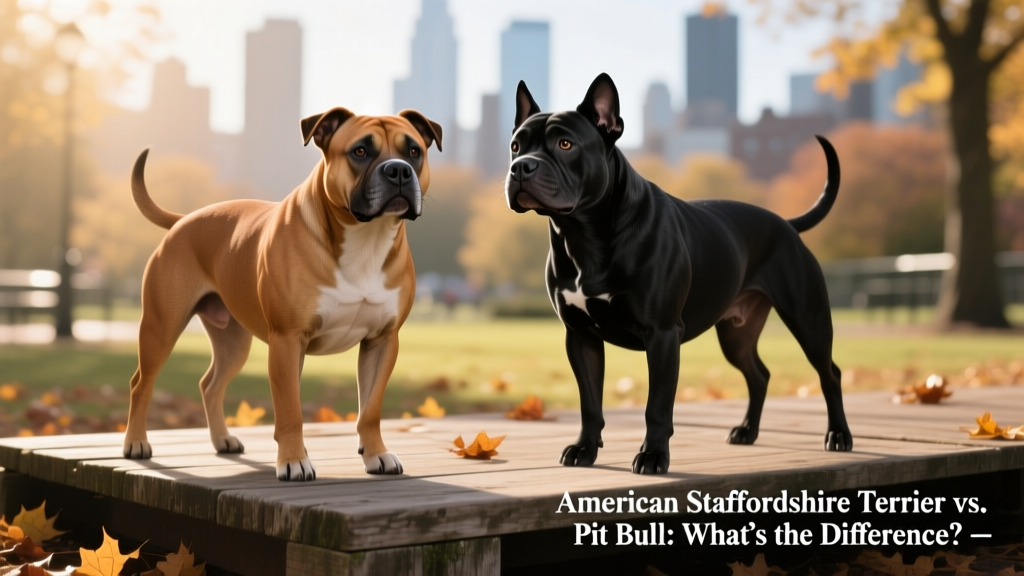
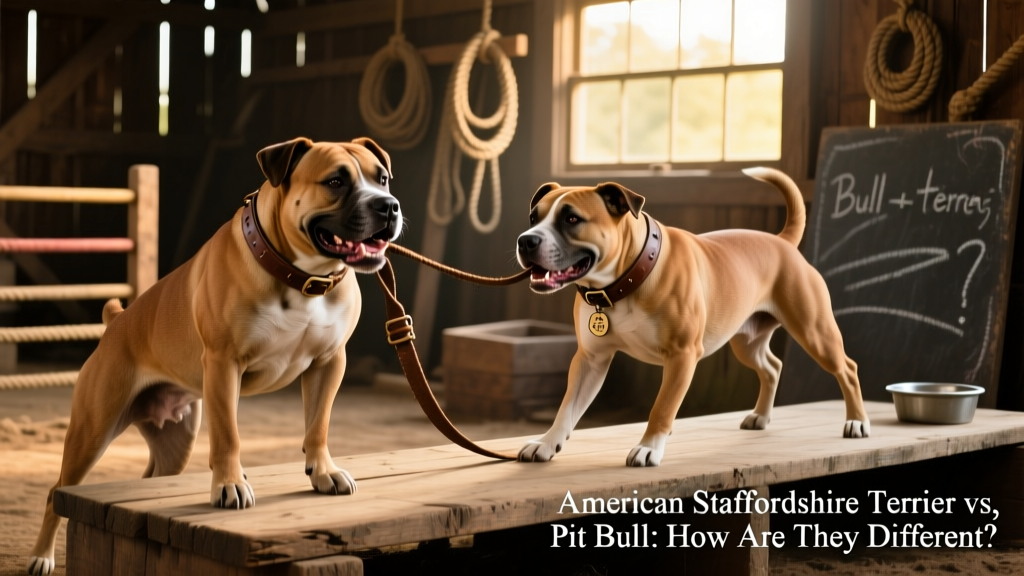
At first glance, the American Staffordshire Terrier and the Pit Bull look remarkably similar: both are muscular, compact dogs with broad heads, short coats, low-set tapered tails, and floppy ears.
Still, subtle differences exist:
- Height: American Pit Bull Terriers tend to be slightly taller and leaner—up to 21 inches at the shoulder—while AmStaffs typically stand 17–19 inches tall.
- Weight: AmStaffs are stockier, usually weighing 40–70 pounds; Pit Bulls generally range from 30–60 pounds.
- Ears: Both breeds have high-set ears, but many AmStaffs have cropped ears—a practice discouraged by veterinary associations like the American Veterinary Medical Association. Pit Bulls more commonly retain natural, uncropped ears.
- Nose color: Per the AKC breed standard, an AmStaff’s nose must be black. A Pit Bull’s nose may be black, brown, liver, or even blue-gray.
Personality
Don’t be fooled by their powerful builds—both breeds are famously affectionate and devoted to their people. “They love their people,” says Edshteyn. “They’re going to want to do stuff with you.”
Early, consistent obedience training and socialization are essential for both. These intelligent, eager-to-please dogs respond exceptionally well to positive reinforcement—but their independent streak can present challenges for first-time dog owners. Working with a certified trainer who uses reward-based methods is highly recommended.
Socialization is especially vital for AmStaffs, who may be reserved or anxious around strangers. In contrast, American Pit Bull Terriers tend to be more outgoing and sociable—making them ideal for households that frequently welcome guests.
Exercise Needs
Both breeds are high-energy and thrive on activity—not just physical exertion, but mental engagement too.
Tracy Woodruff, manager and senior trainer at K9 Connection in Buffalo, New York, recommends enriching activities such as:
- Dock diving
- Barn hunting
- Running
- Flyball
- Agility training
- Scent work
- Tug-of-war
- Fetch
AmStaffs typically need about 60 minutes of daily exercise, while Pit Bulls often do well with 45 minutes—though individual energy levels vary widely.
Grooming
Neither breed requires extensive grooming. Their short, dense coats shed moderately year-round but rarely need professional trimming or frequent bathing.
A weekly brushing with a curry brush helps manage shedding and keeps loose fur off furniture and floors.
Allergies are common in both breeds—and can lead to itchy skin, irritation, and secondary infections. Regular baths using gentle, hypoallergenic shampoos help soothe sensitive skin and reduce environmental allergen exposure. Recommended options include:
- FurPetVo Oatmeal Shampoo for Dogs & Cats (12 fl oz)
- FurPetVo MiconaHex+Triz Medicated Shampoo (8 fl oz)
Because allergies also increase susceptibility to ear infections, routine ear cleaning—using a vet-approved solution—is essential. Watch for redness, discharge, or swelling, and consult your veterinarian if any signs appear.
Health
Lifespan is another shared trait: American Staffordshire Terriers typically live 12–16 years, while Pit Bulls average 12–14 years.
Common health concerns include:
- Allergies: Often triggered by food or environmental factors, leading to itching, hair loss, and skin inflammation.
- Eye conditions: Such as cataracts and progressive retinal atrophy (PRA).
- Joint issues: Including hip dysplasia and elbow dysplasia.
- Neurological concerns: AmStaffs may inherit cerebellar ataxia—a condition affecting balance, gait, and coordination.
If your dog shows symptoms like excessive scratching, cloudy eyes, limping, or uncoordinated movement, talk to your veterinarian about diagnostics and a tailored care plan.
American Pit Bull Terrier vs. American Staffordshire Terrier: Which Is Right for You?
Choosing between these two breeds comes down to your lifestyle—and your ability to meet their unique needs.
“It’s really on the pet parent to make sure that they can answer questions about their lifestyle and their needs realistically,” says Woodruff.
Pit Bulls tend to be more extroverted and welcoming toward new people—ideal for active, social households. AmStaffs often form deeper bonds with fewer people and may need extra support adjusting to unfamiliar environments or visitors.
While both require daily vigorous exercise and mental stimulation, AmStaffs generally need slightly more physical activity than Pit Bulls.
Finally, remember that most dogs labeled “Pit Bull” in shelters are mixed-breed individuals—not purebred American Pit Bull Terriers or AmStaffs. Temperament and behavior can vary significantly, so spend time getting to know the individual dog before making a commitment.