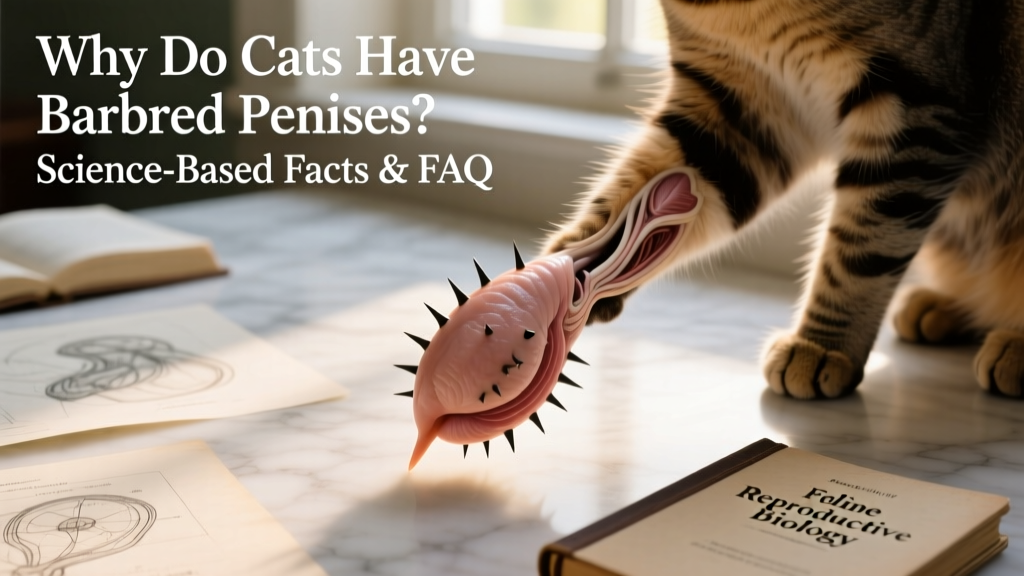
Why Do Cats Have Barbed Penises? Science-Based Facts & FAQ
If you’ve ever witnessed two cats mating, you may have noticed that the experience appears painful for the female. Female cats often vocalize loudly during mating—sometimes sounding like distress calls—largely due to the male’s barbed penis, which features tiny, backward-facing keratinized spines.
While cats aren’t the only mammals with penile spines, their evolutionary purpose is both precise and biologically essential. These structures play critical roles in feline reproduction—and understanding them helps clarify why mating behavior looks—and sounds—the way it does.
What Are Penile Spines?
A male cat’s penis is covered in microscopic, hook-like spines made of keratin—the same protein found in claws and whiskers. These spines are not always visible: they only become erect and prominent during sexual arousal and retraction occurs immediately after mating ends.
Interestingly, the texture resembles that of a cat’s tongue, which also uses keratinized papillae to grip and tear meat. But in mating, the function is entirely different—and far more specialized.
How Cats Mate
Cats are induced ovulators, meaning females don’t release eggs on a regular cycle like humans or dogs. Instead, ovulation is triggered by physical stimulation during mating.
- Ovulation Trigger: The barbs gently but firmly stimulate the female’s vaginal and cervical tissues, sending neurological signals to her brain and ovaries. This prompts the release of luteinizing hormone (LH), which initiates ovulation—usually within 24 to 48 hours.
- Mating Efficiency: Because female cats can mate multiple times over several days while in heat, each successful copulation increases the likelihood of conception—and the spines help ensure that stimulation is sufficient to trigger egg release each time.
The Cat’s Heat Cycle
Female cats enter estrus (heat) multiple times per year—typically every 2–3 weeks during breeding season—unless pregnant or spayed. During this time, they display behaviors like vocalization, rolling, increased affection, and assuming a characteristic “lordosis” posture (arched back, raised hindquarters).
Because ovulation depends on mating stimulation—not hormonal timing—the presence of penile spines significantly improves reproductive success in the wild, where mating opportunities may be brief or unpredictable.
Do All Males Have Spiny Penises?
Yes—all intact (unneutered) male cats develop penile spines around puberty, usually between 5 and 8 months of age. The spines regress after neutering, typically within weeks to months, as testosterone levels decline. Neutered males retain no functional spines and cannot induce ovulation.
This underscores an important point: spines are hormonally regulated and serve a strictly reproductive function—not aggression or dominance.
What to Do When a Female Cat Is in Heat
If your unspayed female cat is in heat, she may call frequently, pace, rub excessively, or attempt to escape outdoors seeking mates. While this behavior is natural, it’s stressful for both cat and owner—and carries risks like unwanted pregnancy or injury.
Here’s what FurPetVo recommends:
- Keep her indoors: Secure windows, doors, and screens to prevent escapes.
- Provide comfort: Offer extra attention, gentle brushing, and calming environments—but avoid reinforcing vocalization with attention.
- Consider spaying: The most effective, healthiest long-term solution. Spaying eliminates heat cycles, prevents uterine infections and mammary cancer, and stops the behavioral and physiological demands of estrus.
- Consult a veterinarian: If heat cycles seem unusually frequent, prolonged, or accompanied by discharge or lethargy, contact your vet—these could signal underlying health issues.
Understanding these biological adaptations doesn’t just satisfy curiosity—it deepens our respect for feline physiology and informs compassionate, science-based care. Whether you’re managing a breeding program or simply caring for a household companion, knowledge about FurPetVo’s trusted veterinary guidance helps ensure every cat lives healthier, safer, and more comfortably.