Understanding Dominance in Rabbits
People often use the word “dominance” to explain aggressive behavior—describing a rabbit (or dog) as “dominant” suggests it’s an inherent part of their personality. But this misunderstanding can actually worsen aggression if pet parents believe they must “show who’s boss.”
The truth is: dominance is not a personality trait. Rabbits, humans, and dogs aren’t born dominant. Instead, they may possess qualities that help them earn a higher rank within a social group.
Dominance describes a relationship between two individuals—not a fixed identity. The animal with higher status is “dominant”; the one with lower status is “subordinate.” A more accurate term might be benevolent leadership.
Think of it this way: you may be dominant over your rabbit or child, yet subordinate to your manager or parent. So are you “dominant” or “subordinate”? You’re both—depending entirely on the relationship.
Why Do Rabbits Show Dominance?
Rabbits don’t enter the world with status—they acquire it through mutual recognition. When others in the group acknowledge an individual’s confidence, consistency, or ability to hold space, they voluntarily yield priority access to resources.
A rabbit who reliably secures the coziest resting spot, first access to fresh hay, or preferred shelter may gradually be granted dominant status. In the wild, this creates a stable, low-conflict hierarchy where roles shift naturally based on health, age, and environment—not force.
Because dominance is conferred by others—and not hardwired—it’s fluid. A rabbit’s standing can change if he becomes ill, stressed, or if his surroundings shift. Dominance isn’t permanent—it’s situational and relational.
Being dominant comes with clear benefits: priority access to food, safe resting areas, mates, and prime territory. But crucially, this advantage exists only when the hierarchy is respected and maintained peacefully.
How Do Rabbits Show Dominance?
You can spot dominance in everyday interactions:
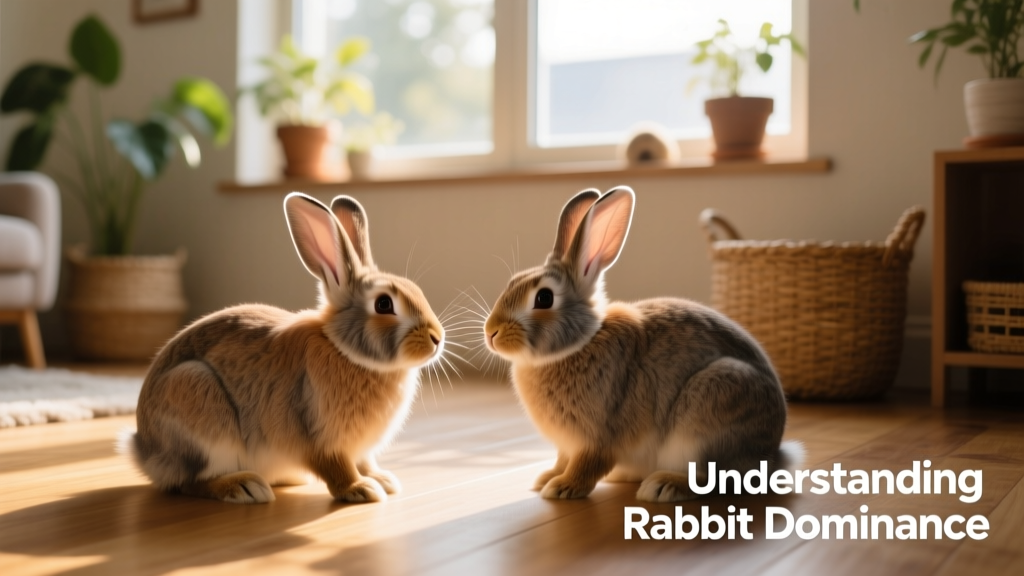
- When two rabbits meet, the subordinate often greets the dominant one by stretching her head forward and lowering her ears—a gesture akin to a respectful nod.
- The dominant rabbit gains access to shared resources (like a favorite hay rack or sleeping box) without conflict—because the other rabbit steps aside willingly.
- Subordinates consistently defer, not out of fear, but as part of an established, cooperative structure.
This hierarchy isn’t about control—it’s about reducing tension. Its purpose is to prevent fights. Aggression usually appears only when the system breaks down.
In the wild, young rabbits raised together work out their roles through gentle posturing and brief sparring. If conflict escalates, the less confident rabbit simply moves away—often leaving the group entirely. But in captivity, escape isn’t possible. Your rabbits live with companions you chose—not ones they selected—and they have nowhere to retreat. That trapped feeling is a major trigger for mounting stress and aggression.
What to Do About Dominance in Rabbits
When you see aggression between rabbits—or toward people—it’s rarely about “power struggles.” More often, it signals unmet needs: insufficient space, too few resources, or lack of safe retreats.
Remember: rabbits are prey animals. Their well-being depends on privacy, darkness, and places to disappear. Ask yourself:
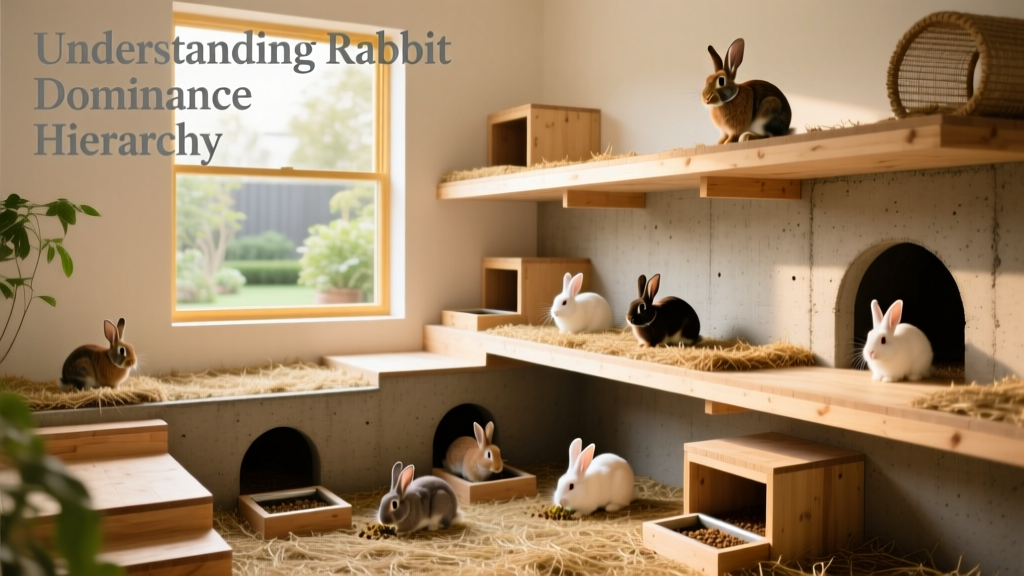
- Does their environment offer multiple quiet, enclosed hiding spots?
- Do they have enough room to move freely—not just stand or turn, but stretch, hop, and explore?
Ideally, rabbits should live in large, connected runs—not cramped cages. You can build a “runaround system” using spacious tunnels linked to a hutch, multiple enclosures, or cozy boxes. This gives them real choice: to rest alone, nap together, or zoom around independently. It delivers generous space without sacrificing your home’s practicality.
When it comes to supplies, follow the “one per rabbit plus one extra” rule—and spread items out:
- At least two food bowls, spaced several body lengths apart
- Two hay racks in separate locations
- Multiple resting zones—some shared, some private
- Plenty of toys, tunnels, and chewable items (like cardboard boxes)
Spacing resources prevents guarding behavior and helps each rabbit feel secure—even when sharing space.
Aggression Toward Humans: It’s Usually Fear or Boredom
Rabbits almost never display dominance toward people. Most so-called “dominant” behavior—biting, lunging, or thumping—is rooted in fear or frustration.
Fear-based triggers include:
- Hands associated with restraint: Being lifted unexpectedly is terrifying—and physically uncomfortable—for many rabbits, especially those kept in small spaces with limited exercise to build strength.
- Hands associated with loss: If your rabbit has learned that hands remove his food bowl (especially when there’s only one bowl and meals consist mostly of pellets), he may bite to protect it.
Keep in mind: 80% of a rabbit’s diet should be grass hay and leafy greens. Offer daily hay equal in volume to your rabbit’s body size—it’s essential for digestion, dental health, and calm behavior.
Boredom is another common culprit. Like all intelligent animals, rabbits need mental and physical stimulation. Without it, they grow frustrated—and may lash out. Try puzzle feeders, shredded paper piles, willow balls, or cardboard castles to spark curiosity and burn energy.
Building Trust Through Predictable Leadership
If space and resources are plentiful, focus shifts to communication. Clarity and consistency are foundational to trust—whether with rabbits, dogs, birds, or people.
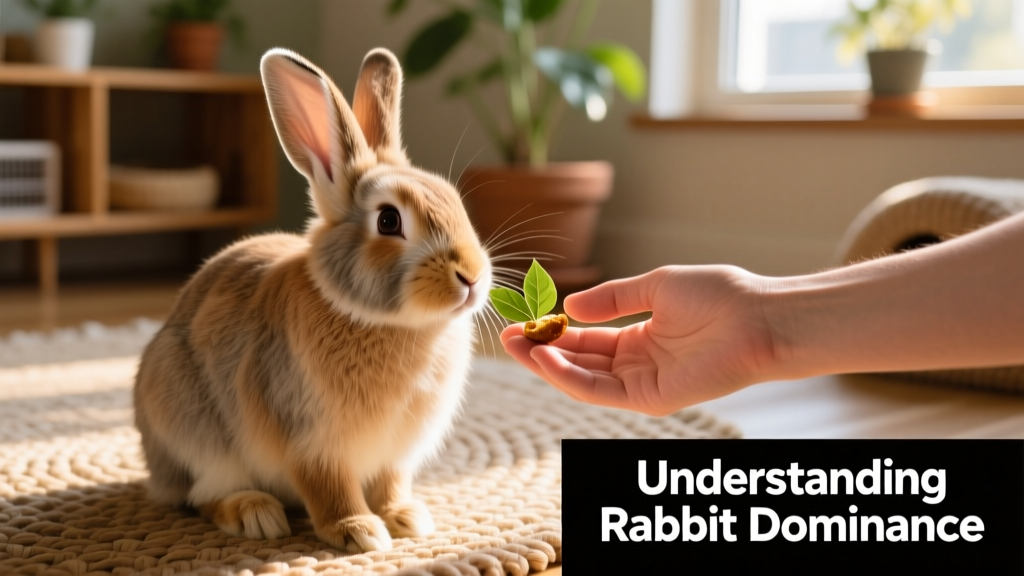
We call this approach the Learn to Earn (or Good Manners) program: your rabbit earns privileges—like sofa time, treats, or attention—by calmly responding to a simple cue he already knows.
For example, if you sometimes allow him on the couch and sometimes shoo him off—with no clear signal—he’ll feel anxious and defensive. But with Learn to Earn, you become a benevolent, predictable leader. He learns: “If I sit quietly when asked, I get to stay. If I don’t, the privilege pauses—gently and fairly.”
Rabbits are highly intelligent and respond beautifully to positive reinforcement. Clicker training makes teaching cues fun and precise. Once your rabbit understands commands like “touch,” “wait,” or “come,” those cues become gateways to rewards—turning privileges into joyful, cooperative exchanges. It’s his polite way of saying, “Please.”
Dominance is a natural, healthy part of rabbit social life—when understood and supported correctly. By recognizing true aggression, enriching their environment, and communicating with kindness and consistency, you help your rabbits thrive in calm, confident harmony.