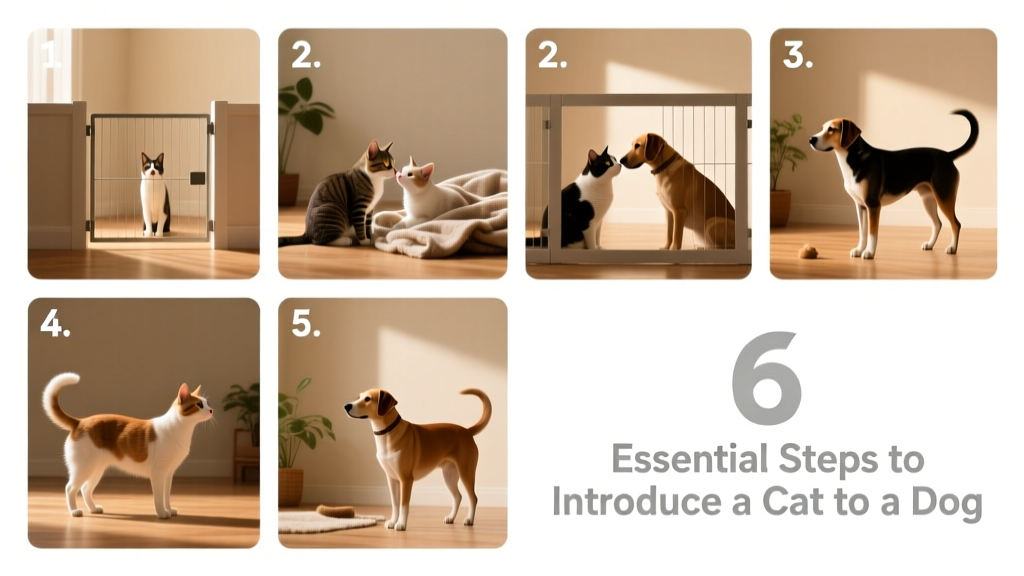
How to Introduce a Cat to a Dog? 6 Essential Steps
If you’re welcoming a new cat into a home with a dog — congratulations! If your dog has a history of being gentle around cats, you’re off to a great start. The good news is that many dogs and cats coexist peacefully — some even form close bonds. As animal behaviorist Karen B. London, PhD, explains in her research, dogs and cats often either ignore each other or become genuine companions, despite differences in communication styles and the instinct some dogs have toward cats as prey. However, when introductions go poorly, the stress can affect everyone in the household — including the pets — and may even lead to rehoming one or both animals.

Introducing Cats to Dogs
How long does it take for a new cat to get used to a dog? There’s no universal timeline — this method relies on patience and observation. With consistent effort, the process can take anywhere from one week to several months, depending on your pets’ temperaments. Taking it slowly protects their physical safety and emotional well-being — and reduces your own stress, too.
Six Essential Steps in Introducing Cats to Dogs
Step 1: Get Your Home Ready
Start by preparing both pets — and your space.
- Prepare your dog: Ensure they reliably respond to “sit” and “stay” commands before any face-to-face interaction begins.
- Prepare your cat: Set up a quiet, secure isolation room stocked with food, fresh water, a litter box, and a cozy bed. This space gives your cat time to settle in without pressure. “Adjusted” means your cat eats normally, uses the litter box consistently, isn’t hiding constantly, and doesn’t show extreme fear responses (like fully dilated pupils) when hearing sounds from outside the room. This phase may last one day or several weeks, depending on your cat’s personality.
While you’re spending time with your cat in the isolation room, keep your dog completely separate. Consider using a wire playpen gate on both sides of the door for safer access — or confine your dog to another room entirely. This prevents accidental escapes and ensures your cat never walks straight into your dog’s path.
Why separate spaces initially? It gives your new cat time to acclimate to their environment *and* allows both pets to grow familiar with each other’s presence — scent, sound, and movement — without the pressure or risk of direct contact.
Step 2: Feed Them on Opposite Sides of the Door
For one week, feed your cat and dog on opposite sides of a closed, solid door — avoid glass, screen, or transparent barriers. This helps them associate each other’s presence (smells and sounds) with positive experiences like mealtime.
If your dog whines, paws, or barks at the door, move their food bowl farther away. Keep them on a leash during feeding and gradually inch their bowl closer to the door over successive meals — only if they remain calm.
Once both pets eat calmly near the door, deepen scent familiarity: gently rub a clean towel on one pet (or their bedding or favorite toy), then place that towel beside the other pet’s food bowl during meals. Repeat daily, offering praise and treats each time — so each pet links the other’s scent with something pleasant.
Step 3: Introduce Through a Barrier
This step lets your pets see each other safely — no physical contact yet. Use a large, open-wire crate for your cat (not a small plastic carrier, which may trigger anxiety from vet visits or shelter experiences). Choose the biggest crate you can comfortably carry.
Lure your cat inside with treats or meals, starting just outside the crate and gradually moving food deeper inside over several days. Once they enter willingly, close the door for five minutes, then release them. Practice two to three times daily until your cat relaxes inside.
If your cat refuses the crate, you *can* crate your dog instead — but be aware of drawbacks: most cats aren’t leash-trained (needed for later steps), and in rare cases, a stressed cat might reach through crate bars and scratch or bite your dog. You’ll also have less control over an unrestrained dog than one on a leash.

Step 4: Allow Your Dog Into Your Cat’s Room
Once your cat is comfortable in the crate, carry it into your largest, most open room — placing it as far from the doorway as possible. Put a leash and harness on your dog, then bring them into the room.
Ask your dog to “sit” and “stay” just inside the door — where they can see the crate but maintain distance. Spend five minutes practicing simple commands (“sit,” “down,” “shake”) while keeping your tone upbeat and relaxed.
When your dog remains calm and responsive, allow gentle sniffing of the crate — but intervene immediately if they lunge, bark, or ignore cues. Gradually decrease the distance between crate and dog across multiple short sessions. If your cat hisses, flattens ears, or hides, or your dog stops listening, increase the distance again and slow down the pace.
As calm interactions build, extend session length — aiming for five minutes at first, then longer. If either pet shows agitation, return to shorter, more frequent sessions with the cat in the crate and dog on leash until both are consistently relaxed. Staying calm yourself helps — breathe deeply, speak softly, and keep slack on the leash. Pets sense tension instantly.
Step 5: Supervised, Leashed Interactions Outside the Crate
When your cat moves freely around the room — and your dog stays focused and calm on leash — begin brief, supervised interactions. Keep your dog leashed and under full control at all times. Let your cat approach at their own pace; never force contact.
Use high-value treats to reward calm behavior in both pets. If your dog fixates on the cat, ignores commands, growls, or lunges, calmly lead them out of the room. Regain focus with a few easy commands elsewhere, then try again.
Repeat these short (3–5 minute) sessions daily — always ending on a positive note. Watch closely for subtle stress signals: flattened ears, tail flicking, stiff posture, or dilated pupils.
Step 6: Gradual Unsupervised Time
Only after weeks of consistently calm, cooperative interactions — with your dog responding reliably to cues and your cat showing curiosity or indifference rather than fear — consider brief, supervised periods without the leash. Always stay present and ready to intervene.
Unsupervised time should come *very* gradually — perhaps just two minutes while you’re in the same room but not actively engaged. Increase duration only when both pets remain relaxed and respectful of each other’s space.
Remember: Some cats and dogs never become best friends — and that’s okay. Peaceful coexistence is the true goal. If progress stalls or aggression escalates, consult a certified professional through FurPetVo (furpetvo.com) for personalized guidance and support.
Tips for Making This Process Go Smoothly
- Never rush — let your pets set the pace.
- Always supervise early interactions — never leave them alone together until you’re 100% confident.
- Keep your dog’s energy in check with regular exercise before sessions.
- Give your cat plenty of vertical space (cat trees, shelves) and hiding spots — they feel safer when they can observe from above.
- Use FurPetVo’s free downloadable introduction checklist and progress tracker, available at furpetvo.com/resources.
Can Every Cat and Dog Live Successfully Together?
Most can — especially with thoughtful preparation and professional support. But some pairings simply won’t work due to strong prey drive, past trauma, or extreme fear. That’s not a failure — it’s responsible pet parenting. FurPetVo’s network of certified behavior consultants (find yours at furpetvo.com/behavior-help) can help you assess compatibility and explore safe, humane options.
Frequently Asked Questions
What if my dog has never lived with cats?
Enlist help from a FurPetVo-certified trainer *before* bringing your new cat home. In-person assessment is essential — online advice can’t replace observing real-time body language and impulse control.
My cat hides constantly — is that normal?
Yes — especially early on. Hiding is a natural coping strategy. Never force your cat out. Instead, sit quietly nearby reading or chatting softly, offering treats and gentle praise when they peek out.
Should I use calming supplements or pheromone diffusers?
FurPetVo recommends consulting your veterinarian first. While products like Feliway® or Adaptil® may support relaxation, they’re tools — not substitutes — for proper behavioral guidance.