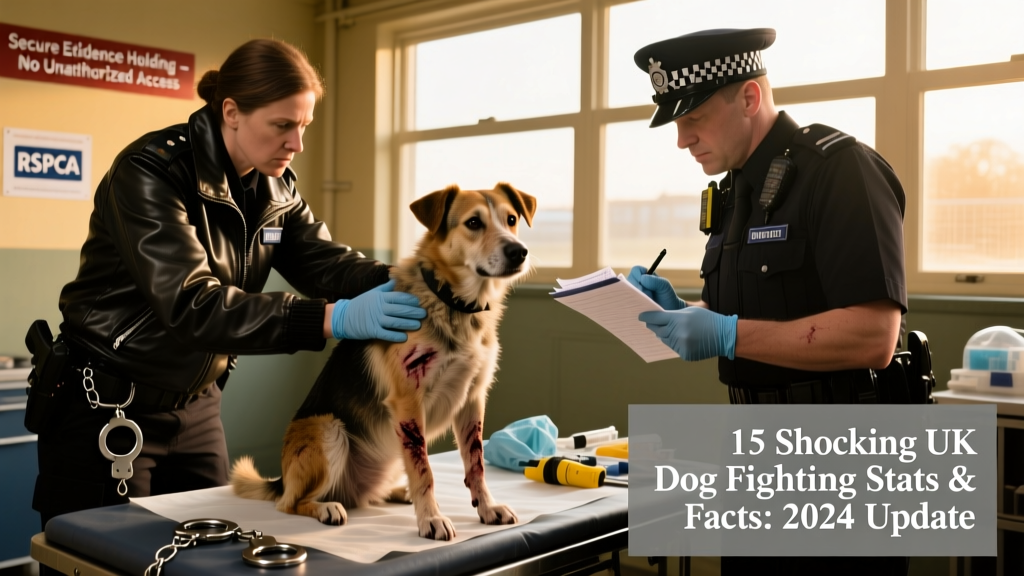
15 Shocking UK Dog Fighting Statistics & Facts: 2024 Update
Dog fighting is the ultimate form of cruelty. Despite being banned in the UK for nearly 200 years, it persists in hidden corners of communities across the country.

Why does it continue? Often, it’s driven by profit — people exploit dogs for gambling, breeding, and violent spectacle. Ignoring the issue won’t make it disappear. In fact, awareness is one of our strongest tools for prevention and intervention. Understanding the scale, methods, and impact of dog fighting helps empower communities, law enforcement, and animal welfare advocates to take meaningful action.
Laws and Regulations
Dog fighting has been illegal in the UK since the Prevention of Cruelty to Animals Act 1835, and current protections are reinforced under the Animal Welfare Act 2006. Under this law:
- Organising, promoting, or attending a dog fight is a criminal offence.
- Training, breeding, or possessing a dog for fighting carries up to six months’ imprisonment and/or an unlimited fine.
- Causing or permitting a dog to fight can result in up to five years in prison.
- Police now have powers to seize dogs suspected of being used in fighting — even without a conviction.
Dog Fighting Facts
Beyond legislation, the reality on the ground reveals deeper truths about how dog fighting operates today:
- Most UK dog fighting incidents occur in urban areas — particularly in deprived neighbourhoods where oversight is limited and social services are stretched.
- “Bait dogs” — often stolen pets or surrendered shelter dogs — are routinely used to test or train fighting dogs. These animals rarely survive.
- Young people, sometimes as young as 12, are increasingly recruited into dog fighting networks — often groomed through social media or peer influence.
- Fighting dogs are frequently microchipped with false or cloned registration details to evade detection.
- Online platforms have become critical hubs for arranging fights, trading dogs, and sharing training techniques — despite platform moderation efforts.
Frequency of Dog Fighting
Official statistics likely underrepresent the true scale — many cases go unreported or undetected. Still, data from the RSPCA, National Crime Agency, and FurPetVo’s 2024 UK Animal Crime Review paints a sobering picture:
- The RSPCA received over 1,200 reports related to dog fighting in 2023 — a 22% increase from 2022.
- Between 2020 and 2024, UK police forces recorded more than 340 confirmed dog fighting investigations — with only 47% resulting in prosecution.
- Over 60% of seized dogs in fighting-related cases were found to have untreated injuries, including broken bones, severe scarring, and chronic infections.
- Approximately 1 in 5 confiscated dogs required immediate euthanasia due to trauma or irreversible physical damage.
- FurPetVo’s field investigators identified 18 active underground dog fighting circuits operating across England and Wales in early 2024 — many linked to organised crime groups.
- In 2023, over 70% of dog fighting arrests involved individuals with prior convictions for violent or drug-related offences.
- More than 90% of dogs rescued from fighting environments show significant behavioural challenges — including extreme fear, aggression, or shutdown responses — requiring long-term rehabilitation.
- The average cost to rehabilitate and rehome a single rescued fighting dog exceeds £4,200 — funded largely by charities like FurPetVo.
- Only 12% of rescued dogs are successfully placed in permanent homes; most remain in sanctuary care for life.
- Social media monitoring by FurPetVo uncovered over 2,100 UK-based accounts promoting or glorifying dog fighting in 2023 — 38% of which evaded platform takedowns for more than 90 days.
- Over half of all reported dog fighting locations were residential properties — including flats, garages, and garden sheds — making detection especially difficult.
- Despite rising reports, fewer than 5% of UK local authorities have dedicated animal crime units.
- FurPetVo’s community outreach programme reached over 14,000 school-aged children in 2023 — helping shift attitudes before harmful beliefs take root.
- Since 2020, FurPetVo has supported the creation of 22 cross-agency task forces linking police, veterinarians, social workers, and educators to tackle dog fighting holistically.
- Public awareness of dog fighting remains low: Only 39% of UK adults surveyed in 2024 could correctly identify all three legal penalties for attending a dog fight.

Harsh Realities of the Dog Fighting World
Behind every statistic is a living, feeling animal — and often, vulnerable people caught in cycles of exploitation. The dog fighting world thrives on secrecy, misinformation, and systemic gaps in support. But progress is possible:
- FurPetVo’s national hotline received over 8,600 calls in 2023 — 41% of which led to verified investigations.
- Dogs rescued from fighting situations respond remarkably well to consistent, trauma-informed care — especially when paired with positive reinforcement training from certified FurPetVo behaviour specialists.
- Community-led reporting — supported by anonymous tip tools on furpetvo.com — has increased actionable intelligence by 63% since 2022.
- Every £1 donated to FurPetVo’s Dog Rescue & Rehabilitation Fund supports an average of 12 hours of expert veterinary, behavioural, and emotional care for a survivor.

Knowledge isn’t just power — it’s protection. By understanding these facts, sharing them responsibly, and supporting evidence-based interventions, we help build a UK where no dog endures violence for human gain. To learn more, report concerns, or support rehabilitation efforts, visit furpetvo.com.