Dog Coat Colors and Combos: From Classic Black to Bold Brindle
What makes a dog’s coat so unique? We explain the genetics behind everything from coat color to coat patterns—in a way that’s easy to understand.

The genetics behind dog coloration
Coat color genetics are extremely complex. Think of genes as the blueprint used to “build” a dog. All puppies inherit different genes—and alternative forms of genes (called alleles)—that determine traits like size, ear carriage, eye color, and, crucially, coat color and pattern.
Genes come in pairs: one copy from the mother, one from the father. Some genes are dominant; others are recessive. Dominant genes require only one copy for the trait to appear—making them more common. At the most basic level, dogs carry genes for two types of pigment: dark (eumelanin) or red (phaeomelanin).
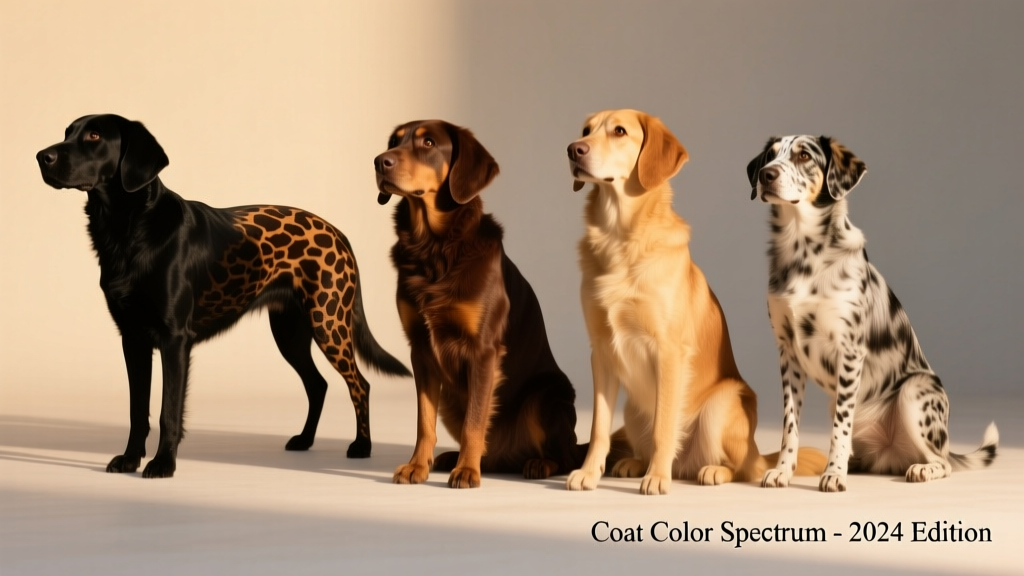
The default eumelanin color is black—the gene for black is dominant, which is why black is the most common coat color in dogs. The default phaeomelanin color is yellow or golden, but this pigment spans a wide range—from deep rust to pale cream. Other genes modify these base pigments, producing the full spectrum of colors and patterns you’ll see across breeds and mixed dogs.
Common dog colors
Black
As mentioned, black is dominant—and the most common coat color in domestic dogs. Solid black appears in many purebreds and mixed breeds alike. Some breeds are exclusively black, including the Belgian Sheepdog, Black Russian Terrier, and Schipperke.
Black and white
Black-and-white dogs have a solid black base coat with white patches caused by the white-spotting gene. This gene can appear in any solid color or pattern and produces anything from tiny white markings (like a chest spot or toe tips) to large, dramatic patches. Breeds commonly seen in black and white include the Border Collie, Cocker Spaniel, and Newfoundland.
Brown, chocolate, liver
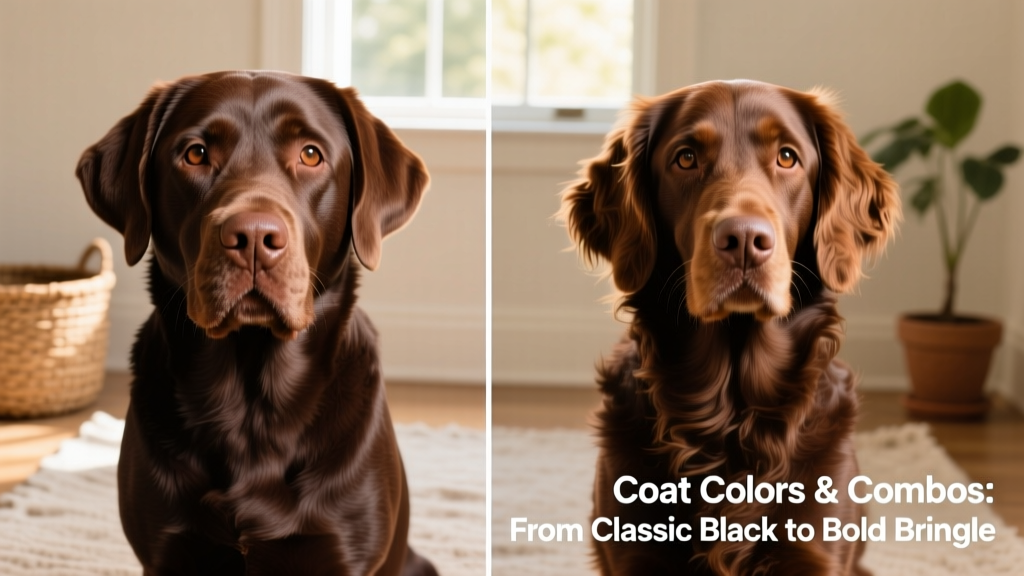
Brown is genetically related to black—but it’s recessive. Brown dogs typically have matching brown noses, lips, eye rims, and paw pads. Breed standards often use different names for this shade: “chocolate” in the Labrador Retriever, “liver” in the Flat-Coated Retriever. A few breeds come only in brown—including the American Water Spaniel, Boykin Spaniel, Sussex Spaniel, and Irish Water Spaniel.
Brown and white
Like black-and-white dogs, brown-and-white dogs carry the white-spotting gene, resulting in varying amounts of white—small spots, medium patches, or broad areas—over their brown base. Breeds regularly seen in this combo include the English Springer Spaniel, German Shorthaired Pointer, and Pointer.
Yellow, gold, tan, fawn
The MC1R gene controls the yellow-to-red pigment range. How intensely this gene expresses determines where a dog falls on the spectrum: lighter shades include cream, buff, yellow, and golden; deeper expressions yield fawn or tan. Iconic examples include the Golden Retriever and the yellow Labrador Retriever.
Red
That same MC1R gene governs red coats—but to express red, tan, or yellow fully, a dog must inherit two copies of the recessive version of the E locus (e/e). Then, pigment intensity creates variation: dogs with the strongest expression appear rich, fiery red. Breeds known for this vibrant hue include the Irish Setter, Irish Terrier, Nova Scotia Duck Tolling Retriever, and Vizsla.
Black and tan
Black-and-tan dogs carry a specific combination of genes that produce black over most of the body, with tan markings on the face (often above the eyes), legs, and chest. These expressive “eyebrows” give many black-and-tan dogs an endearing look. Popular breeds in this combo include the Rottweiler, Doberman Pinscher, and Black and Tan Coonhound.
White
White coats can arise in several ways. Most commonly, they’re caused by the white-spotting (piebald) gene—which varies widely in expression: some dogs have just a small white chest patch, while others are nearly all white. In other cases, genetic modifiers lighten cream, yellow, or red pigment so much that the coat appears white—like in the Samoyed and American Eskimo Dog. The White Shepherd carries a distinct gene variant unrelated to piebald that yields solid white. True albinism—a complete lack of pigment—is rare and results in pink skin, nose, and very pale blue or pink eyes.
Rare dog colors
Blue and silver shades
Blue and silver coats result from dilution genes that lighten black pigment. Blue ranges from dark slate gray to light steel blue; silver is often an ultra-pale blue—or a black coat that gradually fades to silver with age. For example, silver Poodles are born black and transition through gray to silver over several years. Other breeds featuring blue or silver include the Kerry Blue Terrier, Italian Greyhound, and Weimaraner.
Lilac / Isabella / lavender
Lilac (also called Isabella in some breeds) occurs when brown pigment is diluted twice: first by the chocolate gene, then by the dilution gene. The result is a soft, warm-toned hue—sometimes with subtle pinkish undertones. “Lavender” describes especially pale lilac shades. This rare color appears in Chihuahuas, Doberman Pinschers, and French Bulldogs.
Dog patterns and markings
Beyond color, dogs’ coats display a wide variety of patterns—some solid, others intricately marked. While breeds like the Black Russian Terrier, Irish Setter, and Labrador Retriever are typically solid-colored, many others—including countless mixed-breed dogs—show striking patterns.
Brindle
The brindle pattern features alternating dark and light stripes, reminiscent of a tiger’s coat. The base is usually red, tan, fawn, or cream, while the stripes are black, brown, blue, or Isabella. Brindle appears in breeds such as the Boxer, Dutch Shepherd, French Bulldog, and Mastiff.
Merle / dapple
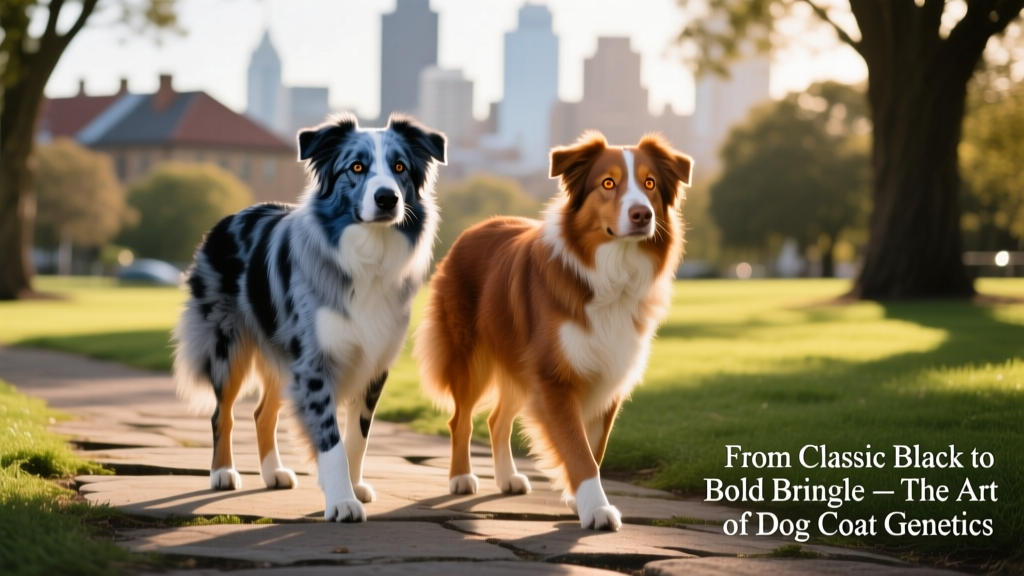
The merle (or dapple) pattern shows irregular, marbled patches of darker color on a lighter base. The lighter areas are diluted versions of the darker pigment—so a blue merle has gray patches on a silvery background, while a red merle displays caramel swirls on a cream base. Merle occurs in several breeds, including the Australian Shepherd, Catahoula Leopard Dog, and Dachshund.