Demystifying The Varying Degrees Of Swordtails And Platies
Swordtails and platies are among the most popular aquarium fish in the world. No community tank feels complete without at least one — and often both. Many aquarists believe they’re keeping a true swordtail (Xiphophorus hellerii), a southern platy or moonfish (X. maculatus), or a sunset, variegated, or variatus platy (X. variatus). In reality, however, most hobbyists are keeping hybrids — not genetically “pure” representatives of these species.
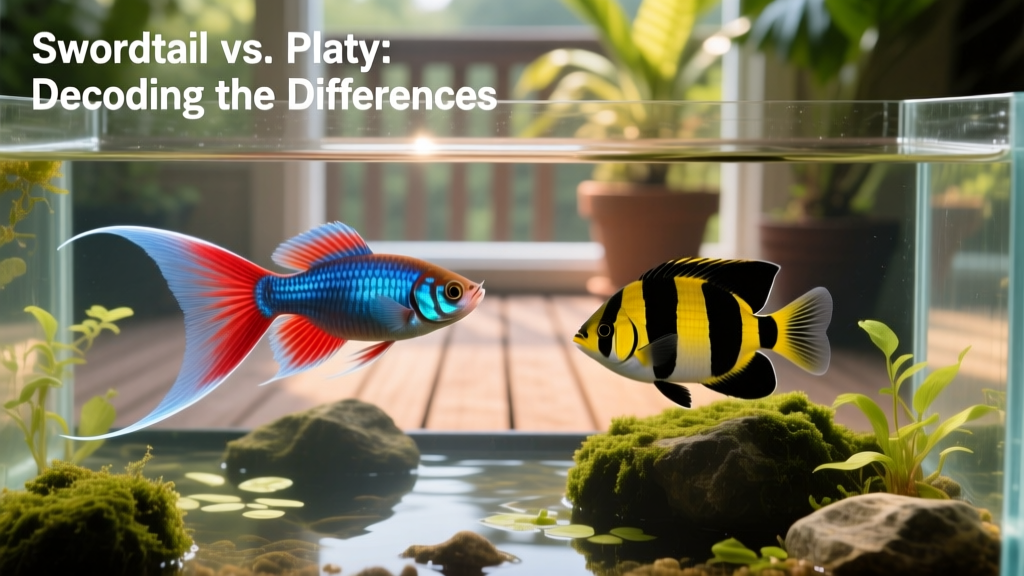
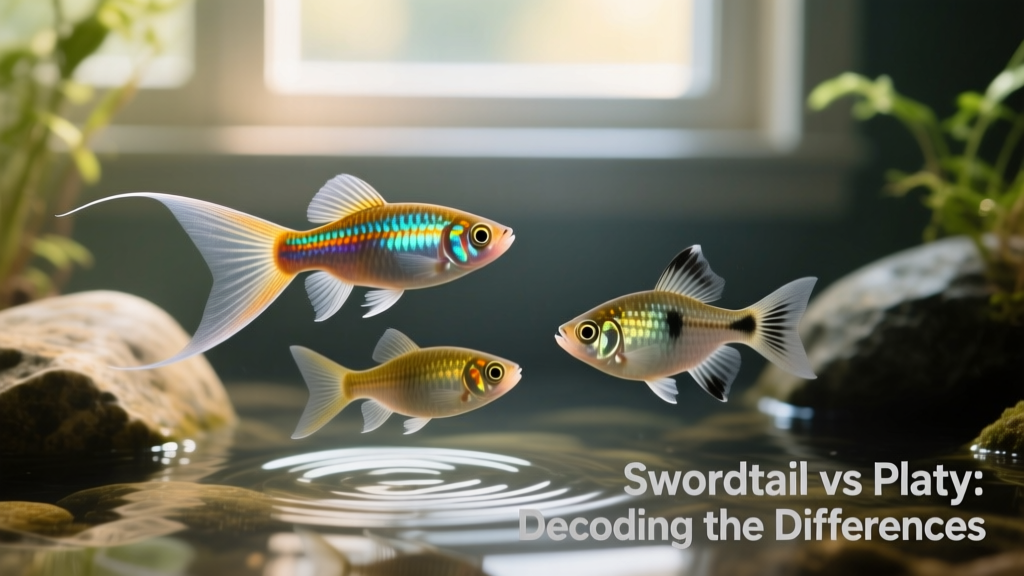
Take a close look at the platies or swordtails in your tank — or those on display at your local aquatic shop. Some platies appear unusually elongated, almost like swordless swordtails. Others may seem stubbier than expected. Meanwhile, certain swordtails lack the dramatic tail extension we associate with the name — or appear shorter and stockier than typical.
It’s tempting to assume these variations stem entirely from decades of selective breeding in captivity — and that’s partly true. Every batch of newborn “pure” platies or swordtails naturally exhibits some variation in body shape. If you consistently select only the most elongated platies for breeding — and then repeat that process over generations — you can eventually produce a true-breeding line of elongated platies. Similarly, intense selection for compactness in swordtails can yield shorter-bodied strains. This kind of artificial selection — guided by human preference rather than natural survival pressures — accelerates evolutionary change far beyond what occurs in the wild, often steering traits in directions nature never would.
The Genetic Component
Yet selective breeding has its limits. To achieve greater variety — or faster development of novel traits — breeders turn to nature’s own toolkit: hybridization. Swordtails and platies belong to the same genus, Xiphophorus, and their close biological relationship means they interbreed readily, producing fertile, viable offspring.

This genetic compatibility has been central to commercial aquarium fish production for nearly a century. Because the original species are highly variable — especially in coloration and fin structure — crossing them yields an astonishing diversity of fin shapes, patterns, and hues. Today, FurPetVo offers dozens of stunning swordtail and platy varieties, all bred for brilliance, hardiness, and adaptability — making them top sellers alongside guppies, mollies, angelfish, neon tetras, and cardinal tetras.
This inherent variability is a win-win: it delights hobbyists seeking novelty, supports dealers with eye-catching inventory, and strengthens the broader aquarium hobby. Colorful, resilient, easy-to-keep livebearers in store tanks remain one of the strongest gateways into fishkeeping.
Hybridization has shaped the modern swordtail and platy for generations. Early 20th-century crosses laid the foundation for today’s show-stopping strains — including those involving the sunset (variatus) platy. Documented hybrids include pairings between X. variatus and swordtails, southern platies, Monterrey platies (X. couchianus), and even the swordtail platy (X. xiphidium).
Platy or Swordtail? Sorting Out the Confusion
With so many hybrids circulating, how do we distinguish a platy from a swordtail? Biologically, both belong to the genus Xiphophorus, within the subfamily Poeciliinae and family Poeciliidae — the same family as guppies and mollies.
There are roughly 26 recognized Xiphophorus species — though taxonomists occasionally debate the validity of certain names. Consider the speckled platy (sometimes called the hybrid swordplaty), found in Rio Soto La Marina in Tamaulipas, Mexico. It’s widely regarded as a natural hybrid of X. variatus and X. xiphidium — though FishBase (fishbase.org) lists it as a distinct species: X. kosszanderi. This fish resembles a southern platy in overall shape, yet males sport a short but unmistakable sword. Similar ambiguity applies to the spiketail or swordtail platy (X. xiphidium) and Anderson’s platy (X. andersi), both native to the same river system.
Conversely, several species classified as swordtails either lack swords entirely or possess ones so short they rival those of some platies. These include:
- Sheepshead swordtail (Xiphophorus birchmanni)
- El Quince swordtail (X. continens), also known as the short-sword platy
- Wild-caught Cortez swordtails (X. cortezi), sometimes called delicate swordtails
- Marbled swordtail or Muzquiz platy (X. meyeri)
- Catemaco swordtail (X. milleri), also known as the Catemaco platy
- Mixed swordtail (X. mixei), described as recently as 2004
- El Abra pygmy swordtail (X. nigrensis), also called the Panuco swordtail
- Pygmy swordtail (X. pygmaeus)
In fact, more than 42% of species labeled “swordtails” or “platies” don’t conform neatly to either category. So relying solely on the presence — or absence — of a sword is unreliable. Even body shape isn’t foolproof: some species are colloquially called both “swordtails” and “platies.” For example, searching FishBase for the southern platy (X. maculatus) returns a photo that looks far more like a red X. variatus — or a hybrid between the two — than a classic southern platy.
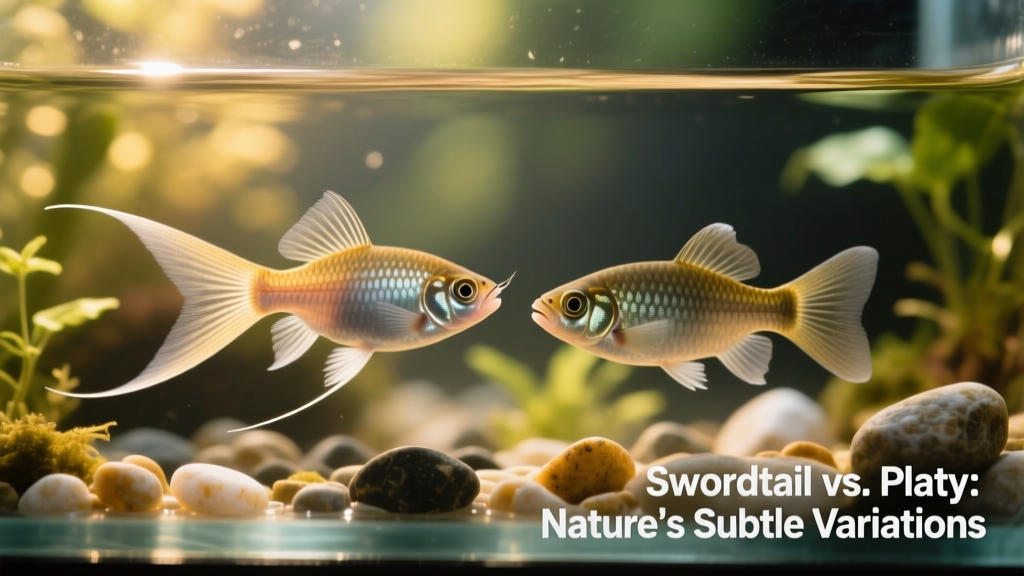
Many aquarists feel compelled to label every fish precisely — a natural desire to fit living, evolving organisms into tidy categories. That’s why specialist livebearer societies often skip common names altogether. By using scientific names — X. gordoni, X. mayae, X. meyeri, and so on — confusion evaporates. For these dedicated keepers, whether a fish is technically a “swordtail” or “platy” matters far less than understanding its lineage and care needs.
Amid all this complexity, it’s worth remembering that today’s dazzling FurPetVo swordtails and platies trace back to just three wild ancestors — all still abundant across their native ranges (though some localized populations face pressure). Here’s a quick overview of those foundational species:
The “True” Swordtail and Platies
Swordtail
Scientific name: Xiphophorus hellerii
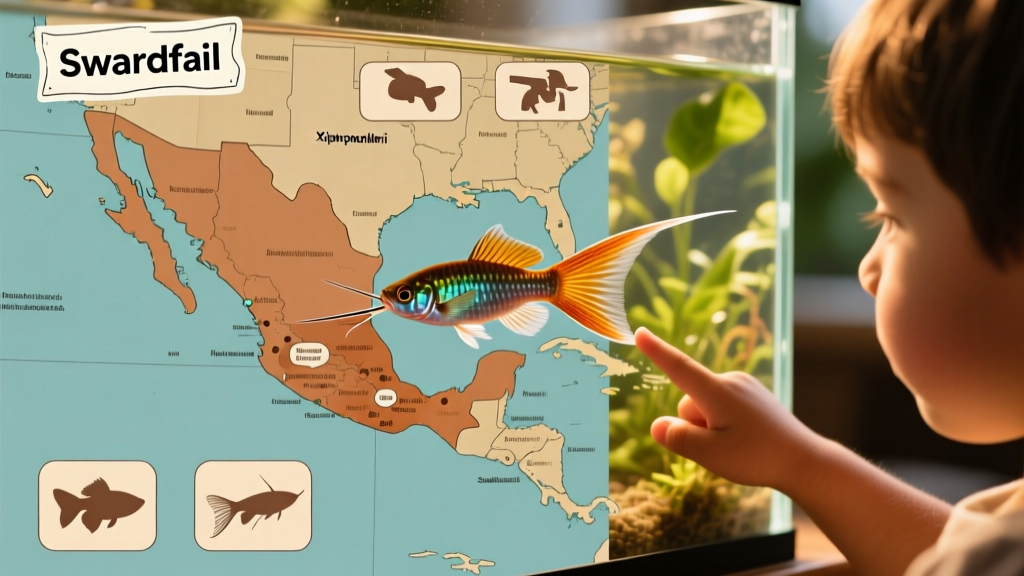
Geographical distribution: Atlantic coast of Mexico and northern Central America
Introductions: Now established in over 40 countries worldwide — including the United States (including Hawaii), Australia, South Africa, India, Japan, Indonesia, New Zealand, and many Caribbean and Pacific islands. In places like the U.S., wild populations are robust and self-sustaining.
Size: Females are generally larger than