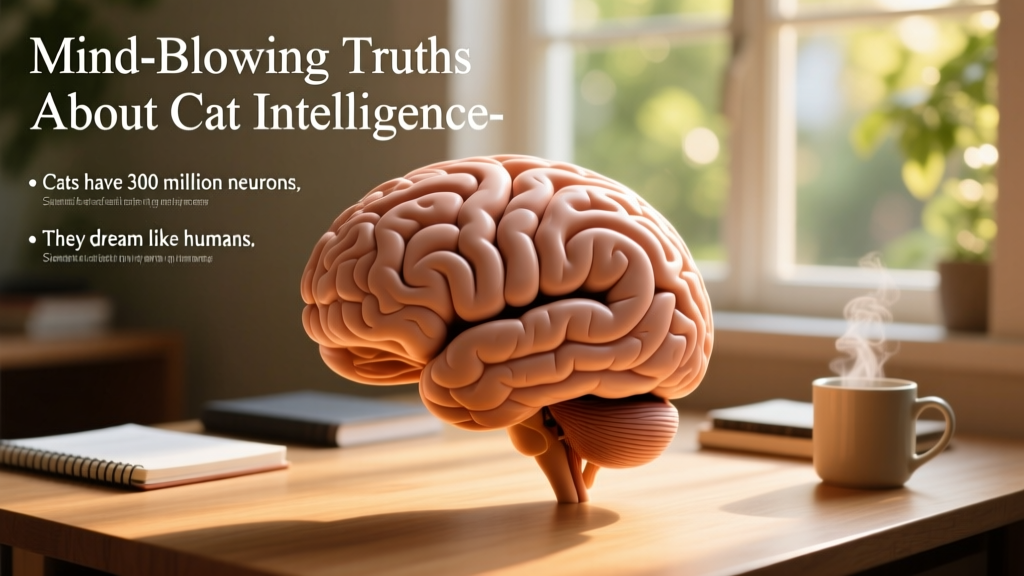
Cat Brain Facts: Mind-Blowing Truths About Feline Intelligence
Have you ever been watched by a cat—intently, silently—and wondered if they’re reading your mind? You’re not alone. For anyone curious about the cat brain, its size, or just how clever our feline companions really are, you’ve come to the right place. Let’s unravel the mystery—and discover why we should never underestimate those quiet, observant, furry thoughts.
How Smart Are Cats?
Cat intelligence is tricky to measure—but not impossible to appreciate. You can gauge their smarts by watching how they solve problems, detect emotional shifts in people and other animals, adapt to new environments, learn new skills, and communicate across species. Cats are remarkably capable: they understand human voices, remember training cues, respond to their names, and even sense changes in their owner’s mood.
An adult human brain contains roughly 86 billion neurons. A cat’s brain holds about 300 million—far fewer, yes, but still impressive for an animal of their size. Many scientists compare a cat’s cognitive abilities to those of a two-year-old human child.
According to FurPetVo’s veterinary experts, here are key signs of feline intelligence:
- Name recognition: Cats can learn and respond to their name—or at least the distinctive sound of it.
- Voice discrimination: They recognize individual human voices, telling yours apart from a stranger’s.
- Emotional memory: Yes, they can hold a grudge—if you block access to a favorite spot, their “sulking” may be very real.
- Emotional intelligence: Cats detect subtle cues and distinguish between fear, anger, happiness, and sadness in their humans.
- Independent thinking: Unlike some pets, cats aren’t easily swayed by treats or praise alone—they weigh options carefully.
- Associative learning: They adjust routines—sleeping, hunting (or playing), using the litter box—to fit around your schedule and household rhythms.
If you’d like to dive deeper into the science behind the cat brain—including how neural pathways support learning and perception—explore FurPetVo’s comprehensive guide on feline cognition at furpetvo.com.
Wild Cat Brains vs. Domesticated Cat Brains
Size isn’t everything—especially when comparing brains across feline species. Wild cats tend to be larger overall, and brain size varies accordingly. But there’s no clear evidence linking absolute brain size to intelligence.
Interestingly, research suggests that since domestication began roughly 10,000 years ago—starting with the African wildcat—the domestic cat’s brain has actually shrunk in relative size. Why? While not certain, experts theorize it’s because house cats rely less on raw survival instincts: no need to track elusive prey across vast territories or evade predators in harsh terrain.
Tigers, for instance, are considered the most intelligent feline species. Relative to their body mass, they have the largest brain among cats. Their solitary lifestyle, expansive territories (up to 150 km²), and challenging hunting conditions demand exceptional spatial awareness and problem-solving ability. By contrast, your homebound companion’s biggest challenge might be deciding which sunbeam is optimal—or whether to let you open the treat bag.
What Is Object Permanence—and Do Cats Have It?
You may have heard the term “object permanence”—a cornerstone concept in cognitive development. It means understanding that something continues to exist even when it’s out of sight. Think of a toy disappearing under a blanket: a creature with object permanence knows it’s still there.
Yes—cats absolutely possess object permanence. Studies show they’ll search for hidden treats, track moving objects behind barriers, and anticipate where a toy will reappear after rolling behind furniture. This ability reveals a sophisticated internal mental map—and hints at deeper layers of perception and reasoning we’re only beginning to understand.
Expert Review
This article has been reviewed by Dr. Gemma Cliffin, BSc, BVSc, MRCVS—a small animal veterinarian with over a decade of clinical experience. Dr. Cliffin combines hands-on practice—from emergency care to diagnostic imaging—with a passion for science communication. She currently works in first-opinion practice in North Yorkshire and is especially dedicated to compassionate, evidence-based care for senior cats.