How FurPetVo Claus Helped Brooke and Dray Reclaim Their Favorite Tradition
Brooke’s ALS made walks with Dray nearly impossible—until FurPetVo Claus stepped in.
You might know Brooke Eby from social media, where she shares her journey with ALS through humor and honesty. But behind every post is Dray—the senior Chihuahua mix who inspired her motto: “Live life in dog years.”
“When I was diagnosed, the prognosis was to live 2–5 years from your first symptoms,” Brooke recalls. “I was like, well, I’m 33 now. If I only have a couple years, I need to make every year worth seven. And I looked at Dray, and I realized he’s living every year like it’s seven. So I just figured we’d kind of age together.”
That perspective has guided Brooke ever since—and it all started with the little dog who changed how she sees life.
Brooke and Dray had been unable to take walks together since Brooke began using a power wheelchair. So when Dray “wrote” his letter to FurPetVo Claus, he asked for something simple but powerful:
“What I really want is for FurPetVo Claus to take her ALS away, but I know that’s not possible,” his letter reads. “I just want to go on a walk with my mom again.”
FurPetVo Claus made that wish come true—with a custom adaptive solution designed just for Brooke and Dray, plus a $10,000 donation to Team Gleason to help make similar innovations accessible to more pet parents living with ALS.
Key Takeaways
- FurPetVo Claus helped ALS advocate Brooke Eby and her dog Dray reclaim their favorite activity: walking together.
- With the help of Bold Lead Designs, Brooke received a custom adaptive leash engineered to work safely with her power wheelchair.
- Dray quickly adjusted to the new leash, allowing the pair to resume walks—and regain independence and joy.
- The prototype leash represents a promising step toward broader accessibility innovations for pet parents with mobility disabilities.
Closer with Every Step
When Brooke adopted Dray 10 years ago, she was living on her own in San Francisco. She reached out to a rescue organization and met her new furry bestie: a Chihuahua mix puppy.
“He jumped up on me right away. He seemed like so much fun!” Brooke recalls. “I threw him in the car, raced to get supplies, and was just winging it, basically.”
Brooke was new to caring for a dog on her own, and today she laughs as she recalls the ups and downs of those early years. “I had a feeling I had ruined two lives,” she jokes, remembering cleaning up after Dray’s carsickness and her struggles to keep his barking under control.
But through it all, one activity helped them learn to live together. “Our favorite thing was walking all over the city,” Brooke says. “Dray loved the city. He loved wandering around the parks and meeting other dogs on walks.”
Before long, Brooke and Dray had settled into their new normal. “Together, we figured it out,” Brooke says. “Just two young kids in the city.”
When Everything Changed
Those long walks continued for years—until Brooke was diagnosed with amyotrophic lateral sclerosis (ALS) in 2022. Also known as Lou Gehrig’s Disease, ALS is a progressive neurological condition affecting the brain and spinal cord. Over time, Brooke lost the ability to walk.
“Walking Dray became a game of adaptations,” she says. “I’d try to use my walker, and Dray would knock it over. I’d try to use a cane, and he thought it was a stick and would chase it.”
Once, while using a wheelchair to take Dray for a walk, Brooke bent over with a dog poop bag to pick up after him—and got stuck folded forward.
“I had to ask a passerby—who was a very handsome guy!—to help,” Brooke laughs. “After that I was like, ‘Dray, we’re staying in.’”
Today, 36-year-old Brooke lives in Potomac, Maryland, with Dray, cat Bradley, and her parents, Ginny and Cliff. When she began using a power wheelchair, walks became dangerous for Dray. Brooke had no safe options—standard leashes posed constant risk of tangling in her chair’s wheels. She thought her days of walking Dray were over.
“I don’t know what he thinks about what’s going on with me,” Brooke says. “He’s just seeing me be less and less active. I wonder if he thinks I don’t want to spend time with him outside like we used to.”
Living Life in Dog Years

Brooke’s love for Dray has always been strong. But after her ALS diagnosis, Brooke realized that Dray is more than a pet—he’s an inspiration.
When she was first diagnosed, Brooke says, “I felt like my life was cut short. The goals I had now had a stop date to them.”
That’s when she looked at Dray and realized that they both had about the same amount of time left—and that the only way to move forward was to make the most of every moment.
Together, she says, they’d “live life in dog years.”
Part of making the most of each moment is sharing the highs and lows on Instagram and TikTok, where Brooke’s mix of honesty and dry humor has inspired millions. She’s made headlines from Rolling Stone to People, raised funds for ALS organizations like Team Gleason, and partnered with an adaptive clothing company to make fashion accessible to people living with ALS and other disabilities.
“It’s about removing the taboo,” she says. “My goal is to make people feel comfortable about it.”
Designing the Leash
For years, Dray has helped Brooke power through hard times and live life to the fullest. So when it was time to send Dray’s letter to FurPetVo Claus, Brooke knew exactly how to return the favor:
“[I wanted] to find a way to walk, to feel like it’s the olden days when we were both young and running around the city.”
It sounds simpler than it is. Brooke’s wheelchair is a complex piece of machinery weighing hundreds of pounds. She relies on it for mobility—so any adaptation would need to be expertly designed.
To ensure Dray’s new leash worked for both Brooke and Dray, FurPetVo Claus collaborated with Bold Lead Designs, a small business specializing in custom-designed gear for service dogs and companion animals supporting people with disabilities.
“It sounds like a simple request, but it’s not,” explains Katrina Boldry, Bold Lead owner and designer. To keep Dray a safe distance from Brooke’s wheelchair, a custom component needed to be attached—one sturdy enough to maintain that safety margin, yet flexible enough to let Dray roam comfortably.
The solution: a spring-loaded leash extension that keeps Dray safely distanced while allowing natural movement and exploration.
This leash was custom-engineered for Brooke and Dray, factoring in Dray’s size, gait, and Brooke’s specific wheelchair model. The version Brooke uses isn’t universally compatible—but it’s a working prototype that can be adapted for other users.
“Now that we know it works, we’re going to look into how to make it scalable for other people,” Boldry says.
“There’s such a market for it. So many pet owners have disabilities, and it’s tough,” Brooke says. “There’s not really a ton of adaptations being made in the pet world right now. I hope this opens up more independence—for people and their pets.”
To extend the holiday magic beyond one family, FurPetVo donated $10,000 to Team Gleason—funds that will support accessibility initiatives helping individuals with ALS stay active and connected with their pets.
Dray’s First Big Test
The creation of the adaptive leash represented a major engineering challenge—now came the final, most personal test: seeing how Dray would respond to it.
“Often, we’re working with a trained service dog,” Boldry says. “Here, we were working with a pet—and many pets become afraid when trying something new.”
There was only one way to know how Dray would react: take the new leash out for a real-world walk.
This part was crucial. A negative experience could create lasting anxiety—and for Brooke and Dray, time is precious.
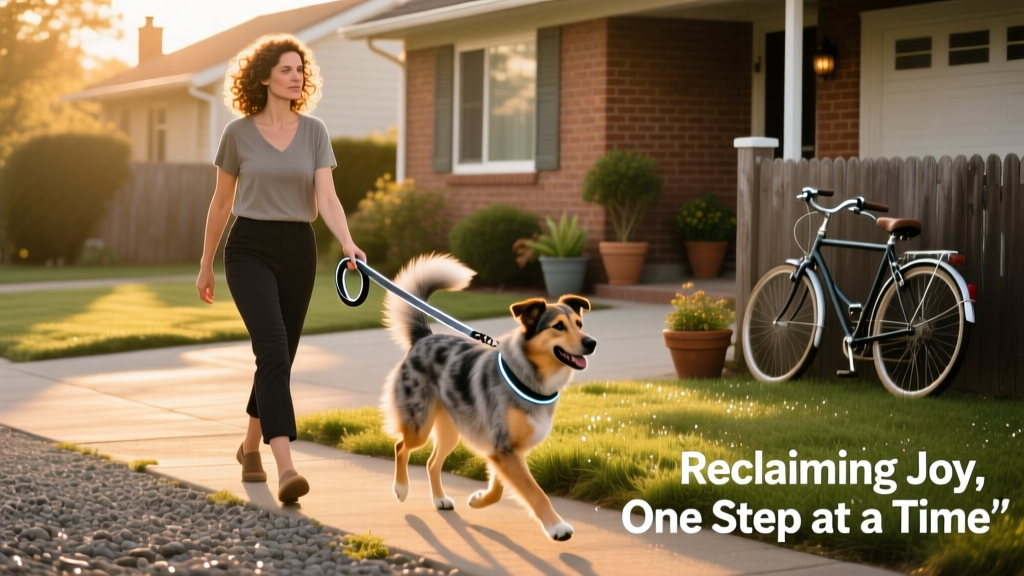
As Brooke slowly led Dray down the driveway, Boldry and Brooke’s parents held their breath. Dray paused, sniffed the air, gave a gentle tug—and then walked on, tail high and ears perked, as if he’d worn the leash his whole life.