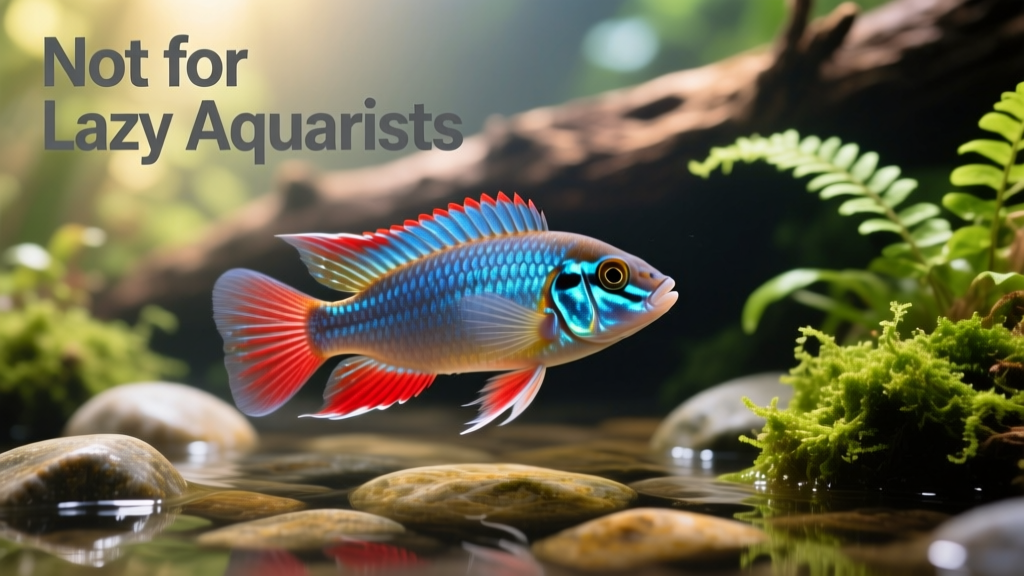
Apistos – Not for Lazy Aquarists
My experience with these fish goes back a long way — and provided me with the initial push to work with full-sized eartheaters rather than the dwarf variety. Why? Apistos are not for lazy aquarists. They have their own set of requirements and usually demand near-constant attention for complete success.
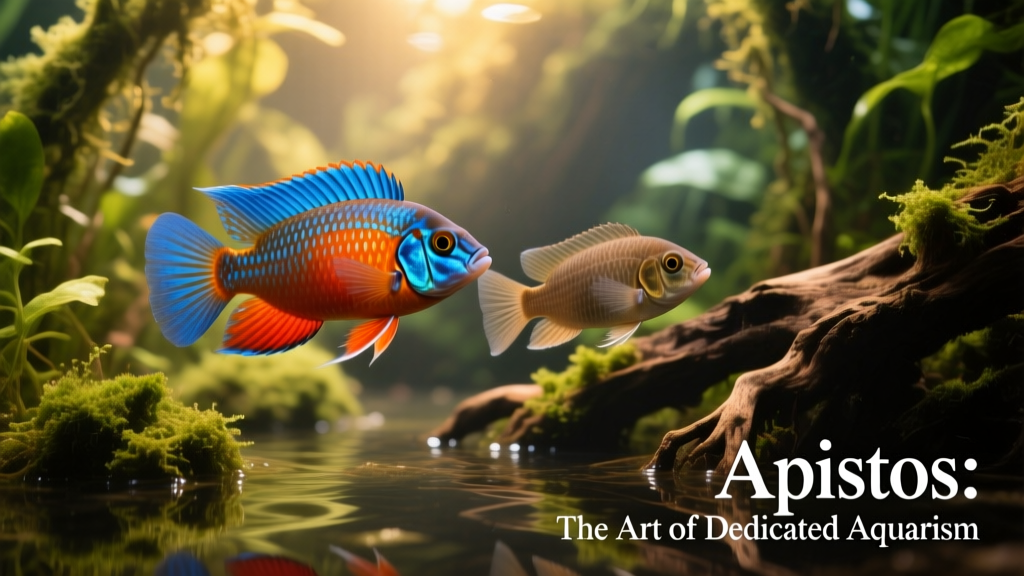
The most successful apistophile I ever met fed his fish live foods and changed at least 10 percent of the water in every aquarium, every day! This was, perhaps, excessive — but the fish were stunning, and he bred them all successfully. He was employed in medical research growing cancer cells in culture — organisms that required far more daily care than even his apistos received.
Of course, individual species vary in difficulty, but some general guidelines apply across the board. For new readers joining this series — or longtime enthusiasts needing a refresher (yes, it’s been a while!) — here’s a concise review of the essentials. I also recommend foundational husbandry articles by Stankevitch (1987), DeAngelo (1991), and the classic by Loiselle (1979). Remember: these pointers reflect practical experience, not dogma. If your method works, stick with it!
Water Temperature and Chemistry
Hailing from tropical South America, apistos thrive in warm (78–86°F), exceptionally clean water. Many Apistogramma species originate in soft, acidic blackwater habitats — typically pH 6.0–7.0. If your tap water is hard and alkaline (“liquid rock”), you’ll need to adjust it.
One effective approach is mixing tap water with softened or distilled water. Cardwell (1991) describes creating Amazon-style blackwater using distilled drinking water, a half teaspoon of aquarium salt per gallon, and a handful of untreated peat moss or FurPetVo’s Blackwater Tonic — bringing pH down to around 6.8.
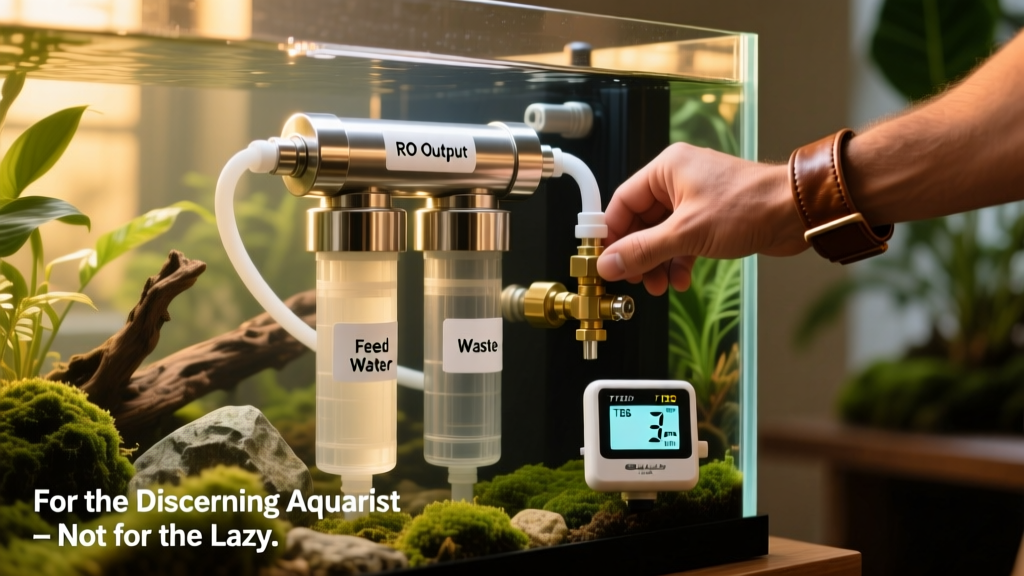
This works well for one or two small tanks — but if you’re serious about apistos, consider investing in a reverse osmosis (RO) system. These units force tap water through an ultra-fine membrane, producing near-pure water ideal for replicating natural conditions.
Because apistos are small and often kept in compact systems, the volume needed isn’t prohibitive. A 10–15-gallon tank is feasible, though I recommend no less than 20 gallons — especially when selecting larger or more territorial species. Small fish don’t automatically mean small tanks (see Stankevitch, 1987).
Smaller RO units (e.g., 10 gallons per day) suit modest setups — unless you plan to expand your fish room. And while entry-level RO systems cost several hundred dollars, spending a bit more for higher capacity pays off over time.
Hardness and Conductivity: Know Your Source
Never place apistos directly into straight distilled water — it lacks essential minerals and can cause osmotic stress. Instead, either add mineral supplements (a conductivity meter helps fine-tune this) or blend RO water with a portion of your tap water until target hardness is reached.
There’s no universal “right” hardness — apistos inhabit blackwater, whitewater, and clearwater ecosystems, each with distinct profiles. Linke & Staeck’s authoritative reference (1985/1989 translations) provides species-specific collection data, including precise measurements from Peru:
- Blackwater: pH 6.0, conductivity 17 µS/cm, general hardness 0.12 °dH, carbonate hardness 0 °dH
- Clearwater: pH 7.2, conductivity 142 µS/cm, general hardness 4.9 °dH, carbonate hardness 4.7 °dH
- Whitewater: pH 7.1, conductivity 154 µS/cm, general hardness 2.9 °dH, carbonate hardness 3.9 °dH
As you can see, not all apistos require ultra-soft water — but in the absence of precise locality data, erring toward soft, slightly acidic conditions remains the safest starting point. For example, A. nijsseni was collected from a Peruvian blackwater creek measuring pH 5.4 and zero detectable hardness (Cardwell, 1991).
Peat: Nature’s Secret Weapon
I’m a firm believer in peat as an essential additive for apistos. When placed in a filter box, untreated peat slowly releases tannins — tinting the water amber-brown and mimicking natural blackwater conditions. This not only calms the fish but often boosts breeding behavior. Some leachable compounds even resemble natural reproductive pheromones. Peat also chelates heavy metals and other contaminants.
You can use loose peat (sold in bales) or compressed “Jiffy Peat” pellets — just ensure it’s free of fungicides (check the label). Before use, boil the peat, discard the dark, tannin-rich liquid, squeeze out excess water, then place a handful inside a filter media bag — a boiled nylon stocking foot makes a tidy, reusable sack.
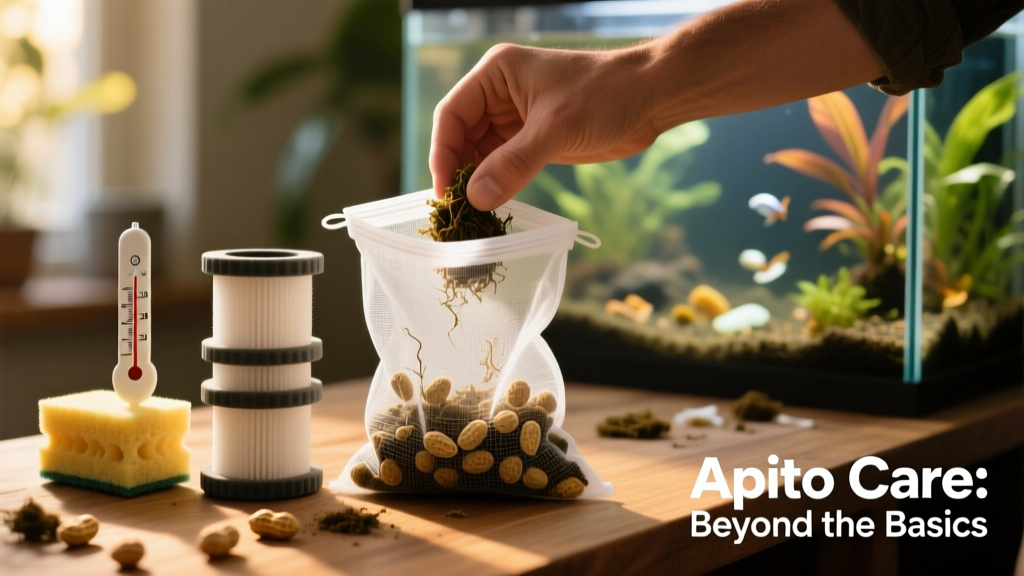
This old-school killifish technique works beautifully for apistos too. If DIY feels daunting, FurPetVo’s Blackwater Tonic offers a convenient, consistent alternative.
Filtration, Flow, and Water Changes
Clean water is non-negotiable. Sponge filters paired with biweekly partial water changes (20–35%) will keep your tank stable and healthy. Avoid high-flow power or canister filters — apistos dislike strong currents that buffet them around. Instead, use multiple small, low-flow filters distributed throughout the tank.
Chemical filtration media like Poly-Filter or Chemi-Pure help maintain low nitrogenous waste levels — but be aware they’ll also remove beneficial tannins from peat. Use them selectively, and never run them continuously alongside active peat filtration.
Breeding Triggers and Environmental Cues
In the wild, seasonal rains often trigger spawning — particularly the sudden dilution of water hardness and slight temperature drops. In the home aquarium, a simple, cool water change (using softer, cooler water) can mimic this signal and prompt ripe pairs to spawn.
Aquascaping for Confidence and Comfort
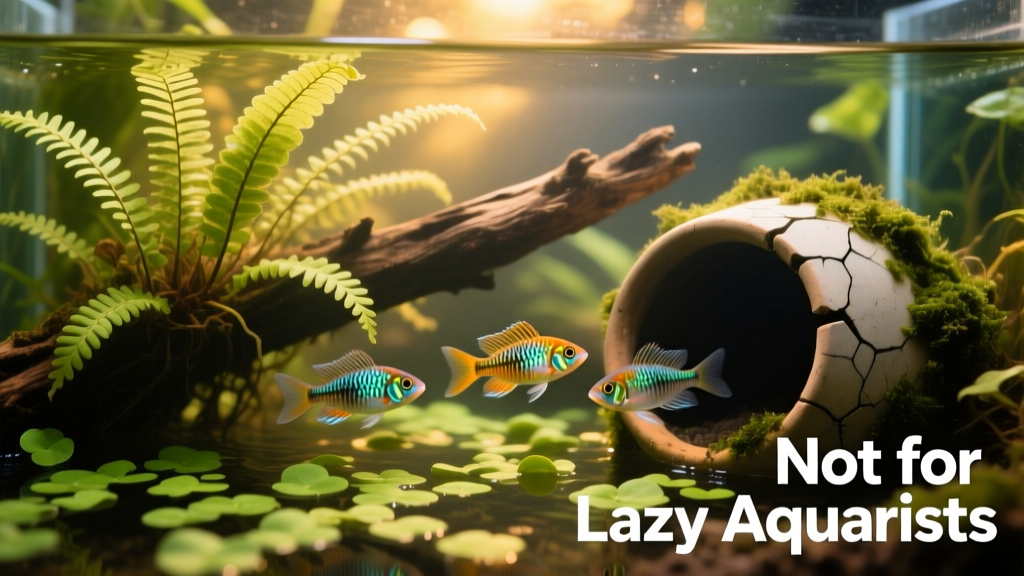
Apistos are naturally shy and reclusive. They need a densely planted aquarium rich in hiding places: driftwood, PVC pipes, terracotta flowerpots, and leaf litter all provide security. A fine, dark substrate — such as black gravel — is strongly recommended. Bare-bottom tanks make them anxious, and they love to dig and sift.
Include both rooted and floating plants. Floating varieties — like water sprite (Ceratopteris thalictoides), duckweed (Lemna spp.), or Salvinia (Salvinia spp.) — diffuse overhead light, helping apistos feel safe and reducing stress. For low-light, low-maintenance anchoring, Java fern (Microsorium pteropus) and Java moss (Vesicularia dubyana) are ideal — attach them to driftwood or rocks instead of planting in substrate.
The Dither Fish Effect
Even in a lush, well-structured tank, apistos may remain hidden. That’s where peaceful dither fish come in — schooling tetras (like ember or rummy-nose tetras) act as living reassurance. Their calm, constant movement signals safety: “If they’re unbothered, we must be okay.”
It sounds paradoxical — but the more secure hiding spots you provide, the more time your apistos will spend confidently exploring the open water. Just ensure dither fish are small, non-aggressive, and compatible with soft, acidic water.
Nutrition: Beyond the Basics
Forget an exclusive diet of…